Marketing Medical Supplies to Clinics: 2026 Strategy Guide

Marketing medical supplies to clinics is the process of strategically promoting and selling medical products to healthcare providers to meet their specific clinical and operational needs. Unlike consumer marketing, clinic supply sales require deep knowledge of procurement cycles, regulatory compliance, and clinical decision-making hierarchies. The professionals who succeed at this understand that a clinic’s purchasing decision involves clinic managers, clinicians, and finance teams simultaneously. This guide covers the essential tools, step-by-step strategy, and common pitfalls for anyone focused on selling medical supplies to clinics in 2026.
What are the key requirements for marketing medical supplies to clinics?
Effective clinic supply marketing starts with understanding two non-negotiable pillars: distribution infrastructure and regulatory compliance. Without both, even the most targeted campaign will stall at the procurement stage.
Distribution channels and prime vendor programs define how supplies reach clinics at scale. Medline’s Prime Vendor agreement with Rural Medical Services gives clinics access to nearly 335,000 medical-surgical products through a single optimized supply chain. That scale matters because it sets the buyer expectation: clinics increasingly want one reliable partner, not five fragmented vendors. Prime vendors like Medline, Cardinal Health, and McKesson use usage forecasting to optimize product availability and delivery, which means your marketing pitch must address supply continuity, not just product specs.

Regulatory compliance is the second pillar. The FDA requires all promotional materials to be truthful, non-misleading, and consistent with cleared intended use. Off-label promotion is prohibited. This applies to every touchpoint: websites, brochures, trade show displays, and social media posts. The FDA broadly defines labeling to include brochures, websites, and mobile apps, which means your entire content library is subject to scrutiny. Companies must maintain claims libraries and substantiation documents for every promotional assertion they make.
The tools you need to operate in this space include:
A CRM platform (Salesforce Health Cloud or HubSpot for Healthcare) to track clinic contacts, procurement timelines, and follow-up sequences
Market research tools to map clinic segments by specialty, size, and purchasing authority
A compliance review process for all promotional content before publication
Educational content assets: clinical white papers, product comparison guides, and webinar programs
Pro Tip: Build your claims library before launching any campaign. Every product benefit statement needs a substantiation document on file. This protects you legally and speeds up compliance review for future campaigns.
For teams navigating the regulatory side, Queenssurgical’s 2026 compliance guide provides a practical framework for meeting FDA promotional standards in healthcare retail and supply contexts.
How to develop an effective marketing strategy for clinic supply sales
A medical supply marketing strategy that works for clinics is built around three decisions: who you target, what you say, and how you reach them.
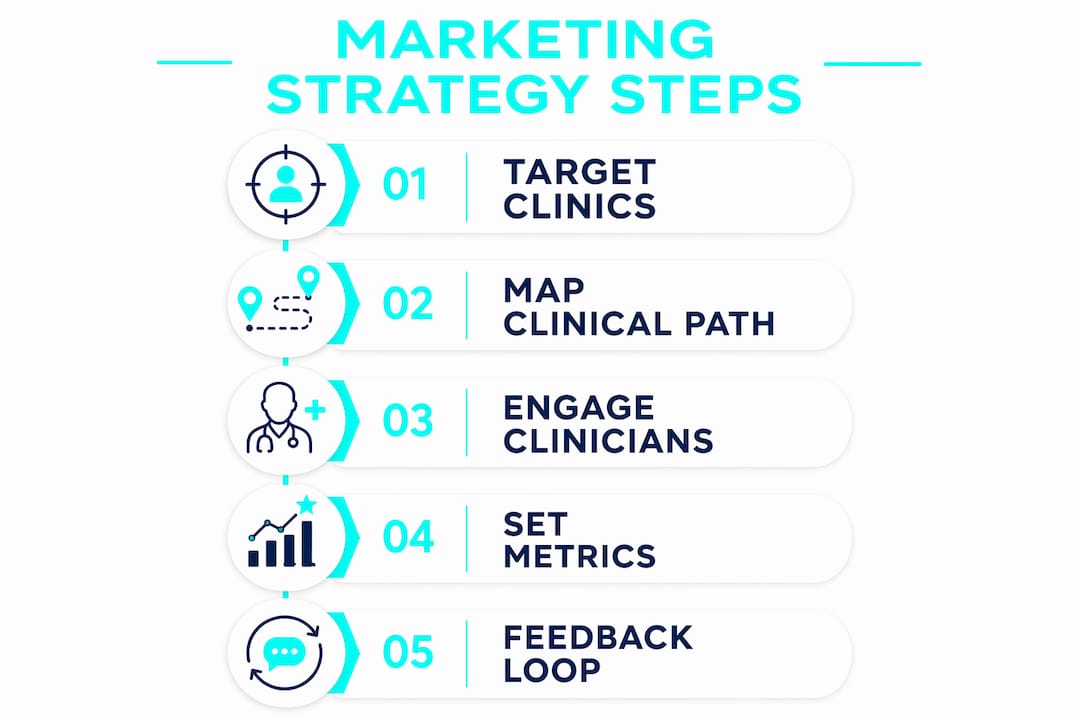
Step 1: Define your clinic segments and buyer personas. Not all clinics buy the same way. A family practice clinic has different procurement authority and supply needs than an urgent care chain or a specialty orthopedic clinic. Map your segments by specialty, patient volume, and purchasing structure. Identify three personas for each segment: the clinic manager who controls the budget, the clinician who influences product selection, and the procurement officer who executes the purchase.
Step 2: Map the clinical pathway and find the upstream decision point. Value conversations start before formulary decisions and procurement, requiring co-design and outcome measurement. This means your marketing must reach clinicians before the procurement process begins, not after. Identify where your product fits in the clinical workflow and build messaging around that workflow improvement.
Step 3: Craft value messages that address both clinical and operational priorities. Clinicians respond to patient outcome data and workflow efficiency. Clinic managers respond to cost per unit, delivery reliability, and vendor consolidation. Your messaging must speak to both. A single product page that only lists specifications misses the clinic manager entirely.
Step 4: Select your marketing channels. The most effective mix for promoting medical supplies to healthcare providers in 2026 includes:
LinkedIn advertising targeting healthcare administrators and procurement professionals by job title and facility type
Educational webinars co-presented with clinical advisors to build credibility with clinician audiences
Medical trade shows such as HIMSS, Medtrade, and specialty society conferences for direct engagement
Email campaigns segmented by persona, with clinical content for providers and operational content for managers
Direct sales outreach supported by digital content assets
Step 5: Set performance metrics and build feedback loops. Track conversion rates by segment, cost per qualified lead, and time from first contact to purchase order. Review campaign performance monthly and adjust messaging based on which value propositions generate the most engagement from each persona.
Pro Tip: Engage clinicians in product pilots before your formal launch campaign. Clinician co-creation with providers yields stronger system adoption than product-first approaches. A clinician who helped shape your product positioning becomes your most credible reference.
What are the common challenges when selling medical supplies to clinics?
The most frequent failure point in clinic supply marketing is treating the clinic as a single buyer. Clinics are multi-stakeholder environments where clinical preference, financial approval, and procurement execution rarely align automatically.
Regulatory missteps are the fastest way to lose credibility and face enforcement action. Marketing materials must present risks and benefits in fair balance and must not mislead, especially across digital platforms where character limits exist. A social media post that highlights only benefits without disclosing relevant limitations violates FDA guidance. Build a compliance checkpoint into every content approval workflow, not just for device-classified products but for all medical supply promotional materials.
Long sales cycles and procurement complexity frustrate marketers who expect consumer-style conversion timelines. Clinics often operate on annual or semi-annual procurement cycles tied to budget approvals. Entering the conversation after the budget is set means waiting another cycle. The solution is to map procurement timelines for your target segments and begin outreach 90 to 120 days before the typical budget review period.
Misaligned incentives between clinicians and finance teams kill deals that should close. Aligning incentives among clinicians and finance leads to higher adoption rates than focusing on product features alone. Build a dual-track value case: clinical outcome data for the provider side, total cost of ownership analysis for the finance side. Present both in the same proposal.
Common mistakes that undermine effective clinic supply marketing include:
Sending generic product catalogs without clinic-specific relevance
Neglecting clinician input during product positioning
Failing to address supply continuity concerns in the pitch
Ignoring post-sale engagement, which is where repeat purchasing is won or lost
Using promotional language that overstates product capabilities beyond cleared indications
How do prime vendor programs influence clinic supply marketing?
Prime vendor programs are the structural backbone of medical supply procurement in the United States, and understanding them is non-negotiable for anyone targeting clinics for medical supplies. These programs consolidate purchasing through a single contracted distributor, which changes how marketing works at the clinic level.
Prime vendors integrate just-in-time logistics with strategic sourcing, generating savings and ensuring timely delivery to medical centers including clinics. For marketers, this means that getting your product onto a prime vendor’s catalog is often more valuable than any direct-to-clinic advertising campaign. A clinic that orders through Medline or Cardinal Health will default to that catalog first.
The VA’s Medical/Surgical Prime Vendor Program mandates that contracting officers use strategically sourced prime vendors to enhance operational reliability at government healthcare facilities. This model is spreading into private clinic networks as group purchasing organizations (GPOs) adopt similar structures. In government and large healthcare systems, marketing means demonstrating proven operational reliability and readiness, not just generating awareness.
Prime vendor | Key feature | Marketing implication |
Medline | 335,000+ product catalog, PPE and lab solutions | Position for catalog inclusion; emphasize supply breadth |
Cardinal Health | National distribution network, GPO contracts | Target GPO relationships; demonstrate delivery performance |
McKesson | Usage forecasting and data analytics | Provide usage data and demand forecasting support |
VA MSPV Program | Mandated use for government facilities | Compliance and reliability documentation required |
The practical takeaway for clinic supply marketers is this: your sales strategy must include a distribution partnership track alongside your direct marketing track. Getting listed with a prime vendor or GPO multiplies your reach without multiplying your sales team.
Key takeaways
Successful marketing medical supplies to clinics requires compliance-first messaging, upstream clinician engagement, and distribution partnerships with prime vendors or GPOs to reach clinic buyers at scale.
Point | Details |
Compliance is non-negotiable | All promotional materials must meet FDA truthfulness and fair balance standards before publication. |
Engage clinicians early | Reach clinical decision-makers before procurement cycles begin to influence product selection upstream. |
Address dual audiences | Build separate value messages for clinicians (outcomes) and clinic managers (cost and reliability). |
Prime vendor access matters | Getting listed with Medline, Cardinal Health, or a GPO often outperforms direct-to-clinic advertising. |
Map procurement timelines | Begin outreach 90 to 120 days before clinic budget review periods to enter the buying conversation. |
What I’ve learned about selling to clinics that most guides won’t tell you
Most marketing guides for medical supplies focus on channels and messaging frameworks. Those matter, but they miss the structural reality that defines clinic purchasing: the person who wants your product almost never controls the budget, and the person who controls the budget rarely understands your product’s clinical value.
I’ve seen well-funded campaigns fail because the marketing team built a clinician-facing message and stopped there. The clinic manager who signs the purchase order never saw a single piece of content that spoke to her concerns about vendor reliability, invoice accuracy, or delivery windows. The deal stalled not because the product was wrong but because the financial case was never made.
The other pattern I’ve observed is that compliance gets treated as a legal department problem rather than a marketing asset. When you build your promotional materials to FDA standards from the start, you create content that is more credible, more specific, and more trusted by clinicians who are trained to be skeptical of overblown claims. Compliance is not a constraint on good marketing. It is the foundation of it.
The clinics that become long-term customers are almost always the ones where you engaged a clinician as a co-creator before the sale, not after. That relationship changes the dynamic from vendor to partner, and partners get renewed contracts without a competitive bid process.
— QB
How Queenssurgical supports your clinic supply strategy
Queenssurgical stocks the medical supplies that clinics order most frequently, from infection control PPE to skin care and wound management products. The DynaShield Skin Protectant Cream is a high-demand clinic staple for patient skin integrity protocols, and the CPE Thumb Loop Isolation Gown meets the fluid-resistant PPE requirements that clinic procurement teams specify. Queenssurgical operates as both a wholesale and retail platform across the Americas, making it a practical sourcing partner for clinic managers who need reliable delivery and competitive pricing. Browse the full catalog at queenssurgical.net to find products that align with your clinic’s supply needs and marketing positioning.
FAQ
What does marketing medical supplies to clinics involve?
Marketing medical supplies to clinics is the process of promoting and selling medical products to healthcare facilities by addressing the clinical, operational, and procurement needs of clinic buyers. It requires targeting multiple stakeholders including clinicians, clinic managers, and procurement officers with tailored value messages.
How do FDA regulations affect medical supply advertising?
The FDA requires all promotional content to be truthful, non-misleading, and consistent with the product’s cleared intended use. This applies to websites, brochures, social media, and trade show materials.
What is a prime vendor program and why does it matter?
A prime vendor program is a contracted distribution arrangement that gives clinics access to a large catalog of medical supplies through a single distributor. Medline, Cardinal Health, and McKesson operate major programs that influence which products clinics purchase by default.
How early should you engage clinicians in the marketing process?
Clinician engagement should begin before the procurement cycle opens. Value-based conversations and co-creation with providers yield stronger adoption than approaching clinicians after a product is already listed for purchase.
What is the biggest mistake in clinic supply marketing?
The most common mistake is building a single message for one stakeholder type. Clinic purchasing decisions involve both clinical and financial decision-makers, and campaigns that address only one audience consistently underperform against those that speak to both.
Recommended
Comments