Match the 5–6 Mil Sweet Spot: Nitrile Glove Thickness for Buyers
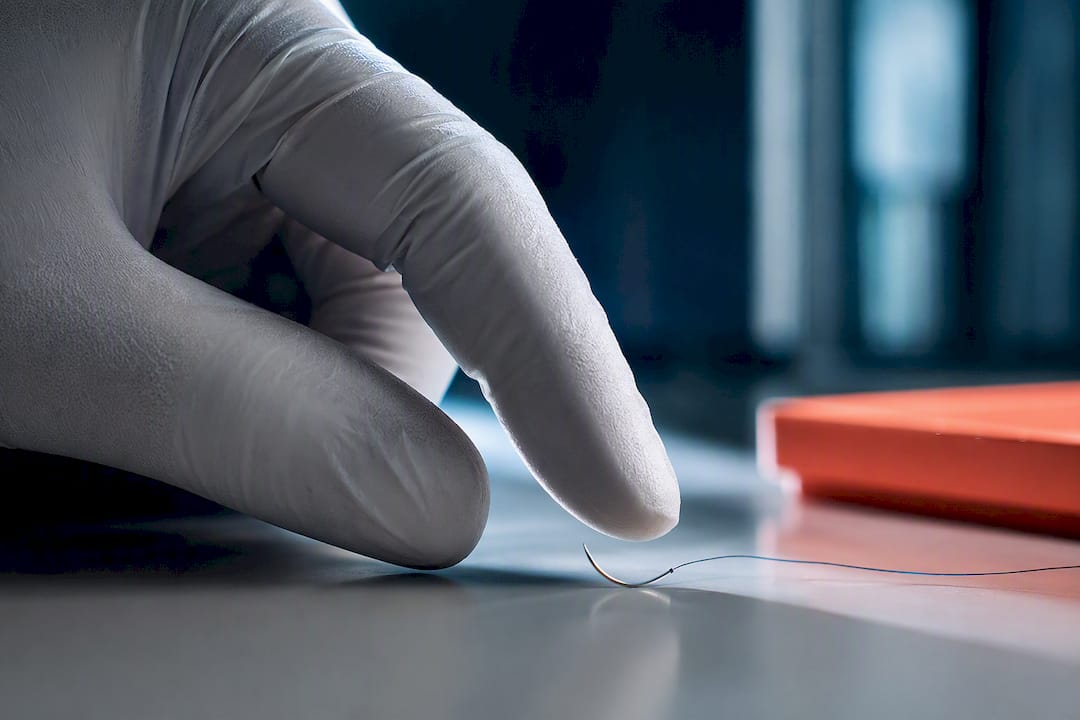
Nitrile glove thickness runs from 2 mil for quick, low-risk tasks up to 8 mil and beyond for chemical or heavy-duty work, with 5 to 6 mil hitting the sweet spot for general-purpose industrial use. The trade-off is constant: every mil you add buys more puncture and chemical resistance but costs you tactile feel, and thicker gloves often need a size adjustment. Match the band to your actual failure mode before you match it to price.
TL;DR:
Thicker gloves, like 6 to 8 mil, provide better puncture and chemical resistance but reduce tactile sensitivity, making them suitable for heavy-duty tasks.
Palm thickness measurement is essential for accurate comparison, with 5 mil being the industry standard for general industrial and medical applications.
Chemical resistance varies significantly between chemicals and glove thickness, so permeation data is crucial for selecting appropriate gloves.
For multi-task environments, use different glove thicknesses: thin gloves for quick changes and thicker ones for hazardous or abrasive work.
Always verify glove specifications with documentation and pilot testing before large-scale procurement to ensure proper fit, durability, and protection.
Table of Contents
What Does “Mil” Actually Mean in Nitrile Glove Thickness?
A mil is one-thousandth of an inch, roughly 0.0254 millimeters, and it’s the standard unit for reporting nitrile glove thickness. Most suppliers quote thickness at the palm, since that’s the surface doing most of the work and the number buyers actually compare. Fingertip and cuff measurements exist too, but if a spec sheet just says “5 mil” with no location, ask.
Mil | Approx. mm | Common Label |
2–3 mil | 0.05–0.08 mm | Ultra-light / fast-change |
4 mil | ≈0.10 mm | Standard exam |
6 mil | ≈0.15 mm | General industrial |
8 mil | ≈0.20 mm | Heavy-duty |
These conversions matter more than they look. A 0.05 mm swing between two “similar” gloves can be the difference between a glove that survives a shift and one that tears by lunch.
Which Thickness Band Fits Which Task?
The bands below reflect how the industry actually groups nitrile gloves by function, not just by number.
2–3 mil (ultra-light): Built for speed. Food service line checks, light electronics assembly, quick clerical or retail tasks where you’re changing gloves constantly. Durability is low, but that’s the point. Confirm the AQL rating since these thin films are more prone to pinholes.
3.5–5 mil (standard exam): This is where most medical examination gloves live, and it’s the band most exam gloves are built around, sitting well inside the 3.5 to 5.0 mil palm range that manufacturers target. Good for exams, phlebotomy, general lab work, and light cleaning where dexterity outranks brute durability.
5–6 mil (general industrial): The workhorse tier. Auto detailing, janitorial chemical handling, general maintenance, and mixed-use warehouse tasks. Ask for palm-thickness confirmation and an AQL report before you buy a pallet.
6–8 mil (heavy-duty): Where you go when punctures and tears are a real risk, think metal fabrication cleanup, tattoo work, veterinary procedures involving claws and teeth, or extended chemical splash exposure. Expect reduced finger sensitivity.
8+ mil (chemical/heavy-duty): Reserved for prolonged chemical contact, industrial cleaning with harsh solvents, or jobs where the glove is the only barrier between skin and something genuinely hazardous. Always pair with permeation data, not just a mil number.
If your team handles food prep in the morning and equipment repair in the afternoon, don’t try to find one glove that does both. Stock a thin exam-style box and a thicker industrial box separately. Trying to split the difference with a single 4.5 mil glove usually means it’s undersized for one task and overkill for the other. And if fingertip wear is your specific pain point, look for fingertip-reinforced specs rather than just bumping the whole-glove mil rating.
Does Thickness Really Improve Chemical and Puncture Protection?
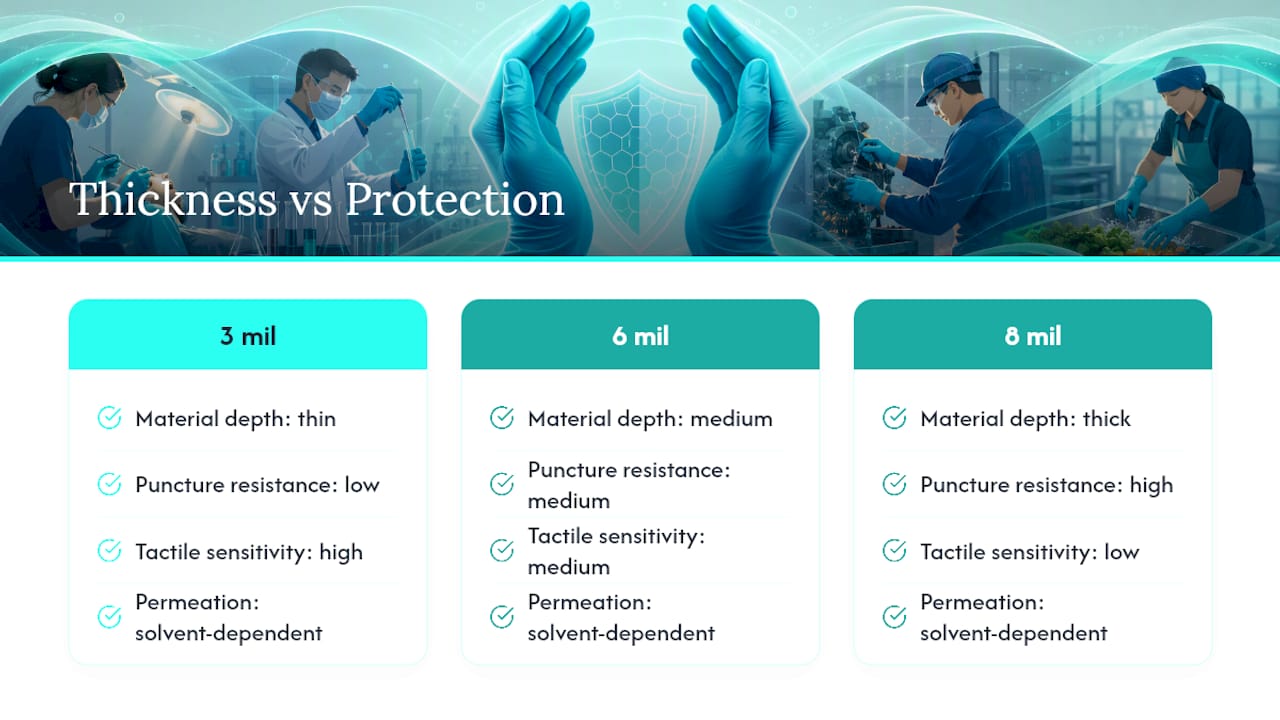
Yes, generally, but not automatically. A thicker wall gives you longer chemical permeation time and better resistance to punctures and tears, since there’s simply more material standing between the hazard and your skin. What it costs you is tactile sensitivity: at 8 mil, you’re not going to feel a suture needle or a small component the way you would at 3 mil.
Here’s the catch buyers miss constantly: thickness by itself is not a chemical compatibility guarantee. A 6 mil nitrile glove resists some solvents for hours and fails against others in minutes, because permeation resistance depends on the chemical’s molecular structure, not just how much rubber is between you and it. Always request permeation or breakthrough-time test data for the specific chemicals your team handles.
Pro Tip: If your team reports frequent mid-shift glove failures, or you’re working around known sharp or abrasive hazards, move up exactly one thickness band before you assume the problem is the brand. Jumping two bands usually just sacrifices dexterity you didn’t need to lose.
Where Should Thickness Be Measured, and Why It Changes Your Comparison?
Palm thickness is the number that matters most for side-by-side comparisons, since it reflects the bulk of the glove’s surface area and where most stress happens during a shift.
Palm: The default reference point industry-wide and the figure you should always ask for first.
Fingertip: Often thinner than the palm by design for grip, but some gloves add reinforcement here for tasks involving fine sharp objects.
Cuff: Rarely the deciding factor, but relevant if roll-off or tearing during donning is a recurring complaint.
When you request a quote, use language like: “palm thickness: 5 mil (minimum), measurement method specified.” Comparing two “5 mil” gloves without confirming both figures come from the palm is one of the most common sourcing mistakes buyers make.
How Does Thickness Affect Sizing and Fit?
Nitrile is a stretch-fit material, which means fit depends heavily on wall thickness. A thin 3 mil glove stretches easily and forgives a slightly wrong size. An 8 mil industrial glove has far less give, so a size that felt fine at 4 mil can feel tight or tear during donning at 8 mil.
For 3 to 5 mil exam-weight gloves, order true to your usual size.
For 6 to 8 mil (or thicker) textured industrial gloves, consider sizing up one increment, especially if you have larger hands or wear the gloves for extended stretches.
When you’re between two sizes on any thicker glove, order samples in both before committing to a case order.
Pro Tip: Run a short pilot: hand out two adjacent sizes or thickness options to a small group for a week and log tear rates per shift. The data settles size debates faster than any chart.
How Do You Choose the Right Nitrile Glove Thickness for Your Job?
Start with the failure mode you’re actually trying to prevent, not the thickness number you saw on a competitor’s site.
Name the risk first. Are you worried about puncture, chemical permeation, abrasion, or simple contamination control? Each points to a different band.
Use mil as your first filter, not your last check. Once you’ve picked a band, verify it against real documentation: an AQL / freedom-from-holes report, ASTM D6319 conformance for exam-grade gloves, and chemical permeation data if solvents or disinfectants are involved.
Pilot before you commit. Order samples in two adjacent bands (say, 5 mil and 6 mil), run them side by side for a week, and track which one keeps failure rates at an acceptable level for your team.
Pro Tip: Ask suppliers directly: “What’s your palm thickness minimum, and can you share your ASTM D6319 or ANSI/ISEA 105 documentation?” A supplier who answers instantly is usually one worth ordering from again.
Queens Surgical’s Take on Verifying Thickness Claims
Procurement teams shouldn’t take a mil number on faith. Queenssurgical works with buyers to confirm palm-thickness specs, pull AQL reports, and arrange sample orders before a full case purchase goes through. If chemical exposure is part of the job, ask for permeation data alongside ASTM D6319 conformance and ANSI/ISEA 105 classification. Documentation catches problems a spec sheet number alone never will.

Balancing Dexterity and Protection: A Procurement Perspective
Pick the lowest mil that reliably stops your most frequent failure. Don’t buy 8 mil “just in case” if your real problem is contamination, not punctures.
Request samples, confirm palm thickness and AQL in writing, and pilot for a week before ordering cases. If you get stuck comparing specs, consider reaching out to your medical supply provider for assistance.
— QB
Get the Right Nitrile Gloves Without the Guesswork
Choosing the correct nitrile glove thickness on paper is one thing. Getting the actual box in hand, at the mil count promised, with documentation to back it up, is another problem entirely, and it’s the one Queenssurgical solves. Rather than piecing together specs from three different manufacturer PDFs, you can order sample boxes across multiple thickness bands directly and compare them against your own failure logs.

Queenssurgical carries nitrile gloves across the common thickness bands for clinical, food-service, and industrial buyers, along with the documentation, palm-thickness confirmation, and sample-order support procurement teams need to make the call with confidence. If you’re outfitting a full PPE kit, pair your glove order with items like the CPE thumb loop isolation gown for complete coverage, or if you’re sourcing broader clinic apparel, check the medical clothing ordering guide from our partner network. Visit Queenssurgical to request samples and get a quote matched to your exact task requirements.
This article is general information, not a substitute for advice from a qualified doctor. Consult a qualified healthcare professional about your own circumstances before acting on anything here.
Sources
FAQ
What Is Thicker, 5 Mil or 7 Mil Gloves?
Seven mil is thicker than 5 mil. The higher the mil number, the more material in the glove wall, which generally means better puncture and chemical resistance but reduced tactile feel.
Which Nitrile Gloves Are Better, 7 Mil or 9 Mil?
Neither is universally “better.” Nine mil offers more protection for heavy chemical or abrasive work, while seven mil keeps more dexterity for tasks that still need some hand sensitivity. Choose based on your specific failure mode, not the higher number by default.
Which Is Thicker, 4 Mil or 6 Mil Gloves?
Six mil is thicker than 4 mil. A 4 mil glove typically falls in the standard exam range, while 6 mil sits at the entry point for general industrial use.
How Thick Are Level 3 Nitrile Gloves?
There isn’t a single universal “level 3” thickness standard for nitrile gloves. If a supplier uses that label, ask them to confirm the actual palm-thickness mil rating and which standard, such as ASTM D6319 or ANSI/ISEA 105, backs the classification.
What Thickness Should Medical Exam Gloves Be?
Most medical exam gloves fall between 3.5 and 5 mil at the palm, balancing dexterity for clinical tasks with adequate barrier protection. For procedures with higher fluid or sharps exposure, some clinicians opt for the thicker end of that range or check surgical-grade options instead.
Recommended
Comments