PPE Donning and Doffing Correctly: A Clinical Guide
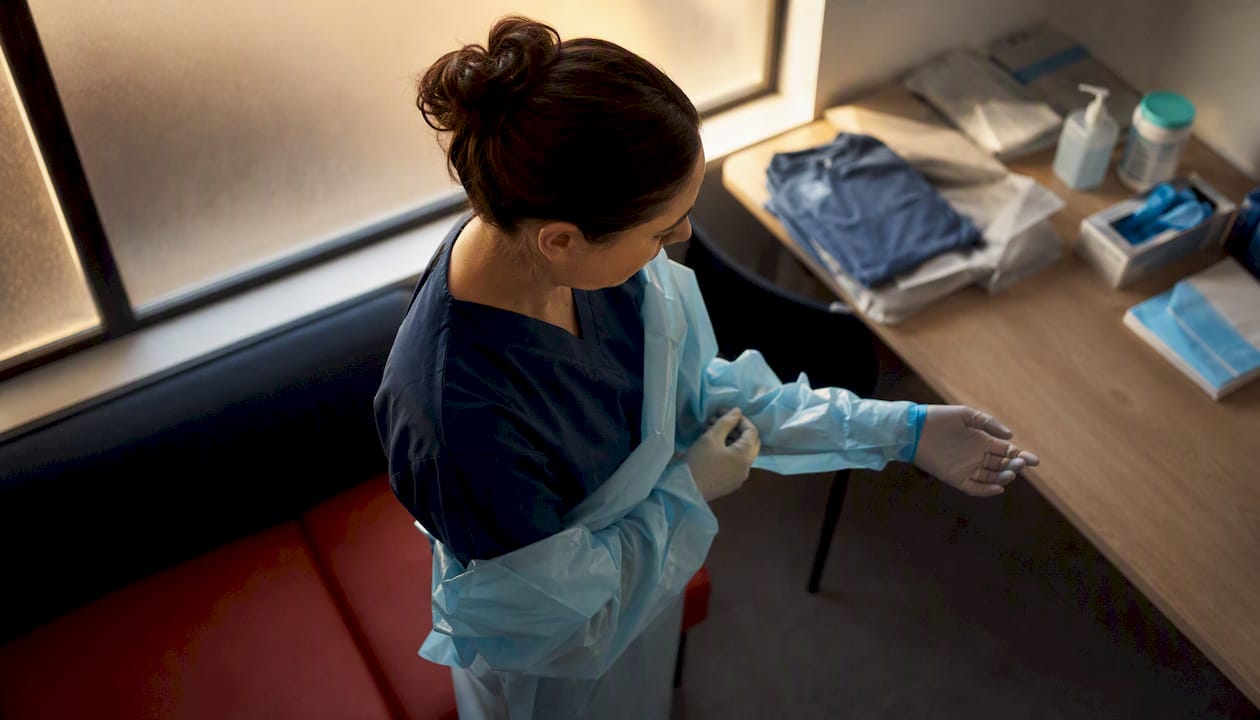
Correct PPE donning and doffing follows a single, non-negotiable sequence: hand hygiene → gown → mask or respirator → goggles or face shield → gloves for donning; gloves and gown first → hand hygiene → eye protection → mask or respirator (removed outside the patient room after closing the door) for doffing. CDC guidance establishes this order specifically to minimize self-contamination at every transition point. Under OSHA 29 CFR 1910.132 mandates that employers must train each employee who uses PPE and confirm demonstrated competency before that worker performs any task requiring it. Getting the sequence wrong is not a minor procedural slip — it is the mechanism by which healthcare workers become exposed. Queenssurgical supplies the compliant gowns, face shields, gloves, and disposable uniforms that make these procedures work as designed.
Donning sequence: hand hygiene → gown → mask/respirator → eye protection → gloves
Doffing sequence: gloves + gown → hand hygiene → eye protection → mask/respirator (outside room)
Hand hygiene is required at a minimum of three defined points during doffing
OSHA mandates documented training and competency demonstration before PPE use
Key Takeaways
Correct PPE donning and doffing requires following the CDC sequence precisely, performing hand hygiene at every defined point, and documenting staff competency per OSHA 29 CFR 1910.132.
Point | Details |
Follow the CDC sequence | Donning: hand hygiene → gown → mask/respirator → eye protection → gloves; doffing reverses with respirator last. |
Hand hygiene is non-negotiable | Perform hand hygiene before donning, after glove and gown removal, and after final doffing. |
Confirm respirator fit | Perform a seal check per manufacturer instructions every time a respirator is donned or re-donned. |
Document competency | OSHA 29 CFR 1910.132 requires demonstrated competency before PPE-required tasks; retrain after any failure or exposure event. |
Queenssurgical for procurement | Isolation gowns, face shields, disposable uniforms, and skin protectants are available for facility orders at queenssurgical.net. |
This article is general information, not a substitute for advice from a qualified doctor. Consult a qualified healthcare professional about your own circumstances before acting on anything here.
Table of Contents
How do you don PPE correctly, step by step?
CDC’s donning sequence starts before you touch a single piece of equipment. First, confirm which precaution level applies to the patient (standard, contact, droplet, or airborne) — that determines what PPE you actually need. Then:
Perform hand hygiene. Wash with soap and water or use an alcohol-based hand rub. Hands must be fully dry before touching PPE.
Put on the gown. Select the correct size so the gown covers your torso from neck to knees and wraps around the back. Tie or fasten at the neck first, then the waist.
Put on the mask or respirator. For a surgical mask, mold the nose wire and secure ties or ear loops. For an N95 or other filtering facepiece respirator, place the lower strap at the base of the neck and the upper strap over the crown of the head. Perform a seal check per the manufacturer’s instructions: cup both hands over the facepiece and exhale sharply. Air should not escape around the edges.
Put on eye protection. Goggles or a face shield go on after the respirator. Verify the eye protection does not shift the respirator or break its seal — if it does, try a different combination before entering the patient area.
Put on gloves. Pull gloves over the cuffs of the gown so no skin is exposed at the wrist.
Pro Tip: Stage your PPE in donning order on a clean surface or cart before you enter the anteroom. A laminated diagram or a short training video posted at the staging station cuts hesitation and reduces sequencing errors during high-pressure situations.
Sizing matters more than most staff realize. A gown that does not fully cover the torso leaves skin exposed; gloves that are too loose bunch at the palm and compromise grip. Stock multiple sizes and verify fit during initial competency checks. For guidance on glove types and sizing, review your facility’s clinical guide before ordering.
What is the correct order for removing PPE safely?
The logic of doffing is simple: remove the most contaminated items first, and never touch your face or clothing with a contaminated surface. CDC’s doffing sequence puts gloves and gown first because they carry the highest surface contamination load.
Remove gloves. Pinch the outside of one glove near the wrist and peel it off, turning it inside out. Hold the removed glove in the gloved hand. Slide two fingers of the ungloved hand under the remaining glove at the wrist and peel it off over the first, creating a glove-in-glove bundle. Discard immediately.
Remove the gown. Unfasten ties or snaps. Pull the gown away from the neck and shoulders, touching only the inside surfaces. Roll it inside-out as you pull it down and off your arms. Bundle it and discard without shaking.
Perform hand hygiene. This step is non-negotiable before touching anything else.
Remove eye protection. Grasp the earpiece or headband — never the front lens or shield surface — and lift away from the face. Place in a designated receptacle for reprocessing or discard.
Exit the patient room and close the door.
Remove the mask or respirator. For a surgical mask, handle by the ties or ear loops only. For a respirator, pull the bottom strap over the head first, then the top strap, holding both straps as you pull the respirator away from the face. Never touch the front of the facepiece.
Perform hand hygiene again.
If you suspect contamination occurred at any point, stop, perform immediate hand hygiene, and re-don clean PPE before continuing.
When do standard procedures change for high-risk situations?
Standard sequence holds for most clinical encounters. Add or modify steps when the situation involves airborne precautions, a high-consequence pathogen, extended respirator use, or a setting with defined contamination zones.
Airborne precautions: An N95 or higher-level respirator is required. The seal check before entry is mandatory, not optional.
Extended use vs. reuse: Extended use means wearing the same respirator for multiple patient encounters without removing it. Reuse means donning a previously worn respirator after storage. CDC sample procedures require a seal check at each re-don and specify storage conditions (paper bag, labeled with wearer’s name).
High-consequence pathogens: NIOSH guidance recommends observer-monitored doffing, where a trained colleague watches each removal step and verbally confirms correct technique.
Zone-based doffing: Hot (exclusion) zones are the patient care area; warm (contamination reduction) zones are where doffing occurs; cold (support) zones are clean areas. PPE must be fully removed before entering a cold zone.
Observer monitoring checklist for controlled doffing:
Confirm donning was complete before entry
Watch glove and gown removal for inside-out technique and no-touch disposal
Confirm hand hygiene performed before eye protection removal
Confirm respirator removed outside room after door is closed
Confirm final hand hygiene completed
Document any deviation immediately
Facilities handling high-risk agents should write zone definitions and observer roles into their written exposure control plan.
How do you choose, maintain, and dispose of PPE correctly?
OSHA’s PPE guidance is direct: fit, comfort, and compatibility are not secondary concerns. Poorly fitting PPE reduces protection and discourages consistent use. Select PPE that meets the relevant ANSI, ASTM, or NIOSH standard for the hazard level.
Selection and compatibility checklist:
Gown length covers torso from neck to at least the knee; thumb loops hold cuffs in place
Gloves extend past the gown cuff; stock at least three sizes (S, M, L)
Eye protection does not shift or compress the respirator seal; test the combination before approving it for use
Respirators are NIOSH-approved for the intended hazard level; fit-testing is required for tight-fitting respirators under OSHA standards
All PPE is checked for tears, broken seals, or expired dates before donning
For preventive care equipment selection, consult your facility’s clinical guide alongside manufacturer specifications.
PPE Item | Inspection Point | Disposal Method |
Disposable gown | Tears, intact ties, correct size | Biohazard waste bag |
Gloves | Punctures, correct size, no powder residue | Biohazard waste bag |
Surgical mask | Intact nose wire, no soiling | Regular medical waste |
N95 respirator | Strap integrity, no deformation, seal check | Biohazard waste bag if contaminated |
Face shield/goggles | Cracks, fogging, strap function | Reprocess or discard per facility policy |
Contaminated disposable PPE goes into a biohazard medical waste bag immediately after removal. Reusable items (goggles, face shields) require cleaning and disinfection per the manufacturer’s protocol before storage.
What does OSHA require for PPE training and competency?
OSHA 29 CFR 1910.132 requires employers to train each employee who must use PPE and to verify demonstrated understanding and ability before that worker performs PPE-required tasks. Training must cover when PPE is necessary, which PPE to select, how to don, doff, adjust, and wear it, its limitations, and its care and disposal.
Competency checklist (trainer-observed):
Performs hand hygiene before donning
Selects correct PPE type and size for the precaution level
Dons in correct sequence without prompting
Performs respirator seal check per manufacturer instructions
Removes gloves using glove-in-glove technique without touching skin
Removes gown inside-out without touching the front
Performs hand hygiene after glove and gown removal
Removes eye protection by earpiece or headband only
Removes respirator outside patient room after closing door
Performs final hand hygiene
Retraining is required when:
An employee fails to demonstrate competency during observation
Workplace hazards change (new pathogens, new procedures)
New PPE types are introduced
An exposure incident occurs
Prior training is assessed as obsolete
Training materials must be accessible to all staff. For workers with limited English proficiency, provide materials in their primary language. Document all training dates, trainer names, and competency outcomes.
What mistakes do healthcare workers most often make when donning or doffing?
The most common errors are touching the face during doffing, skipping hand hygiene between steps, donning in the wrong order, and removing the respirator inside the patient room. Each one creates a direct contamination pathway.
Touching the face or mask front: The front of a mask or respirator is the most contaminated surface. If you touch it, perform hand hygiene immediately before continuing.
Skipping hand hygiene between steps: Hand hygiene after glove and gown removal is not optional. Skipping it transfers contamination to the eye protection and respirator during their removal.
Poor respirator seal: A common cause is eye protection that compresses the facepiece. Test the combination during training drills, not for the first time in a patient room.
Removing the respirator inside the room: The respirator comes off outside the room, after the door is closed. This is a defined CDC step, not a suggestion.
Gown removal that touches the outside surface: CDC’s removal instructions specify touching only inside surfaces and rolling the gown inside-out. Pulling it off by the front transfers contamination to hands and clothing.
Pro Tip: Run a 10-minute micro-drill at the start of a new staff rotation: have each worker don and doff in front of a trained observer using the checklist from Section 6. Catching a sequencing error in a drill costs nothing; catching it during an exposure event costs far more.
Immediate contamination event checklist:
Stop the doffing sequence
Perform hand hygiene immediately
Notify the charge nurse or infection control officer
Re-don clean PPE if continued patient care is required
Document the event per facility incident reporting protocol
Donning and doffing quick-reference checklist
Post this at the PPE staging station or laminate it as a pocket card.
Donning checklist:
[ ] Hand hygiene performed
[ ] Correct PPE type confirmed for precaution level
[ ] Gown on, tied at neck and waist, covers torso to knee
[ ] Mask or respirator on; seal check passed
[ ] Eye protection on; respirator seal unaffected
[ ] Gloves on over gown cuffs
Doffing checklist:
[ ] Gloves removed glove-in-glove, discarded
[ ] Gown removed inside-out, touching inside only, discarded
[ ] Hand hygiene performed
[ ] Eye protection removed by earpiece or headband, placed in receptacle
[ ] Exit room, close door
[ ] Mask or respirator removed by straps only, discarded or stored
[ ] Final hand hygiene performed
Trainer competency scoring template:
A score of 8/8 is required for initial competency sign-off. Any fail triggers immediate retraining before the worker returns to PPE-required tasks.
Why the sequence matters more than the equipment itself
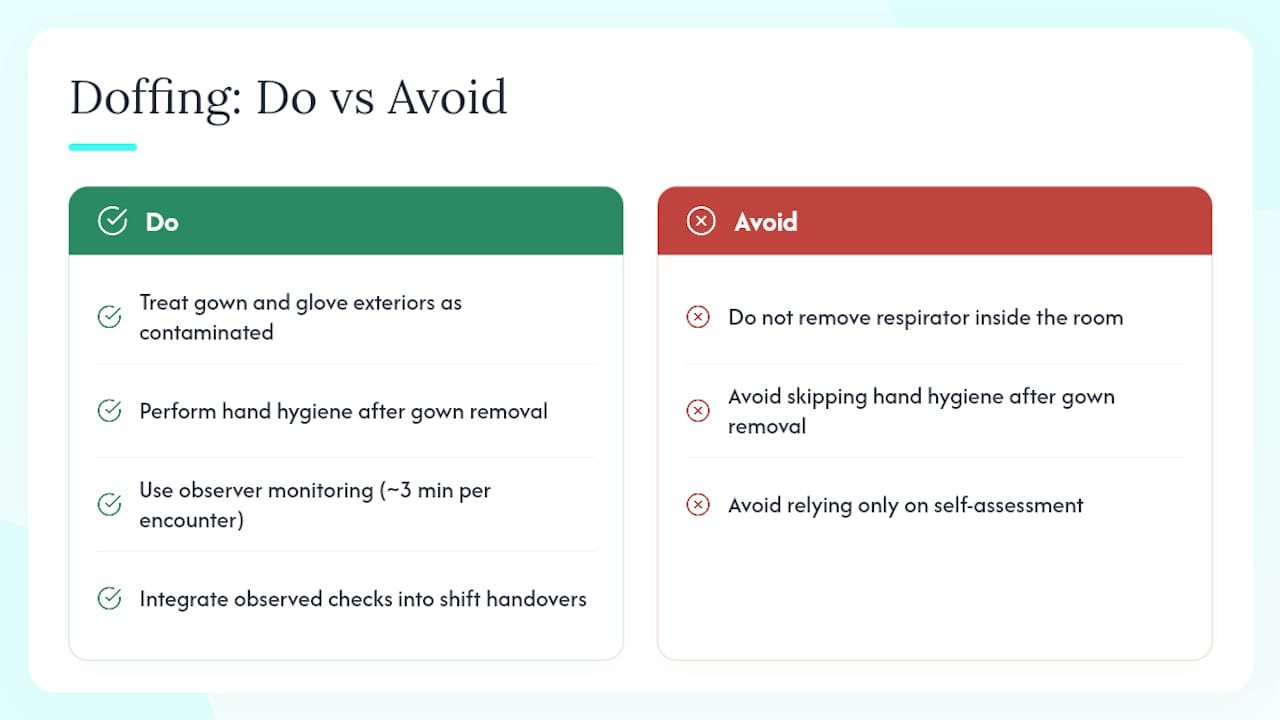
Most facilities invest heavily in sourcing compliant PPE and comparatively little in verifying that staff can actually use it. The sequence is not bureaucratic formality. The gown front and glove exteriors are treated as contaminated from the moment you enter a patient room, and every removal step is designed around that assumption. A worker who removes their respirator inside the room, or who skips hand hygiene after gown removal, has effectively negated the protection the equipment was meant to provide.
The observer-monitoring model that NIOSH recommends for high-risk agents deserves wider adoption in standard practice. Having a second set of eyes on doffing costs about three minutes per encounter and catches the errors that self-assessment misses. Facilities that integrate observed competency checks into shift handovers rather than treating them as annual training events see fewer exposure incidents. The checklist in Section 8 is designed to make that practical.
Where to source compliant PPE for your facility
Getting the procedure right starts with having the right equipment on hand in the right sizes. Queenssurgical stocks the core PPE categories your donning and doffing program depends on: the CPE Thumb Loop Isolation Gown provides full torso coverage with thumb loops that keep cuffs in place during donning, and the Full Length Face Shield offers full-face coverage that can be tested for respirator compatibility before purchase. For facilities running high-volume disposable programs, the Disposable Laboratory Uniform reduces laundry burden and simplifies post-doffing disposal.
Frequent hand hygiene and extended glove use take a toll on skin integrity. DynaShield Skin Protectant Cream supports skin health between shifts without compromising glove donning. Browse the full catalog at Queenssurgical or contact the procurement team directly to discuss bulk pricing for your facility.
Sources
Recommended
Comments