Quality Medical Supply Sourcing for Procurement Teams

The fastest path to a quality medical supply is a vetted distributor or a directly verified manufacturer, and the single move that protects you before the first order ships is confirming enrollment and documentation before you sign anything.
Confirm FDA registration or a device’s 510(k) status when it applies, plus any CE or ISO statement the supplier lists.
Request a certificate of analysis (COA) with lot traceability before your first shipment leaves the warehouse.
Ask for the warranty and returns policy in writing, not just a link on a product page.
Pro Tip: Run the supplier through Medicare’s supplier lookup tool before your first purchase order, especially for anything Medicare might reimburse. It takes five minutes and eliminates an entire category of billing headaches later.
Key Takeaways
Reliable sourcing of a quality medical supply depends on verified documentation, checkable credentials, and a contract that locks in pricing and remedies before you order.
Point | Details |
Verify before you buy | Check FDA/ISO status, COA availability, and Medicare/DMEPOS enrollment before the first order. |
Match supplier type to need | Manufacturers suit custom specs; distributors suit fast restocking; GPOs suit contracted scale pricing. |
Lock contract terms early | Secure pricing, Incoterms, delivery SLAs, and return remedies in writing before signing. |
Confirm Medicare enrollment for DME | Use Medicare’s supplier lookup and get written enrollment confirmation to avoid reimbursement denials. |
Consider Queenssurgical for routine restocking | Its wholesale and retail model fits bundled PPE and recurring consumable orders well. |
Table of Contents
What counts as a quality medical supply?
A quality medical supply spans six product categories procurement teams manage daily: PPE, general consumables, durable medical equipment (DME), surgical instruments, diagnostic devices, and single-use disposables. Each category carries its own documentation trail, and the paperwork is where quality actually gets proven, not on a product description page.
Devices requiring FDA clearance need a valid 510(k) number you can independently check. Manufacturers marketing internationally often cite ISO 13485 or CE marking. Every consumable lot should trace back to a COA. DME suppliers need active Medicare/DMEPOS enrollment if reimbursement is in play at all.
Category | Typical quality documentation to request |
PPE (gloves, masks, gowns) | Lot-specific COA, FDA listing if applicable |
Consumables and disposables | Lot traceability, expiration/batch records |
Durable medical equipment | Medicare/DMEPOS enrollment, 510(k) if device class requires |
Surgical instruments | ISO 13485 statement, material spec sheets |
Diagnostic devices | FDA clearance number, calibration/validation records |
A supplier who can’t produce a lot number on request is not managing quality control, regardless of what their catalog claims.
Warranty terms matter more for DME and instruments than for disposables, since replacement cycles and failure modes differ substantially.
How do you evaluate a medical-supply vendor’s credentials?
Start with paperwork you can verify independently, not paperwork the vendor hands you. A business license and W-9 confirm the entity exists. FDA registration and 510(k) numbers, when applicable, are checkable against public databases. ISO certificates should list an accredited certification body. DME suppliers need active Medicare/DMEPOS enrollment, which CMS oversees directly.
Beyond credentials, operational performance separates suppliers who talk about quality from ones who deliver it consistently:
Ask for order accuracy rates and how they’re measured.
Confirm typical lead times for your specific product categories, not generic averages.
Clarify minimum order quantities before you request a quote.
Review the return and warranty process, including who pays return shipping.
Verify lot traceability and how quickly they can produce a COA on request.
Red flags cluster around evasiveness. A registration number that doesn’t match public records, a refusal to share COAs, no written quality-management statement, or vague answers about shipping and customs costs should stop a deal before it starts. The Joint Commission publishes accreditation standards many hospitals already use to judge vendor relationships, and those same criteria translate well to a smaller clinic’s vendor call.
Use this checklist on your next vendor call:
Does the supplier volunteer their FDA/ISO status, or do you have to extract it?
Can they produce a COA for the exact lot you’d receive, not a generic sample?
Do they have a documented process for returns and nonconforming shipments?
Are their references from facilities similar in size and specialty to yours?
A supplier’s comparison checklist can shortcut a lot of this legwork if you’re evaluating several candidates at once.
What should procurement ask before signing a contract?
Before you commit budget, run through a short set of questions that surface problems while they’re still cheap to fix:
Can you provide samples, and what’s the turnaround on a sample request?
What are your inspection rights on delivery, and how are disputes documented?
What’s your process for issuing a COA per lot, and how fast can you produce one?
What are current lead times for the specific SKUs I need?
What’s your minimum order quantity, and does it change with contract length?
Can you provide two or three references from facilities of similar size?
Once you’re ready to move to contract, lock in specifics rather than relying on verbal assurances:
Pricing structure, including unit price and volume-break thresholds.
Shipping terms (Incoterms) and who owns risk during transit.
Delivery SLAs with a defined remedy if the supplier misses them.
Warranty and return terms spelled out, not referenced vaguely.
Confidentiality language covering your negotiated pricing.
Cost surprises usually hide in the fees nobody mentions upfront: duty on imported items, handling charges, restocking fees on returns, and small-order surcharges below a certain dollar threshold. Ask for a full landed-cost example on a typical order before you compare quotes. Two suppliers with identical unit prices can differ significantly once you add these line items, and you won’t know that until you ask directly. This vetting guide walks through the same sequence in more detail if you’re building a formal RFP.
Where should you buy medical supplies: manufacturer, distributor, or GPO?
Four supplier types dominate this market, and each fits a different procurement need. Direct manufacturers work best when you need custom specifications or OEM-level supply, though manufacturer messaging often leans on clinical differentiation rather than logistics, so verify device-specific documentation instead of taking marketing claims at face value.
Wholesalers and distributors carry broad catalogs and hold inventory, which matters when you need something in stock now rather than in six weeks. Large distributors promote metrics like next-day delivery and order accuracy as their core pitch, and those claims are worth validating against actual SLAs and customer references rather than accepting at face value. Marketplaces aggregate many vendors under one storefront, which gives you selection but pushes quality verification entirely onto you. Group purchasing organizations (GPOs) negotiate contracted pricing for their members, which helps on cost but usually limits flexibility on brand or SKU substitutions.
Supplier type | Best for | Procurement tip |
Direct manufacturer | Custom specs, OEM supply | Request 510(k) and clinical data directly, not brochure claims |
Wholesaler/distributor | Broad catalog, ready inventory | Validate delivery and accuracy claims against your own order history |
Marketplace | Variety, smaller one-off orders | Vet each vendor individually, no shared quality baseline |
GPO | Contracted pricing at scale | Confirm SKU availability before assuming full catalog access |
Queenssurgical operates as a wholesale and retail source covering disposables, PPE, masks, and general consumables, which puts it closer to the distributor model with retail-level accessibility for smaller practices. That combination fits routine restocking and bundled PPE orders particularly well, especially for clinics that don’t have the purchasing volume to negotiate GPO-level contracts but still need consistent lead times.

What Medicare enrollment issues affect DME purchases?
For any durable medical equipment you expect Medicare to reimburse, confirm the supplier is actively enrolled in Medicare’s DMEPOS program and willing to accept Medicare-approved amounts. Skipping this step is how facilities end up with equipment nobody will pay for.
Three steps prevent that outcome:
Search the supplier directly on Medicare’s supplier lookup before placing a DME order.
Get written confirmation of DMEPOS enrollment status, not a verbal claim from a sales rep.
Document the supplier’s billing terms in writing so patients don’t get surprise charges later.
The most common pitfalls: suppliers who let enrollment lapse without notifying customers, incomplete documentation of medical necessity, and missing supplier identifiers on claims that cause denials months after delivery. CMS administers the rules governing this process, and the Department of Health and Human Services maintains broader regulatory context procurement teams can reference for compliance questions. A quick reference on DME classification and Medicare basics is worth bookmarking if your facility orders DME regularly, since enrollment status can change between orders.
What procurement conversations actually reveal supplier quality?
I’ve sat through enough vendor calls to know the three questions that cut through sales pitches fast: can you produce a COA for this exact lot, what’s your real lead time versus your quoted one, and what happens if I need to return part of an order. A supplier who answers all three without hesitation is usually managing quality the way they claim to on their website.
How Queenssurgical supports your procurement process
Queenssurgical carries the breadth procurement teams actually need for day-to-day operations: PPE, disposables, masks, and general consumables, sold through both wholesale and retail channels depending on your order volume.
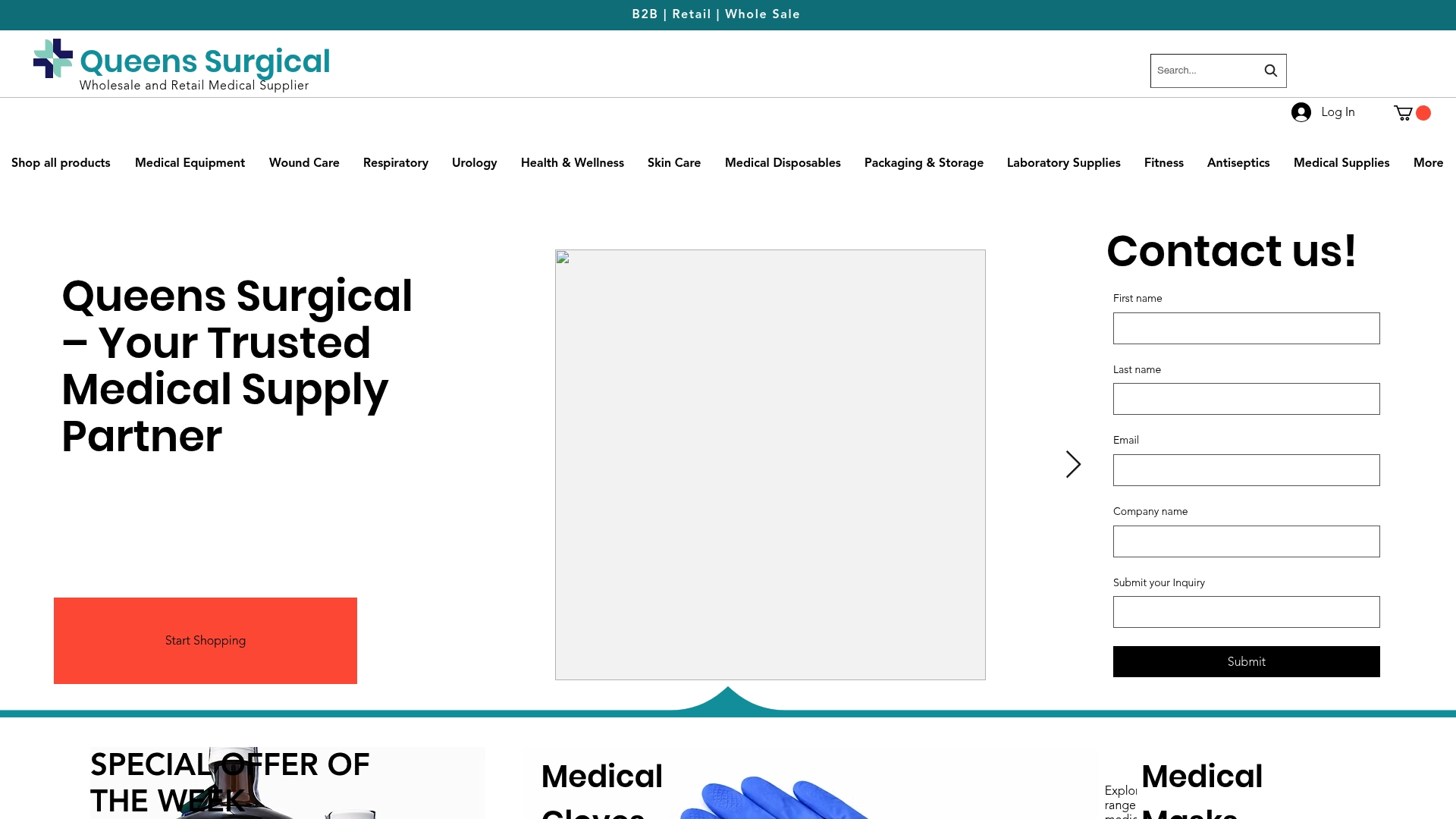
That flexibility matters if your facility’s needs shift month to month, since you’re not locked into a single purchasing tier to get competitive pricing. Documentation is available on request, and fulfillment is built to handle both one-off restocks and recurring bulk orders without forcing you through a separate enterprise sales process.
Pro Tip: Start with a single SKU, like a box of disposable medical face masks, before committing to a larger contract. It’s the fastest way to validate lead time, packaging, and COA turnaround with minimal risk. If you’re ready to move forward, request a sample or place a starter order through the Queenssurgical product catalog and see how the ordering process holds up against your own checklist.
Frequently asked questions
What makes a medical supplier “quality” versus just cheap? A quality medical supply comes with verifiable documentation: FDA/ISO status where applicable, lot-traceable COAs, and a clear warranty policy. Price alone tells you nothing about whether a supplier can back up what they sell.
Do I need to verify Medicare enrollment for every purchase? Only for durable medical equipment or items you plan to bill through Medicare. Routine consumables like gloves and masks don’t require this check, but DME always does.
How long should vendor verification take? A basic credential check, including a Medicare supplier lookup and a COA request, typically takes under a week if the supplier is responsive. Slow or evasive responses at this stage are themselves useful information.
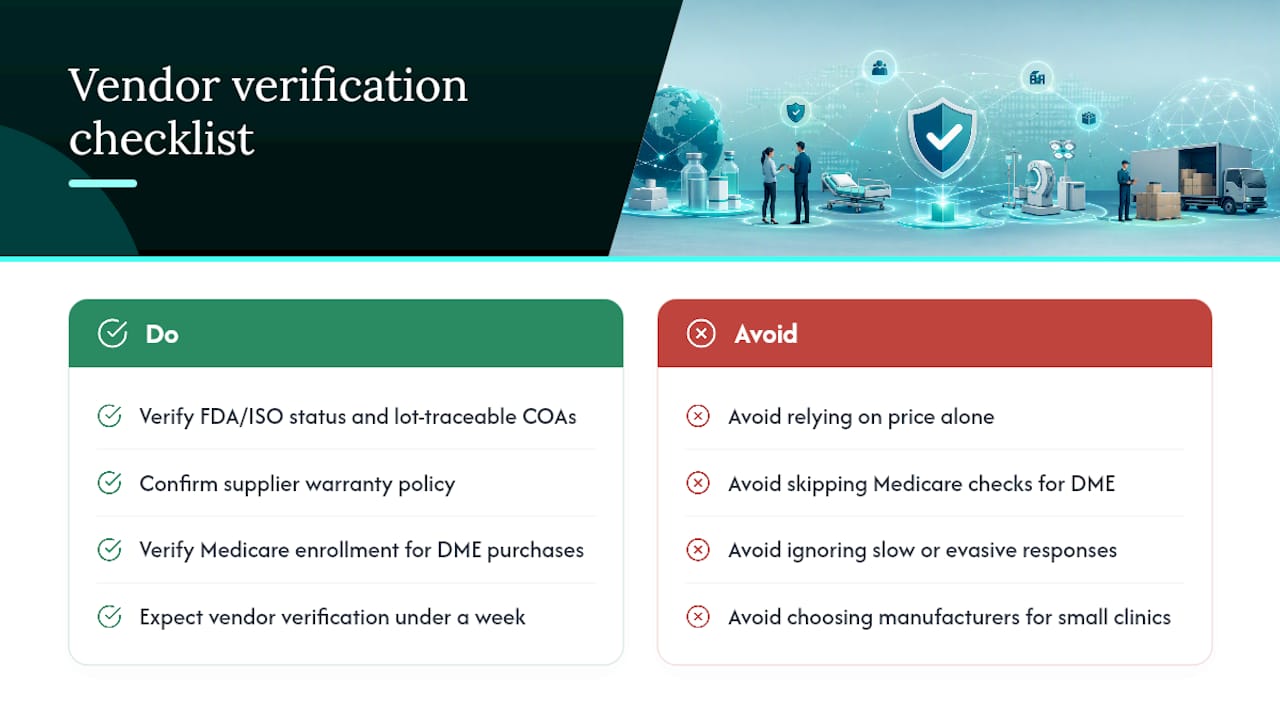
Is a distributor or direct manufacturer better for a small clinic? Distributors and wholesale suppliers like Queenssurgical usually fit small and mid-sized practices better, since they offer lower minimum order quantities and faster restocking than most manufacturers require.
Sources
Recommended
Comments