Regulated Medical Device Retail: What You Must Know

Healthcare administrators and procurement specialists often underestimate how much regulatory complexity sits beneath the surface of what is regulated medical device retail. Selling or buying medical devices through retail channels is not simply a commercial transaction. Federal oversight, state licensing, device classification, and advertising rules all intersect in ways that create genuine legal exposure for unprepared organizations. This article breaks down every layer you need to understand, from foundational definitions and state permits to FDA requirements and procurement best practices.
Table of Contents
Key takeaways
Point | Details |
Two regulatory layers exist | Both federal FDA rules and state-level licenses are required for legal medical device retail operation. |
Licensing costs vary widely | State retail licenses range from $100 to over $1,500 annually, separate from federal registration fees. |
DME requires extra permits | Durable Medical Equipment retailers face additional licensing requirements beyond standard retail permits. |
Non-compliance carries severe risk | Penalties include civil fines, inventory seizure, criminal charges, and loss of Medicare billing rights. |
Vendor credentials are not licenses | Hospital credentialing platforms confirm access policies, not government-issued retail authorization. |
What is regulated medical device retail
Regulated medical device retail refers to the commercial sale of FDA-classified medical devices to end users, which includes patients, individual clinicians, or healthcare facilities, through channels that are subject to both federal and state oversight. The word “regulated” here does the heavy lifting. Not every product sold in a pharmacy or medical supply store falls into this category, but any device that the FDA has classified under its three-tier system does.
The FDA classifies medical devices into Class I, Class II, and Class III based on risk level. Class I devices include items like bandages and tongue depressors. Class II covers devices such as powered wheelchairs and infusion pumps. Class III includes implantable devices like pacemakers. Where a product falls in this system directly determines what a retailer must do before selling it.
Understanding what are medical device retailers requires drawing a sharp line between three distinct roles.
Retailers sell directly to end users, whether consumers or healthcare providers, and hold state-issued retail facility licenses.
Wholesale distributors sell in bulk to other businesses rather than to end users, and they require separate wholesale distributor licenses.
Manufacturers produce the device, register with the FDA, and pay device establishment registration fees.
Business-level licensing for medical device retail is entirely separate from product-level FDA clearance, and both must be in place for legal operation. A retailer who stocks a properly cleared device but lacks a state retail permit is still operating outside the law.
State licensing requirements for medical device retailers
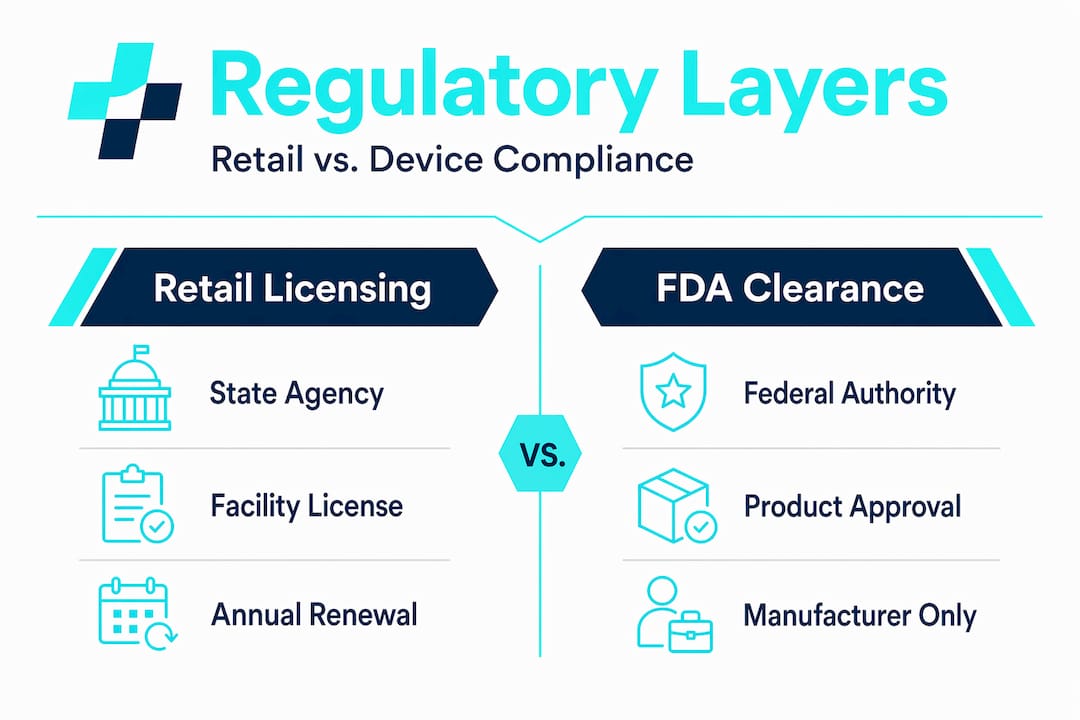
State-level compliance is where most healthcare organizations encounter the most confusion and the most risk. Each state controls its own licensing framework for medical device retail, and the differences across jurisdictions are not minor. A facility licensed to sell medical devices in Texas is not automatically authorized to do the same in California or New York.
Factor | Retail license | Wholesale distributor license |
Typical annual cost | $100 to $1,500+ | $200 to $500 |
Governing body | Board of Pharmacy, Dept. of Health | State licensing agency, varies |
Applies to | Direct sale to end users | Sale to other businesses |
DME add-on required | Often yes | Sometimes |
Renewal frequency | Annual in most states | Annual in most states |
The agencies responsible for issuing these licenses vary. In many states, the Board of Pharmacy oversees retail medical device sales, particularly when the products are dispensed by or alongside prescription items. Others route authority through the Department of Health or a dedicated medical device licensing office.

Durable Medical Equipment presents an additional layer. Most states require separate DME licenses that go beyond what a standard retail permit covers. These additional licenses typically impose equipment safety standards, maintenance documentation requirements, and customer service obligations that standard retail permits do not.
The consequences of skipping state licensing are not theoretical. Penalties for unlicensed medical device retail include civil fines, license revocation, criminal exposure, and loss of Medicare billing privileges. For any facility that bills CMS programs, that last penalty is particularly damaging because it can disqualify a provider from reimbursement across all CMS-covered services.
Pro Tip: Before entering any new state market with medical device sales, check directly with that state’s Board of Pharmacy and Department of Health simultaneously. Regulatory authority is sometimes split between agencies, and checking only one can leave you with an incomplete picture.
Federal FDA regulations that govern medical device sales
The FDA’s authority over medical devices is broad, but it does not replace state retail licensing. Understanding where federal rules apply and where they stop is critical for building a compliant operation.
The FDA governs medical device safety, classification, marketing authorization, and manufacturer registration. When a device reaches the retail level, FDA rules on labeling and advertising continue to apply. A retailer cannot make claims about a device that go beyond its cleared intended uses. Doing so constitutes misbranding, which is a federal violation.
Key federal compliance obligations relevant to regulated medical device sales include:
Device registration fees. For fiscal year 2026, FDA device establishment registration fees are set at $11,423. This applies primarily to manufacturers and importers, not typically to retailers, but understanding the fee structure clarifies where each entity sits in the distribution chain.
Labeling requirements. All labeling must reflect the device’s cleared or approved indications. Retailers who create their own marketing materials for devices must stay within those boundaries.
Advertising scrutiny. Both the FDA and the FTC monitor advertising claims. Off-label promotion risks include warning letters, injunctions, and substantial civil penalties.
Post-market surveillance. Depending on device class, retailers may have reporting obligations when they become aware of adverse events.
“Advertising claims for medical devices must conform exactly to the device’s cleared intended uses. FDA and FTC both scrutinize advertising, and misbranding includes unsupported claims and off-label promotion.” — FDA Advertising and Promotion of Medical Devices Guide
One practical reality that procurement teams often overlook: even after a device receives FDA clearance, there is a significant lag before it moves smoothly through commercial channels. A 12 to 18 month preparation period is common before a newly cleared device achieves widespread hospital adoption. That gap involves reimbursement coding, clinical training, and supply chain onboarding, all of which affect when and how a device becomes available through compliant retail channels.
Procurement best practices for sourcing regulated medical devices
For procurement specialists, compliance in medical device sales is not only a regulatory obligation. It is a financial and reputational safeguard. Sourcing from an unlicensed or gray market vendor exposes your organization to the same penalties as if you were the unlicensed party, because regulators examine the full supply chain.
Here is a practical framework for doing this well:
Verify state licenses before purchase. Request current copies of the retailer’s facility license, wholesale distributor license if applicable, and any DME-specific permits. Do not accept verbal assurances or outdated documentation.
Confirm FDA device clearance separately. Use the FDA’s 510(k) database or PMA database to verify that the specific device model you are purchasing has clearance for its intended use.
Assess quality management certifications. ISO 13485 certification is a strong indicator that a supplier maintains documented quality systems. It is not a legal requirement in the U.S., but its presence signals organizational discipline.
Avoid gray market sources. Gray market medical equipment includes devices that are genuine but sold outside authorized distribution channels. These products may lack proper service histories, current firmware, or valid warranties, and sourcing them can put your organization in a legally ambiguous position.
Distinguish credentialing from licensing. Vendor credentialing platforms like Reptrax are hospital operational tools, not regulatory licenses. A vendor appearing on a credentialing platform does not mean they hold the government-issued licenses required for legal regulated medical device sales.
Request a compliance summary. Ask suppliers to provide a written summary of their applicable licenses, registration status, and any relevant certifications. A reputable supplier will have this ready.
Pro Tip: When onboarding a new medical device supplier, request documentation from the supplier AND verify independently through public databases. Fraudulent license documentation is not unheard of in gray market transactions.
Medical device sales cycles are longer and involve more stakeholders than most other procurement categories. That complexity means your due diligence process should be built into your standard procurement workflow rather than treated as a one-time check.
Regulated retail vs. related categories at a glance
Healthcare administrators often conflate regulated medical device retail with adjacent commercial activities. The distinctions matter because each carries different licensing obligations, regulatory oversight, and legal consequences.
Category | Primary regulator | License type | Typical products | Key compliance risk |
Regulated retail | FDA + state agency | State retail facility license | DME, Class II devices, diagnostics | Operating without state license |
Wholesale distribution | FDA + state agency | Wholesale distributor license | Bulk Class I, II devices | Selling to unauthorized entities |
Manufacturing | FDA | Device establishment registration | All classes | Missing 510(k) or PMA clearance |
Non-regulated retail | State commerce rules | General business license | Non-device health products | Misclassifying devices as non-devices |
The distinction between regulated retail and non-regulated retail is where organizations trip up most frequently. Selling compression socks through a wellness brand may seem like general retail. If those socks carry FDA device classification, selling them requires device retail compliance. Misclassifying a regulated device as a general consumer product creates misbranding risk under federal law.
The regulatory and reimbursement fragmentation across jurisdictions creates market access challenges even for products that appear straightforward to sell. That fragmentation does not ease with scale. Larger organizations often face greater scrutiny precisely because their purchasing volume draws more regulatory attention.
My take on where compliance gaps actually happen
I’ve reviewed enough procurement operations over the years to say with confidence that the most common failure point is not ignorance of the rules. It is the assumption that someone else already handled it.
In practice, I’ve seen organizations where the legal team handled FDA clearance verification but assumed the supplier held valid state licenses. Meanwhile, the supply chain team assumed legal had checked everything. The result was a purchasing relationship with a distributor that held no DME license in the relevant state. Nobody lied. The system simply had no clear owner for that specific check.
What I’ve found actually works is treating regulatory verification as a checklist item in your vendor onboarding documentation rather than a judgment call. When it is documented, it gets done consistently. When it is left to professional judgment, it gets skipped when deadlines are tight.
I also think the industry underestimates the risk attached to requirements for medical device retail that vary by state. Procurement teams that operate nationally tend to standardize their processes around one or two familiar states and then assume those standards transfer. They usually do not. Building a state-by-state compliance matrix for your active vendor base takes time upfront, but it is far less expensive than a Medicare billing suspension.
— QB
Why Queenssurgical is built for compliant procurement
If you are actively managing regulated medical device retail purchasing for a healthcare organization, your supplier’s compliance posture matters as much as their pricing.
Queenssurgical operates as a licensed provider of high-quality medical supplies and equipment across the Americas, serving hospitals, clinics, and procurement teams who need both product depth and regulatory reliability. From regulated products like DynaShield Skin Protectant Cream to a broad catalog of clinical supplies, every product is sourced through authorized distribution channels. Queenssurgical’s B2B and B2C capabilities mean procurement specialists can manage both institutional and departmental purchasing through a single trusted platform. Explore the full catalog at Queenssurgical and source with confidence.
FAQ
What is regulated medical device retail?
Regulated medical device retail is the sale of FDA-classified medical devices to end users through channels governed by both federal FDA rules and state-level licensing requirements. Both layers of compliance must be satisfied for legal operation.
Do medical device retailers need a state license?
Yes. Most states require a separate retail facility license for selling medical devices, with annual fees ranging from $100 to over $1,500. Durable Medical Equipment retailers typically need additional specialized licenses beyond standard retail permits.
What happens if you sell medical devices without proper licensing?
Penalties include civil fines, inventory seizure, criminal charges, and revocation of Medicare billing privileges. Operating without the required state or federal authorizations exposes both the retailer and purchasing organizations to legal and financial liability.
Is FDA clearance enough to legally sell a medical device?
No. FDA clearance applies to the device itself and is issued to the manufacturer. Retailers must separately obtain applicable state facility licenses before selling that device commercially. Both authorizations are required for lawful regulated medical device sales.
How can procurement teams verify a supplier’s compliance?
Request current copies of all applicable state licenses, confirm device clearance through FDA public databases, and check quality certifications like ISO 13485. Vendor credentialing platform participation does not substitute for government-issued licenses.
Recommended
Comments