Integrated Delivery Networks Explained: A U.S. Guide
- Qubit Technology
- Aug 6
- 10 min read

An integrated delivery network (IDN) is a health system that owns and operates a coordinated network of hospitals, clinics, physician groups, and related services to manage patient care across the full continuum, from primary visits through post-acute recovery. According to IQVIA, between 40% and 70% of U.S. providers and 30% to 70% of facilities are affiliated with IDNs or provider networks, though penetration varies sharply by region. The Centers for Medicare and Medicaid Services (CMS) and organizations like the World Health Organization (WHO) both point to coordinated, accountable care systems as a cornerstone of modern healthcare delivery. Understanding how IDNs work matters whether you are a patient navigating referrals, a student studying health systems, or a procurement professional sourcing supplies for a multi-site health network.
Table of Contents
What is an integrated delivery network, and what defines one?
The Definitive HC glossary describes an IDN as an organization that owns and operates a network of healthcare facilities and services designed to coordinate the patient journey across care transitions. That definition sounds clean, but the practical reality is messier. Not every organization that calls itself a health system qualifies.
What separates a true IDN from a looser health system is the degree of centralized control. A genuine IDN typically features:
Ownership or formal affiliation — across multiple facility types, not just a shared brand name
The IQVIA report on integrated delivery networks underscores that IDN market penetration is highly variable by Core-Based Statistical Area (CBSA). In some metro markets, IDNs drive the majority of claim volume; in others, independent providers still dominate.
Affiliation Type | National Range (U.S.) |
Providers affiliated with IDNs or networks | between 40% and 70% |
Facilities affiliated with IDNs or networks | between 30% and 70% |
That range reflects genuine geographic variation, not data imprecision. A procurement team in a dense urban market faces a very different IDN landscape than one operating in a rural state.
How do horizontal and vertical integration differ in health systems?
The Essential Hospitals literature review documents dozens of overlapping definitions for integrated delivery systems, but two structural categories appear consistently: horizontal and vertical integration.
Horizontal integration happens when organizations at the same level of care, say two competing hospital systems in the same city, merge or formally affiliate. The primary driver is economies of scale: shared administrative costs, unified purchasing contracts, and stronger negotiating leverage with payers. A hospital acquiring three community hospitals across a region is the textbook horizontal move.
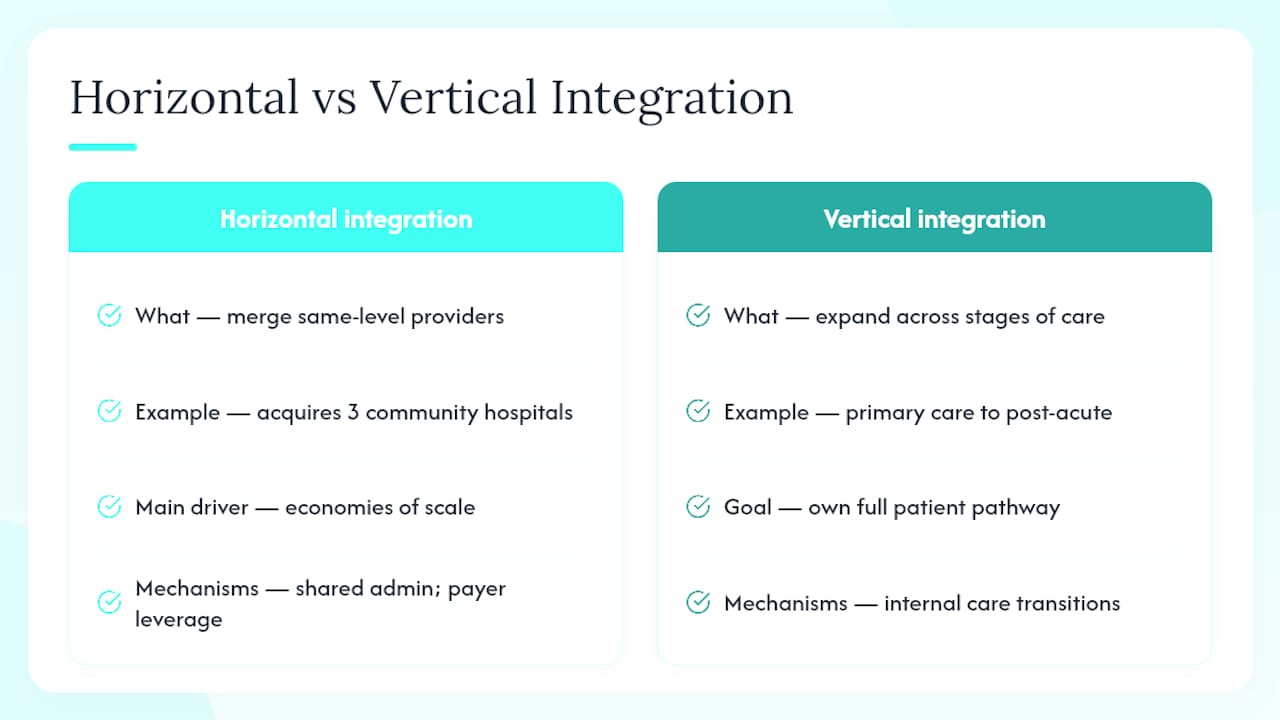
Vertical integration works differently. Here, a single organization expands across multiple stages of care, from primary care and specialty services through ambulatory surgery, imaging, pharmacy, and post-acute rehabilitation. The goal is to own the full patient pathway so care transitions happen inside the system rather than across organizational boundaries. This is where IDNs get their defining character.
Beyond those two categories, health policy researchers describe several organizational models worth knowing:
Multispecialty group practice with a health plan
A physician-led multispecialty group that also operates or owns an insurance product. The group controls both care delivery and the financial risk of that care, creating strong incentives to keep patients healthy and costs predictable.
Hospital-centered system
A hospital or academic medical center that expands outward by acquiring physician practices, outpatient clinics, and post-acute facilities. The hospital remains the operational and financial hub.
Payer-owned network
An insurance company that builds or acquires provider assets, creating a vertically integrated model where the insurer directly employs or contracts with clinicians. This model aligns financial incentives tightly but raises distinct regulatory questions.
Strategic or virtual integration
Organizations that stop short of full ownership but align purchasing, IT infrastructure, and governance through long-term contracts and shared data platforms. Less capital-intensive, but also less cohesive than full ownership models.
What facilities and services make up a typical IDN?
Medpak’s IDN overview lists the core facility types that appear in most U.S. integrated delivery networks. A fully built-out IDN typically includes:
Acute care hospitals (often the anchor institution)
Primary care clinics and community health centers
Employed or affiliated physician groups across specialties
Ambulatory surgery centers (ASCs)
Diagnostic imaging centers
Clinical laboratory services
Post-acute facilities: skilled nursing, long-term acute care, home health
Specialty pharmacies
Population health management teams
Behavioral health services
Sometimes, an owned or affiliated health insurance plan
These components do not operate in isolation. A patient discharged from the acute hospital gets a follow-up appointment scheduled inside the same system, with records already visible to the outpatient team. Referrals to a specialist flow through the same EHR. The specialty pharmacy fills the discharge prescription and ships it directly to the patient’s home.
When a health plan sits inside the IDN structure, the dynamic shifts further. The system now holds both the clinical and financial risk for a defined population, which pushes leadership to invest in preventive care and chronic disease management rather than waiting for expensive acute episodes.
Which U.S. health systems illustrate what an IDN can look like?
These eight organizations represent different integration strategies and scales. Each one teaches something specific about how IDNs work in practice.
Kaiser Permanente is the most cited example of a payer-provider IDN in the United States. Kaiser owns hospitals, employs physicians through the Permanente Medical Groups, and operates its own health plan, all under one organizational umbrella. The model eliminates the usual tension between insurer and provider because they are the same entity.
UPMC (University of Pittsburgh Medical Center) demonstrates how an academic medical center can build a regional IDN with significant insurance operations. UPMC Health Plan covers millions of members in Pennsylvania, and the clinical network spans dozens of hospitals and hundreds of outpatient sites.
Mayo Clinic shows what a multispecialty group practice model looks like at scale. Physicians are salaried and work in teams organized around the patient’s condition rather than individual specialty silos. Mayo’s campuses in Rochester, Phoenix, and Jacksonville function as integrated hubs rather than independent hospitals.
Cleveland Clinic illustrates the academic IDN model with a strong international footprint. Its institute-based structure, where cardiologists, surgeons, and nurses treating heart disease all sit in the same Heart, Vascular and Thoracic Institute, is a deliberate attempt to eliminate departmental fragmentation.
Geisinger Health in Pennsylvania is frequently cited in policy research for its ProvenCare bundled payment programs and its Geisinger Health Plan. Geisinger has been a testing ground for value-based care models that tie reimbursement to outcomes rather than volume.
Jefferson Health in the Philadelphia region shows how a mid-size academic system can grow through strategic affiliations rather than full acquisitions, building a regional network while preserving some local institutional identity.
Intermountain Healthcare in Utah and the Mountain West is known for its clinical quality programs and data-driven care protocols. Intermountain has long used internal analytics to standardize care pathways and reduce unnecessary variation across its hospitals and clinics.
Highmark Health in western Pennsylvania represents the payer-led integration model. Highmark, primarily a Blue Cross Blue Shield insurer, owns Allegheny Health Network, creating a structure where the insurer directly controls a large provider system.
How does an IDN differ from a health system, GPO, or ACO?
These terms overlap in real markets, which causes genuine confusion. Here is how they actually differ:
IDN vs. health system: A health system is a broad term for any organization that includes at least one hospital and affiliated providers. An IDN implies a higher degree of formal integration, including centralized purchasing, shared governance, and accountability across care settings. All IDNs are health systems; not all health systems qualify as true IDNs.
IDN vs. GPO: A Group Purchasing Organization (GPO) like Vizient or Premier is a purchasing cooperative, not a care delivery organization. GPOs aggregate buying power for member hospitals to negotiate supplier contracts. An IDN may use a GPO for some purchasing, but the IDN itself delivers care. They are not interchangeable.
IDN vs. ACO: An Accountable Care Organization (ACO) is a value-based contracting arrangement, typically with CMS or a commercial payer, where a group of providers shares financial risk for a defined patient population. An ACO is a payment and accountability structure. An IDN is an ownership and operational structure. A single IDN may operate one or more ACOs, but an ACO does not require the full ownership integration that defines an IDN.
In practice, the lines blur. A large IDN often operates an ACO, participates in a GPO, and calls itself a health system depending on the audience. The key question is always: who owns what, and who is accountable for outcomes and costs?
Why do IDNs matter for care quality and cost?
The core promise of an IDN is continuity. When a patient moves from an emergency visit to a hospitalization to a skilled nursing facility and then to home health, a well-integrated IDN can manage that transition without the information gaps and duplicated tests that plague fragmented care. The symplr glossary highlights chronic disease management as a particular strength: IDNs can track patients with diabetes or heart failure across years of care, not just individual encounters.
Procurement is the other major advantage. An IDN that controls dozens of hospitals and hundreds of clinics can negotiate supply contracts from a position of real leverage. Aggregated purchasing across a system drives down per-unit costs on everything from surgical gloves to imaging contrast agents. For suppliers, winning an IDN contract means access to the entire network, which is why understanding wholesale purchasing advantages for hospitals matters to any vendor working in this space.

Population health programs are a third benefit. IDNs with owned health plans or ACO arrangements have financial incentives to invest in preventive care, care management teams, and social determinants of health programs that fee-for-service systems typically ignore.
What are the main criticisms and risks of the IDN model?
Integration does not automatically produce better outcomes or lower costs. The challenges are real:
Market consolidation: When an IDN acquires most of the hospitals and physician practices in a region, competition weakens. The Health Affairs analysis on consolidation warns that reduced competition can push prices upward even when clinical coordination improves.
Regulatory scrutiny has increased alongside consolidation. CMS programs like the Hospital Readmissions Reduction Program create financial penalties for poor care transitions, which pushes IDNs to invest in post-discharge follow-up. But those same incentives can also push systems toward acquiring post-acute facilities to control outcomes rather than genuinely improving care coordination.
How do IDNs operate day-to-day, and what payment models do they use?
Governance structures vary by ownership type. A corporate-owned IDN like HCA Healthcare operates with centralized financial controls and standardized protocols pushed down to member facilities. A joint venture IDN, where a health system and a physician group co-own a network, requires negotiated governance agreements that balance system priorities with physician autonomy. A payer-owned network like Highmark/Allegheny Health Network operates with insurance logic driving clinical investment decisions.
Payment models inside IDNs typically layer several approaches:
Fee-for-service remains common for individual clinical encounters, especially for commercially insured patients. The IDN bills for each service rendered.
Bundled payments cover a defined episode of care, say a hip replacement from surgery through 90-day recovery, with a single payment that the IDN distributes internally. Geisinger’s ProvenCare program is a well-known example.
Value-based contracts tie a portion of reimbursement to quality metrics and cost targets. ACO arrangements with CMS are the most visible form, but commercial payers use similar structures.
The CMS Hospital Readmissions Reduction Program illustrates how federal policy shapes IDN behavior directly: hospitals face payment penalties for excess readmissions in conditions like heart failure and pneumonia, which gives IDNs a concrete financial reason to invest in transitional care teams, post-discharge phone calls, and home health coordination.
What does being inside an IDN mean for patients?
For most patients, the most visible effects are practical:
Referrals happen faster — because the primary care physician and the specialist share the same scheduling system and EHR
The downside is real too. If you need a specialist who is not employed by or affiliated with your IDN, your plan may not cover that visit at the same rate, or may require a referral authorization that takes time. Some IDNs actively discourage outside referrals through financial incentives to physicians.
Pro Tip: Before your first appointment inside a new IDN, ask your primary care physician two questions: “Is every specialist you might refer me to in-network?” and “What happens if I need a service your system does not offer?” Those two questions surface the network’s actual limits faster than reading the plan documents.
Billing surprises are less common inside a well-integrated IDN than in fragmented systems, but they still happen at the edges, particularly when an out-of-network provider participates in a procedure at an in-network facility. The No Surprises Act provides some federal protection here, but patients should still verify coverage before elective procedures.
Key Takeaways
An IDN is a formally integrated health system that coordinates care, purchasing, and governance across multiple facility types, and its impact on patients and procurement depends heavily on how deeply that integration actually runs.
Point | Details |
Core definition | An IDN owns or formally affiliates facilities to coordinate care across the full patient continuum. |
Integration levels | Horizontal integration merges similar-level organizations; vertical integration spans primary through post-acute care. |
U.S. penetration | Between 40% and 70% of U.S. providers and 30% to 70% of facilities are affiliated with IDNs or provider networks, with wide regional variation. |
Key benefits | IDNs reduce care fragmentation, enable aggregated purchasing, and support chronic disease and population health programs. |
Primary risks | Consolidation can reduce competition and raise prices; interoperability gaps and governance complexity persist even inside integrated systems. |
The procurement angle most people miss
The conversation about IDNs usually stays at the clinical level, which makes sense. But for anyone sourcing medical supplies or equipment, the IDN structure changes the entire procurement dynamic. A purchasing decision that used to happen at the individual hospital level now happens at the system level, often through a value analysis committee that evaluates products against standardized clinical criteria and total cost of ownership across dozens of facilities.
That shift has a direct implication: suppliers who understand how IDNs evaluate and contract for products have a real advantage over those who still pitch individual department heads. The aggregated purchasing power of a large IDN means that winning or losing a formulary decision affects supply volume across an entire regional network, not just one building.
Queenssurgical works with clinics, hospitals, and healthcare facilities across the Americas, supplying the kind of disposable consumables and medical equipment that IDN value analysis committees review regularly. If your facility is part of an IDN and you need a reliable, competitively priced supply partner, Queenssurgical’s catalog covers the core categories procurement teams need.
Authoritative sources and further reading
INTEGRATED DELIVERY NETWORKS
INTEGRATED HEALTH CARE LITERATURE REVIEW (Essential Hospitals)
Hospital Readmissions Reduction Program (HRRP) | CMS
Health Affairs — Consolidation and its effects
Recommended
Comments