Healthcare Supply Chain Resilience: What Administrators Must Do

Healthcare supply chain resilience is the ability to anticipate, prepare for, respond to, and recover from disruptions to ensure continuous availability of critical medical products for patient care — a definition grounded in the ASPE/Mathematica framework. If you’re a supply chain leader deciding where to start, three moves matter most right now:
Identify clinically critical items — the products where a shortage directly harms patients or halts procedures.
Extend visibility beyond your Tier 1 suppliers — most disruptions originate where you have no contract or oversight.
Adopt targeted buffer stock for high-risk, high-criticality SKUs only — not across the board.
Pro Tip: Don’t treat resilience as a project with an end date. The organizations that sustain it embed it into procurement cycles, clinical governance, and executive dashboards from the start.
Queenssurgical’s catalog of critical consumables, from isolation gowns to PPE, is one practical resource for building those targeted buffers quickly.
Table of Contents
Why does supply chain resilience matter for patient outcomes and finances?
What are the four core components of healthcare supply chain resilience?
How do you build practical resilience strategies this quarter?
How should you set up governance and continuous improvement?
How do you triage products by clinical criticality and supply vulnerability?
What are the financial trade-offs and how do you build the business case?
Queenssurgical supports your critical-supply resilience program
Why does supply chain resilience matter for patient outcomes and finances?
Shortages don’t just inconvenience staff. They delay or alter treatment pathways, force costly emergency purchases, and erode physician confidence in the system. The importance of healthcare supply chain management becomes undeniable when a missing consumable pushes a procedure to the next day or forces a clinician to substitute a less familiar product mid-care.
Financially, the damage compounds fast. Emergency spot-buys carry significant price premiums. Disrupted surgical schedules translate directly to lost revenue. And when shortages persist, staff spend hours on workarounds that should never be part of their workflow.
Surveys documenting resilience gaps show that many healthcare professionals reported experiencing shortages in the prior year, while most organizations still focus primarily on direct suppliers rather than integrated risk frameworks. That gap between exposure and preparedness is exactly where the financial and clinical risk lives. A well-designed supply chain management guide for healthcare managers addresses this systematically.
What are the four core components of healthcare supply chain resilience?
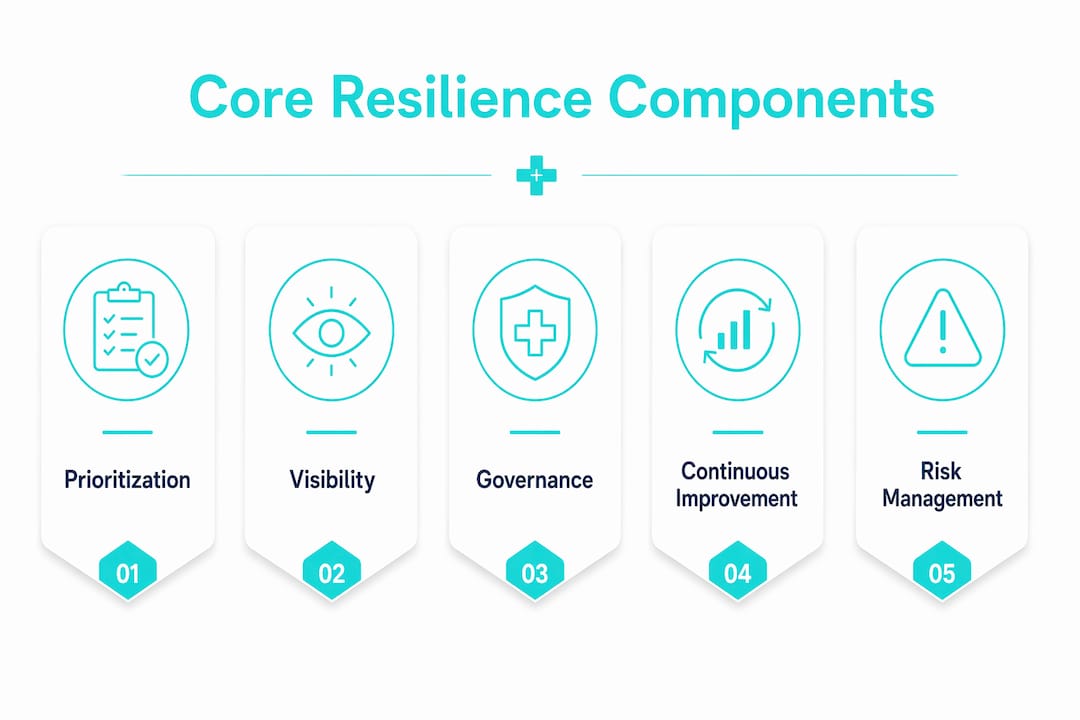
Think of resilience as four capability buckets. Gaps in any one of them leave the whole system exposed.
Anticipation and visibility. Knowing what is in your supply chain before a disruption hits — including Tier 2 and Tier 3 suppliers. Example: contract clauses requiring distributors to report SKU-level inventory and days-on-hand weekly.
Mitigation through stock and sourcing. Selective safety stock for clinically critical items, plus alternate-source agreements already in place before you need them. Example: dual-sourcing isolation gowns from two geographically separate manufacturers.
Response and recovery capabilities. Protocols that activate fast when a shortage is confirmed — reallocation rules, clinical substitution playbooks, and manual workflow fallbacks for IT outages.
Governance and continuous improvement. A cross-functional steering structure that reviews risk on a regular cadence, not just after a crisis. Resilience requires integrated governance across procurement, clinical, and finance — not a one-time project.
Not every SKU needs equal investment across all four buckets. Clinical criticality and supply vulnerability together determine where to concentrate resources.
How do you build practical resilience strategies this quarter?
Visibility is the fastest lever to pull. Require distributors to share SKU-level inventory reporting and days-on-hand data on a weekly basis. Add Tier 2 mapping to your next contract renewal cycle — most organizations audit only Tier 1 suppliers, which means disruptions that start upstream arrive as surprises.

For inventory, segment before you stockpile. Hold larger buffers only for items with high clinical criticality and high supply vulnerability. Applying just-in-time logic to stable, low-risk commodities while reserving just-in-case buffers for critical SKUs keeps carrying costs from spiraling. Practical sourcing tips for healthcare providers cover this segmentation in detail.
On sourcing and contracting, three steps move the needle quickly:
Diversify suppliers for your most critical SKUs — at minimum, identify one qualified alternate source per item.
Add visibility and allocation clauses to distributor contracts so you receive early warning of supply tightening.
Build an alternative-sourcing playbook so staff aren’t searching for vendors during a shortage.
Operationally, run at least one tabletop exercise per year simulating a critical-item shortage. Digital tools like IoT tracking and digital twins let teams stress-test scenarios before they happen. Keep low-tech fallbacks — paper-based reorder forms, manual count sheets — ready for IT outages.
How should you set up governance and continuous improvement?
Resilience without governance degrades within a year. A cross-functional steering committee is the structural fix: include procurement, clinical leads, emergency preparedness, finance, and IT. Each function needs a defined owner, a backup, and a clear escalation path for emergency sourcing decisions.
Role | Primary Responsibility | Meeting Cadence |
Procurement lead | Supplier contracts, visibility feeds, emergency sourcing | Weekly critical-SKU review |
Clinical lead | Criticality scoring, substitution protocols | Monthly supplier-risk review |
Finance | Budget authority, carrying-cost approvals | Quarterly stress-test review |
IT/Data | Dashboard maintenance, item-master hygiene | Monthly |
Emergency preparedness | Tabletop exercises, response playbooks | Quarterly |
Meeting cadences matter as much as the committee itself. A weekly critical-SKU review catches emerging shortages early. A monthly supplier-risk review surfaces Tier 2 changes. A quarterly enterprise stress test keeps the whole team sharp.
Pro Tip: Tie resilience KPIs directly into executive dashboards and budget cycles. Resilience programs that live only in procurement rarely survive the next budget cut.
Embedding ISO 31000 risk management principles into your governance structure gives the program a recognized framework that finance and legal teams understand.
Which KPIs and tools actually measure resilience progress?
Five KPIs give you a clear picture without drowning in data:
Days of inventory on hand for critical SKUs (target varies by item; track trends, not just snapshots)
Fill rate for critical items — the percentage of orders fulfilled on time and in full
Supplier time-to-notify for disruptions (how quickly your supplier alerts you to a problem)
Number of Tier 2/3-covered suppliers in your risk map
Cost per disruption event — emergency purchase premiums plus staff time
The technology stack supporting these KPIs typically includes ERP/item master hygiene as the foundation, inventory management software for real-time counts, supplier portals or API feeds for upstream data, IoT sensors for location and condition tracking, and analytics platforms for predictive forecasting. Poor data quality in the item master is a frequent root cause that prevents accurate tracking across facilities — clean it before launching any large-scale analytics project. Safe online ordering practices for supplier portals are worth reviewing as part of that hygiene effort.
How do you triage products by clinical criticality and supply vulnerability?
Score every SKU on two axes: clinical criticality (patient outcome impact, lack of substitutes, patient reach) and supply vulnerability (single-source dependency, long lead times, raw-material concentration). The ASPE/Mathematica criticality and vulnerability framework is the most rigorous U.S.-focused reference for this scoring.
Criticality / Vulnerability | High Vulnerability | Low Vulnerability |
High criticality | Immediate mitigation: stockpile, dual-source, contract visibility clauses | Monitor closely; add one alternate source |
Low criticality | Reduce dependency; consider substitution or standardization | Routine JIT management; no special buffer |
Use a simple 1–3 score on each axis, multiply for a composite (1–9), and set action thresholds: composite 7–9 triggers immediate mitigation, 4–6 triggers monitoring and a sourcing review, 1–3 stays in standard JIT. Involve clinical leads in the scoring — procurement alone will underestimate the substitutability of clinical items.
What does a realistic implementation roadmap look like?
Phase 1 (months 0–3): Baseline assessment. Clean the item master, run criticality/vulnerability scoring on your top 200 SKUs, and map Tier 1 suppliers for all high-composite items. Assign a resilience owner.
Phase 2 (months 3–6): Pilots. Activate visibility feeds for your top 25 critical SKUs, amend two to three distributor contracts to include allocation clauses, and establish targeted buffer stock for the highest-composite items.
Phase 3 (months 6–12): Scale and integrate. Roll pilots across the full critical-SKU list, integrate KPI dashboards into executive reporting, and run the first enterprise tabletop exercise.
Resource estimates to plan for:
Internal FTEs: one dedicated supply chain analyst plus part-time clinical and finance liaisons
Technology integration budget: depends on existing ERP capabilities; API feeds and dashboard tools are the primary costs
Contingency fund: reserve for emergency sourcing during the transition period
What are the financial trade-offs and how do you build the business case?
Higher safety stock increases carrying costs. That is the honest trade-off. But the math usually favors resilience when you account for emergency purchase premiums, disrupted procedure revenue, and staff overtime during shortage response. Optimized procurement can reduce supply spending by up to 10%, which partially offsets the carrying-cost increase for targeted buffers.
For the CFO conversation, frame it this way:
Incremental carrying cost of a 30-day buffer on your top 25 critical SKUs vs. avoided emergency-purchase spend on those same items over 12 months
Cost per prevented shortage event as the primary ROI metric
Scenario-based stress testing showing the financial impact of a 2-week shortage of a high-criticality item
Budget planning guidance for healthcare supply procurement can help structure these projections. The business case is strongest when it uses your own historical emergency-purchase data — pull that before the CFO meeting.
A short case walkthrough: isolation gowns
A mid-size hospital system identified isolation gowns as high criticality (no viable substitute during infectious-disease surges) and high vulnerability (single offshore manufacturer, 90-day lead time). Before intervention: 7 days of inventory on hand, 100% single-source, no visibility contract.
Actions taken: added a second domestic supplier, negotiated a weekly inventory-reporting clause with the primary distributor, and established a 45-day buffer for the high-criticality tier. CPE isolation gowns from a reliable U.S.-accessible distributor were part of the alternate-source solution.
After 6 months: days of inventory on hand increased to 45, fill rate held at 98% through a regional shortage event, and emergency purchase costs for gowns dropped to near zero for that period.
Three lessons: start with a single high-impact SKU before scaling, involve infection control clinicians in the criticality score, and document the alternate-sourcing playbook before you need it.
Key Takeaways
Healthcare supply chain resilience requires clinical-criticality-first prioritization, extended upstream visibility, and sustained cross-functional governance to protect patient care and control costs.
Point | Details |
Prioritize by criticality × vulnerability | Score SKUs on both axes; composite 7–9 triggers immediate mitigation and targeted stockpiling. |
Extend visibility beyond Tier 1 | Map Tier 2/3 suppliers and require SKU-level, days-on-hand reporting in distributor contracts. |
Track five core KPIs | Fill rate, days of inventory on hand, supplier time-to-notify, Tier 2/3 coverage, and cost per disruption event. |
Build the CFO case with real data | Use historical emergency-purchase costs to quantify avoided spend; optimized procurement can reduce supply spending by up to 10%. |
Queenssurgical as a sourcing resource | Queenssurgical supplies critical consumables including isolation gowns and PPE for targeted buffer-stock programs across the Americas. |
The gap most resilience programs miss
Most healthcare supply chain programs fail not because the strategy is wrong but because the prioritization is. Teams spend months building governance structures for noncritical SKUs while their highest-risk, highest-impact items sit on a single-source contract with no visibility clause and a 90-day lead time.
The clinical-criticality-first approach flips that. It forces the uncomfortable conversation with clinicians about which items are truly irreplaceable and which have workable substitutes. That conversation is harder than building a dashboard, but it is the one that actually determines whether your resilience investment protects patients or just looks good in a board presentation.
The other underrated move: keep finance in the room from day one. Resilience programs that are built by procurement alone tend to get defunded at the first budget cycle. When finance owns a line item for resilience carrying costs and sees the avoided-emergency-spend data quarterly, the program survives.
Queenssurgical supports your critical-supply resilience program
When your resilience plan calls for a reliable source of critical consumables, Queenssurgical delivers. Health systems and clinics across the Americas use Queenssurgical for wholesale and recurring procurement of PPE, isolation gowns, instruments, and disposable consumables — exactly the product categories that appear most often in high-criticality, high-vulnerability assessments.
Queenssurgical supports both bulk institutional orders and flexible recurring purchasing, so you can build targeted buffer stock without committing to a single rigid contract. Browse critical consumables including isolation gowns and PPE, or contact the team to discuss wholesale pricing and order reliability for your top critical SKUs. Wholesale purchasing benefits for hospitals are detailed on the site if you want to compare cost models before reaching out.
Useful sources for further reading
The following U.S.-focused resources are worth bookmarking when preparing executive briefings or funding requests:
ASPE/Mathematica: Defining and Measuring the Resilience, Criticality, and Vulnerability of Medical Product Supply Chains — the canonical U.S. framework for criticality and vulnerability scoring; cite this in any board-level resilience proposal.
NCBI Bookshelf: Causes and Consequences of Medical Product Supply Chain Failures — rigorous analysis of shortage root causes (demand surges, capacity reductions, coordination failures); useful for justifying upstream visibility investments.
McKinsey: Bolstering Health System Supply Chain Resilience to Reduce Risk — practical strategies and the procurement savings estimate; strong reference for CFO conversations.
Health Care Council: State of Supply Chain Risk — documents the Tier 1-only audit gap and the case for deeper supplier mapping.
American Public University: The Importance of Supply Chain Management in Healthcare — accessible overview linking supply chain performance to patient outcomes; good for orienting non-procurement stakeholders.
Recommended
Comments