Why Medical Supply Transparency Matters for Organizations

Medical supply transparency is defined as the strategic disclosure of supply chain data that enables accountability, informed decision-making, and operational efficiency across healthcare organizations. Unlike basic inventory tracking, transparency requires sharing contextual data across organizational boundaries so that providers, suppliers, regulators, and distributors can all verify what is happening and why. The importance of supply chain transparency has grown sharply as regulations tighten and supply disruptions become more costly. Healthcare administrators and procurement professionals who treat transparency as a strategic capability gain measurable advantages in efficiency, compliance, and stakeholder trust.
Why medical supply transparency matters for organizations
Transparency in healthcare supply chains is not the same as knowing where your stock is. The industry standard framework distinguishes three related but distinct concepts: visibility, traceability, and transparency each serve different purposes and operate at different levels of the supply chain.

Visibility delivers real-time operational data. It answers the question “Where is this shipment right now?” and supports immediate decisions like rerouting an order or flagging a delay. Visibility tools feed dashboards and alert systems used by logistics teams every day.
Traceability delivers historical product-level data. It answers “Where did this product come from, and what happened to it?” Traceability is the backbone of recall management and retrospective audits. It works backward through the supply chain to reconstruct a product’s journey.
Transparency operates at a higher level. It requires the disclosure of contextual, multi-dimensional data for stakeholder accountability. It answers “Can every party in this supply chain verify compliance, pricing, and sourcing decisions?” That question crosses organizational lines. A hospital administrator cannot answer it alone. It requires suppliers, distributors, and regulators to share data in formats that are mutually verifiable.
Concept | Data type | Primary purpose | Example |
Visibility | Real-time operational | Immediate decisions | Live shipment tracking |
Traceability | Historical product-level | Retrospective analysis | Recall investigation |
Transparency | Contextual, multi-dimensional | Stakeholder accountability | Supplier compliance disclosure |
Pro Tip: When evaluating your current systems, ask which of these three capabilities you actually have. Most organizations have visibility. Far fewer have true transparency.
How does transparency improve efficiency and reduce manual workloads?
The operational case for transparency is concrete. Automating manual sourcing and implementing cross-organizational data visibility saves healthcare organizations up to 60 FTE hours weekly. That figure represents a significant reduction in the labor cost of procurement, and it comes directly from eliminating the manual research, phone calls, and spreadsheet reconciliation that siloed data systems force onto staff.
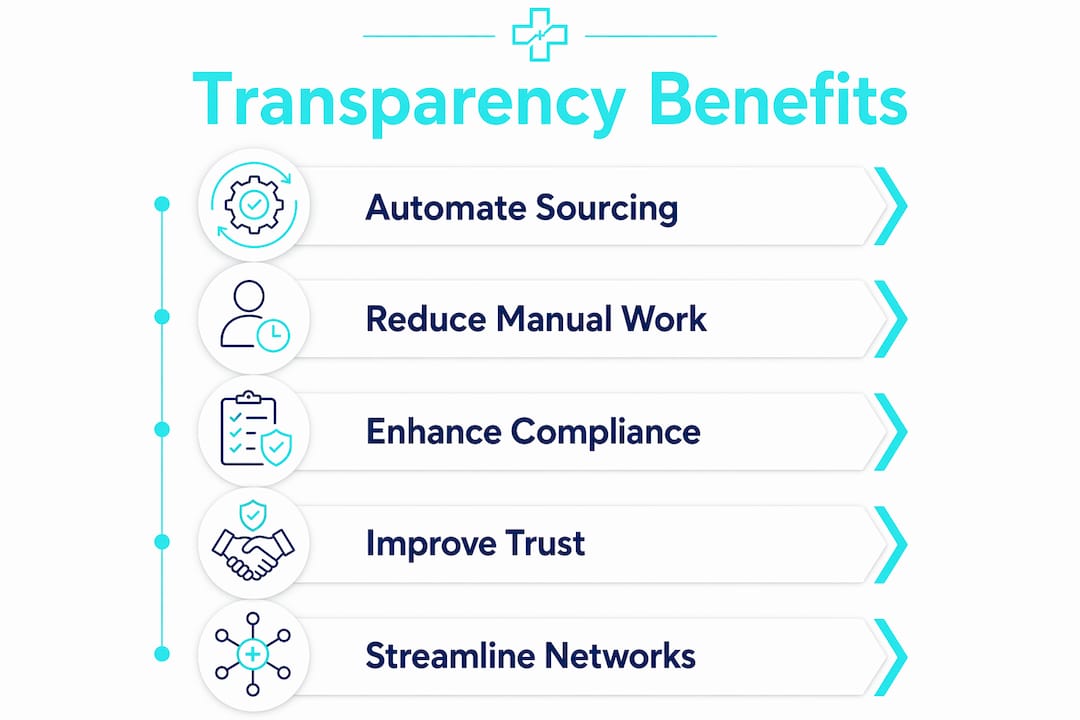
Siloed ERP, supplier, and distributor data is the root cause of those delays. When each system holds its own version of product availability, pricing, and compliance status, procurement teams spend hours reconciling conflicting information before they can act. Integrated data streams eliminate that reconciliation step entirely.
AI-driven tools add another layer of efficiency. AI-enabled benchmarking reduces information asymmetry between procurement teams and suppliers by giving buyers market-wide purchase visibility. That shift moves procurement from reactive negotiation to data-driven decision-making. Procurement professionals who once spent hours researching fair market pricing can now access that intelligence in minutes.
Operational efficiencies gained through transparency implementation include:
Faster substitute product identification when primary items are unavailable
Reduced time spent on manual supplier verification and compliance checks
Earlier detection of supply disruptions before they affect patient care
Fewer purchase order errors caused by outdated or conflicting product data
Shorter audit preparation cycles because documentation is already organized and current
Pro Tip: Start with one high-volume product category when piloting transparency tools. The efficiency gains in a single category are often enough to build the internal case for broader adoption.
For practical guidance on sourcing surgical supplies efficiently, the process starts with data integration before it starts with vendor selection.
Why is transparency critical for compliance and risk management?
Regulatory pressure is the most urgent driver of supply chain transparency for healthcare organizations right now. Nearly 90% of supply chain professionals identify transparent, traceable systems as critical to avoiding fines, protecting brand reputation, and preventing disruptions. That near-unanimous consensus reflects how much the regulatory environment has shifted in recent years.
Regulations now require verifiable transparency data across multiple supplier tiers, not just first-tier vendors. Forced labor compliance laws in the United States, Canada, and the European Union require hospitals and procurement organizations to document that their supply chains are free from exploitative labor practices. That documentation cannot exist without transparency protocols that reach deep into the supplier network.
Healthcare organizations with documented supplier access protocols and transparency handling are strategically better positioned for regulatory audits and supply disruption management. Hospitals that lack these protocols face longer audit timelines, higher legal exposure, and greater operational risk when disruptions occur.
The compliance benefits extend beyond avoiding fines. Cloud-based product identification and connected networks increase audit readiness by 34%, improve compliance by 43%, and enhance supply chain visibility by 40%. Those are not marginal gains. They represent the difference between a procurement function that passes audits and one that scrambles to prepare for them.
Transparency also protects organizations from reputational risk. A single sourcing scandal tied to a supplier several tiers removed can damage a hospital’s public standing even when the hospital had no direct knowledge of the problem. Documented transparency protocols create a defensible record that shows due diligence was exercised. For healthcare administrators, that record is as valuable as the compliance itself. Understanding retail medical compliance requirements in 2026 is a practical starting point for building that documentation structure.
What benefits does transparency bring to trust and stakeholder collaboration?
Transparency is now a baseline expectation in healthcare trade, not a competitive advantage. Buyers, regulators, and supply partners expect product origin verification, compliance documentation, and pricing clarity as standard conditions of doing business. Organizations that cannot meet those expectations lose contracts and partnerships, regardless of product quality.
Transparent pricing changes the character of supplier relationships. Auditable pricing data shifts procurement from adversarial negotiation to data-driven partnership. When both sides of a transaction can see market benchmarks, disputes over pricing become shorter and less frequent. Trust builds faster when neither party holds an information advantage over the other.
Global standards like GS1 support this trust by creating interoperable data formats that work across organizational and national boundaries. When a hospital in the United States and a supplier in Mexico both use GS1 product identification standards, the data they exchange is mutually verifiable without manual translation or reconciliation. That interoperability is the technical foundation of stakeholder trust at scale.
The trust-building outcomes of supply chain transparency include:
Smoother regulatory audits because documentation is already structured and accessible
Faster product approvals because compliance records are verifiable on demand
Fewer contract disputes because pricing and sourcing data are shared openly
Stronger long-term supplier relationships built on shared accountability
Reduced onboarding time for new suppliers because transparency requirements are standardized
How can organizations implement and sustain supply chain transparency?
Transparency works best when it is embedded into existing supply chain workflows rather than managed as a separate initiative. Integrating transparency into daily operations makes compliance a natural byproduct of normal work rather than a periodic project. Organizations that treat transparency as a standalone platform often find it becomes siloed itself, which defeats the purpose.
Digitally connected supplier networks are the infrastructure layer that makes sustained transparency possible. When suppliers, distributors, and providers share data through connected systems, the information flows automatically rather than requiring manual requests and responses. That connectivity reduces the labor cost of maintaining transparency over time.
AI plays a growing role in automating data collection and validation across multiple supplier tiers. Manual validation of supplier compliance data across dozens of vendors is not practical at scale. AI tools can flag inconsistencies, verify certifications, and update records continuously without human intervention at each step. For a deeper look at how automation supports supply chain management, the principles apply directly to transparency implementation.
Best practices for implementing and sustaining transparency include:
Embed transparency data requirements into supplier contracts from the start
Use standardized data formats, such as GS1, to support interoperability across systems
Assign cross-departmental ownership so transparency is not solely a procurement responsibility
Audit supplier data regularly rather than only during compliance reviews
Avoid building transparency in a separate platform that does not connect to your ERP or procurement system
Common pitfalls to avoid include treating transparency as a one-time project, relying on self-reported supplier data without verification, and failing to train clinical and administrative staff on why the data matters.
Pro Tip: Cross-departmental ownership is the single most underrated factor in transparency success. When legal, clinical, and finance teams all have a stake in the data, the system gets maintained. When only procurement owns it, it gets neglected.
Key Takeaways
Medical supply transparency is the strategic disclosure of supply chain data that enables accountability, reduces manual workloads, and positions healthcare organizations to meet regulatory requirements before audits arrive.
Point | Details |
Transparency vs. visibility | Transparency requires cross-organizational data disclosure; visibility only tracks real-time operations. |
Efficiency gains | Automating sourcing and integrating data saves up to 60 FTE hours weekly for healthcare organizations. |
Compliance readiness | Connected networks increase audit readiness by 34% and improve compliance by 43%. |
Trust as a baseline | Transparency is now a standard expectation from buyers, regulators, and supply partners, not a differentiator. |
Implementation approach | Embed transparency into existing workflows and assign cross-departmental ownership to sustain it long term. |
The shift I keep seeing organizations get wrong
Most healthcare organizations I work with have invested heavily in visibility tools. They can tell you where every shipment is in real time. What they cannot tell you is whether the supplier three tiers back meets forced labor standards, or whether the price they paid last quarter was competitive against the market. That gap between visibility and transparency is where the real risk lives.
The organizations that close that gap fastest are not the ones that buy the most sophisticated platform. They are the ones that reframe transparency as an organizational discipline rather than a technology purchase. They assign ownership across departments. They build supplier data requirements into contracts before the relationship starts. They treat audit readiness as a continuous state, not a sprint before an inspection.
The transition from reactive to resilient supply chain management does not happen because of a software rollout. It happens because administrators and procurement professionals decide that knowing is not enough. Verifying, documenting, and sharing that verification with every relevant stakeholder is what transparency actually means. The organizations that internalize that distinction are the ones that will navigate the next supply disruption without scrambling.
— QB
Queenssurgical: medical supplies with transparent sourcing
Healthcare administrators who want to put transparency principles into practice need a supply partner whose sourcing and product quality are verifiable from the start.
Queenssurgical supplies medical products across the Americas with a catalog built for both wholesale and retail procurement. From isolation gowns to BP cuff barrier sleeves and respiratory equipment, every product category is organized for easy verification and reordering. Queenssurgical’s platform supports the kind of documented, repeatable procurement that makes audit readiness a standard outcome rather than an emergency effort. Procurement teams that prioritize supply chain accountability will find a catalog and fulfillment structure that matches that standard.
FAQ
What is medical supply transparency?
Medical supply transparency is the strategic disclosure of supply chain data across organizational boundaries to enable accountability, compliance verification, and informed decision-making by all stakeholders involved.
How does transparency differ from supply chain visibility?
Visibility provides real-time operational data for immediate decisions, while transparency requires contextual, multi-dimensional data disclosure that supports stakeholder accountability across the entire supply chain.
Why do organizations need transparency for regulatory compliance?
Nearly 90% of supply chain professionals identify transparent systems as critical to avoiding fines and preventing disruptions, and current regulations require verifiable supplier data across multiple tiers.
How much time can transparency save healthcare organizations?
Automating manual sourcing and implementing cross-organizational data visibility saves healthcare organizations up to 60 FTE hours weekly, according to healthcare supply chain research.
What role does AI play in supply chain transparency?
AI automates data collection, validates supplier compliance records, and delivers pricing benchmarks that reduce information asymmetry between procurement teams and their suppliers.
Recommended
Comments