Class II Medical Devices: A Regulatory Guide for Professionals

Class II medical devices are defined as moderate-risk devices that require both general controls and special controls to provide reasonable assurance of safety and effectiveness. The FDA places roughly 43% of all regulated device types into this category, making it the largest single class in the agency’s framework. That scale matters: understanding what qualifies as Class II shapes every decision from product design through post-market surveillance. The regulatory foundation sits in 21 CFR Parts 800–898, and the primary clearance pathway is the 510(k) premarket notification. Healthcare professionals, regulatory affairs specialists, and students who work with these devices need more than a surface definition. They need a working map of the controls, pathways, and common pitfalls.
What are Class II medical devices, and what examples fall under this category?
Class II devices occupy the middle tier of the FDA’s three-class risk framework. They carry more risk than Class I devices, such as tongue depressors or bandages, but less risk than Class III devices, which include implantable cardiac pacemakers and require Premarket Approval (PMA).
The class II medical device list spans a wide range of clinical applications. Representative examples include:
Infusion pumps used to deliver controlled doses of medication
Powered wheelchairs that support mobility for patients with physical limitations
Pregnancy test kits used for in vitro diagnostic purposes
Pulse oximeters that monitor blood oxygen saturation noninvasively
Surgical mesh used in hernia and pelvic floor repair procedures
AI/ML-enabled software as a medical device (SaMD), which the FDA increasingly classifies at this level based on intended use and risk
Each of these devices shares a common trait: general controls alone are not sufficient to manage their risk. That is the defining criterion for Class II classification.
A common misconception is that Class II devices are simple or low-stakes. Some include complex technology like AI/ML-enabled software, and the regulatory framework scales with technological complexity and associated risk. A pulse oximeter used in an ICU and a consumer-grade pregnancy test both fall into Class II, yet their risk profiles and special controls differ significantly.
Pro Tip: When evaluating whether a device qualifies as Class II, focus on the intended use and the risk it poses in that specific clinical context, not on the physical complexity of the device.

How are Class II medical devices regulated?
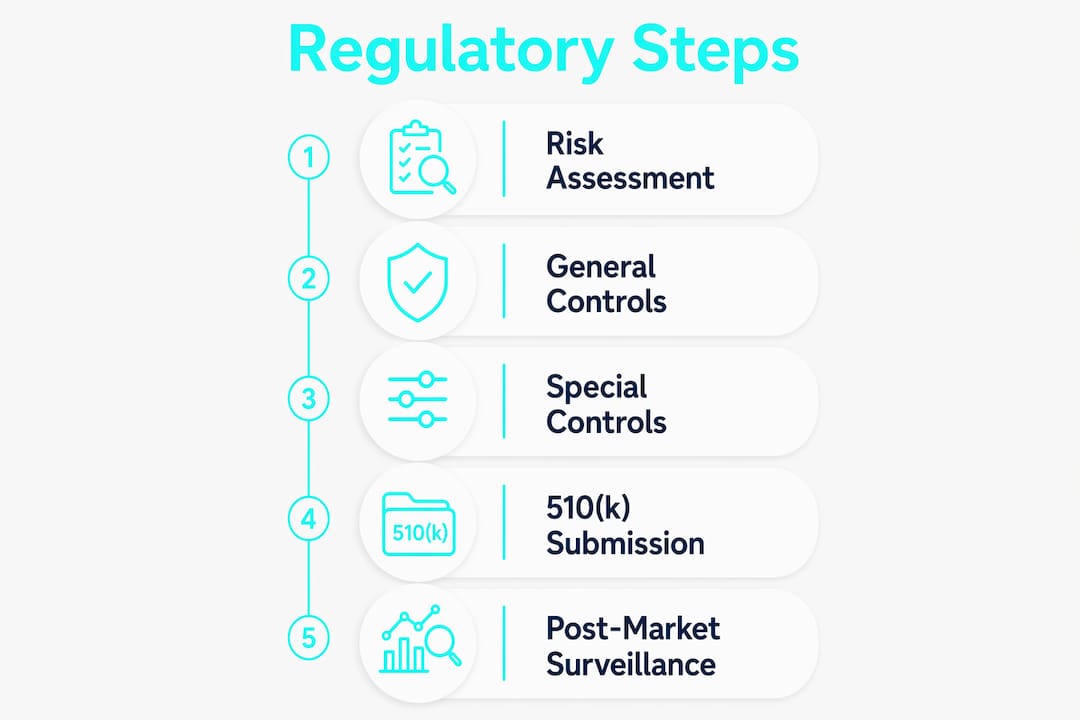
The FDA regulates Class II devices through a two-layer control structure. The first layer, general controls, applies to all device classes and covers registration, listing, labeling, and prohibited acts under the Federal Food, Drug, and Cosmetic Act. The second layer, special controls, is what distinguishes Class II from Class I.
Special controls are device-specific and can take several forms:
Performance standards that define minimum safety and effectiveness benchmarks
Post-market surveillance requirements mandating ongoing data collection after clearance
Specific labeling requirements that communicate risk information to users and patients
Guidance documents published by the FDA that outline acceptable testing methods
Patient registries that track real-world outcomes for specific device types
These controls are not consolidated in one place. Device-specific special controls may be scattered across CFR sections, FDA guidance documents, and De Novo decision summaries. Manufacturers who rely only on the CFR text frequently miss critical requirements, which leads to submission rejections.
The primary premarket pathway for Class II devices is the 510(k) premarket notification. Under this pathway, a manufacturer must demonstrate substantial equivalence to a legally marketed predicate device. Substantial equivalence does not mean identical. It means the new device is at least as safe and effective as the predicate, even if the technology differs. Some Class II device types are exempt from 510(k) requirements by FDA regulation, but those exemptions are device-specific and must be verified against the applicable CFR part in 21 CFR Parts 862–892.
Pro Tip: Always cross-reference the applicable CFR part, the FDA’s device-specific guidance document, and any relevant De Novo decision summary before finalizing your 510(k) submission. Relying on a single source is the most common cause of incomplete submissions.
What distinguishes Class II devices from Class I and Class III?
The line between Class I and Class II is whether general controls alone provide reasonable assurance of safety. When they do not, the device moves into Class II territory and requires special controls. When even special controls are insufficient, the device becomes Class III and requires PMA, which demands clinical trial data and a full safety and effectiveness review.
The table below summarizes the key distinctions across all three classes:
Feature | Class I | Class II | Class III |
Risk level | Low | Moderate | High |
Controls required | General controls only | General + special controls | General controls + PMA |
Primary pathway | Exempt or 510(k) | 510(k) or De Novo | Premarket Approval (PMA) |
Clinical data required | Rarely | Sometimes | Almost always |
Design controls (21 CFR Part 820) | Required | Required | Required |
Examples | Bandages, tongue depressors | Infusion pumps, pulse oximeters | Implantable pacemakers, cochlear implants |
Class II devices require design controls under 21 CFR Part 820, just as Class III devices do. This surprises many professionals who assume design controls are reserved for the highest-risk tier. The difference is that Class III devices face a far more demanding evidentiary standard before they reach the market.
Another distinction worth noting: Class II devices can carry significant clinical risk in practice. Surgical mesh, for example, has been the subject of extensive post-market safety actions by the FDA. The moderate-risk label reflects the regulatory framework applied before market entry, not the potential severity of adverse events once a device is in use.
What compliance steps do manufacturers and stakeholders need to take?
Compliance for Class II devices is not a one-time event. It begins before submission and continues through the entire product lifecycle. The following priorities define a sound compliance approach:
Identify all applicable special controls early. Do not assume the CFR section for your device code captures everything. Check FDA guidance documents, De Novo summaries, and any applicable performance standards.
Build the 510(k) submission around substantial equivalence. The FDA evaluates whether your device has the same intended use and the same or different technological characteristics as the predicate. If technological differences exist, you must show they do not raise new safety questions.
Recognize when De Novo is the right pathway. If no valid predicate exists, a 510(k) will fail. The De Novo pathway creates a new classification for novel low-to-moderate risk devices and can itself become a predicate for future 510(k)s.
Plan for post-market surveillance from day one. Post-market surveillance is increasingly required as a special control. Manufacturers who treat it as an afterthought face compliance gaps that regulators are actively scrutinizing.
Establish adverse event reporting systems before launch. FDA MedWatch reporting obligations begin the moment a device enters commerce. Internal systems for capturing, evaluating, and reporting adverse events must be operational at launch, not built reactively.
Track guidance document updates continuously. The FDA revises device-specific guidance regularly. A submission that was compliant two years ago may not meet current expectations if guidance has been updated.
Significant modifications to a cleared device, whether in design, materials, or intended use, can require a new 510(k) or even trigger reclassification. Manufacturers should establish a formal change control process that evaluates every modification against this threshold. This is one area where regulatory affairs specialists add direct value by preventing costly missteps.
Understanding regulated medical device retail requirements also matters for procurement teams and distributors, not just manufacturers. Distributors who handle Class II devices carry their own labeling and reporting obligations under FDA regulations.
Key Takeaways
Class II medical devices require both general and special controls because general controls alone cannot provide reasonable assurance of safety and effectiveness for moderate-risk devices.
Point | Details |
Class II definition | Moderate-risk devices requiring general controls plus device-specific special controls. |
Scale of the category | Approximately 43% of all FDA-regulated device types fall into Class II. |
Primary clearance pathway | The 510(k) premarket notification requires proof of substantial equivalence to a predicate device. |
Special controls are fragmented | Controls appear across CFR sections, guidance documents, and De Novo summaries, not in one place. |
Post-market obligations are ongoing | Adverse event reporting and surveillance requirements begin at product launch, not after a problem arises. |
Why the regulatory map matters more than the rulebook
Regulatory professionals often focus on the CFR as the authoritative source, and it is. But the CFR is the skeleton. The FDA’s guidance documents, De Novo decision summaries, and special control performance standards are the muscle and connective tissue that make compliance actually work.
I have seen submissions stall because a team built a technically sound 510(k) against the CFR text and missed a critical performance standard buried in a guidance document published three years after the CFR section was last updated. That gap is not a technicality. It is the difference between clearance and a major deficiency letter.
The other area where I see consistent underinvestment is post-market planning. Effective post-market surveillance integrated early improves patient safety over the device lifecycle and reduces the risk of enforcement action. Most teams treat it as a compliance checkbox. The teams that treat it as a data asset, feeding real-world performance back into design and risk management, consistently have smoother regulatory relationships.
AI/ML-enabled devices add another layer of complexity. The FDA’s evolving framework for software as a medical device means that a device cleared today under one set of special controls may face new expectations as the agency’s thinking matures. Regulatory professionals working in this space need to monitor FDA Digital Health Center of Excellence publications actively, not just at submission time.
The practical lesson: read the guidance, not just the regulation. Plan post-market systems before you launch. And treat substantial equivalence as a legal standard with real evidentiary weight, not a formality.
— QB
Queenssurgical supports clinical environments that depend on regulated devices
Healthcare facilities that manage Class II devices also depend on a reliable supply of clinical consumables that meet regulatory standards. Queenssurgical stocks a broad catalog of protective apparel and supplies designed for regulated clinical environments, from disposable laboratory uniforms built from anti-fluid SMS material to isolation gowns suited for settings where infection control is a priority.

Queenssurgical serves medical professionals, clinics, and hospitals across the Americas with wholesale and retail access to quality-focused medical supplies. Whether your facility manages infusion pumps, pulse oximeters, or other moderate-risk equipment, the right consumables support safe, compliant clinical practice. Browse the full catalog at Queenssurgical to find supplies that meet your facility’s standards.
FAQ
What are Class II medical devices?
Class II medical devices are moderate-risk devices regulated by the FDA under both general controls and device-specific special controls. They represent approximately 43% of all FDA-regulated device types and include products like infusion pumps, pulse oximeters, and pregnancy test kits.
What qualifies a device as Class II rather than Class I?
A device qualifies as Class II when general controls alone are not sufficient to provide reasonable assurance of safety and effectiveness. The FDA applies special controls, such as performance standards and post-market surveillance requirements, to address the additional risk.
What is the 510(k) pathway for Class II devices?
The 510(k) premarket notification requires a manufacturer to demonstrate substantial equivalence to a legally marketed predicate device. Substantial equivalence means the new device is as safe and effective as the predicate, even if the technology differs.
What is the difference between Class II and Class III medical devices?
Class II devices require general controls plus special controls and typically clear through the 510(k) pathway. Class III devices carry high risk, require Premarket Approval (PMA), and almost always demand clinical trial data before the FDA grants market authorization.
Are post-market obligations required for Class II devices?
Post-market surveillance is increasingly required as a special control for Class II devices, meaning regulatory obligations extend well beyond initial clearance. Manufacturers must establish adverse event reporting systems and, where required, participate in patient registries from the point of product launch.
Recommended
Comments