Facility Managers' Infection Control Supplies List: Par Levels and Storage

Every infection control supplies list needs six core categories: hand hygiene products, personal protective equipment, surface disinfectants, sterilization and reprocessing consumables, sharps and biohazard waste containers, and isolation supplies for point-of-care use. The CDC, WHO, and OSHA all publish standards behind these categories, and Medical supply distributors stock products across every one of them for facilities that need to restock fast.
TL;DR:
Ensuring accurate par levels involves weekly routine counts and monthly specialty item audits, with redistribution based on actual usage patterns.
Proper PPE stock includes all sizes, full compliance with fit-testing protocols, and training on correct donning and doffing sequences to prevent contamination.
Surface disinfectants must be chosen based on target pathogens, with attention to contact times and compatibility to ensure effective cleaning and prevent contamination.
Waste containers must be appropriately sized and strategically placed to avoid overfilling, with clear separation of sharps, biohazard, and pharmaceutical waste streams.
Building a diversified, tiered stock reserve and updating contingency plans annually minimizes shortages during supply chain disruptions or surges.
Table of Contents
How This Infection Control Supplies List Is Organized
Not every item on a facility’s supply roster carries the same weight. Core items keep the doors open safely, day one, no exceptions: alcohol-based hand rub, gloves, surgical masks, surface disinfectant, sharps containers. Supplemental items depend on your setting and patient population, things like N95 respirators for airborne isolation rooms, or enzymatic detergents if you run your own reprocessing.
A dialysis center and a same-day surgical center draw from the same base list but scale it differently. The surgical center needs sterile gowns and instrument trays in volume; the dialysis center leans harder on hand hygiene stations and bloodborne pathogen precautions. A primary care clinic sits somewhere in between, usually needing less PPE variety but tighter hand hygiene and disinfectant rotation given daily patient throughput.
Quantity estimation does not need to be complicated. Start with three numbers: average daily patient encounters, average items consumed per encounter, and your desired days of buffer stock (most facilities run 14 to 30 days for routine items, longer for anything with a supply-chain history of shortages).
Multiply daily usage by your buffer window to set your par level, the minimum quantity that triggers a reorder.
Recount routine items weekly and specialty items (like sterilization indicators) monthly.
Log stock in a shared spreadsheet or inventory system, not sticky notes on a supply closet door, since turnover in staff means institutional memory disappears fast.
Flag any item that dropped below par multiple times in a quarter. That’s usually a sign your par level is wrong, not that your staff is over-consuming.
Cyclical counts, checking a rotating subset of items weekly rather than the entire inventory once a month, catch shortages before they become emergencies. A clinic supply inventory approach that separates routine par levels from surge reserve stock gives you a buffer that survives both a slow Tuesday and a flu surge.
Hand Hygiene Supplies: What to Stock and Where
Hand hygiene sits at the top of every infection prevention program because it is the highest-frequency, lowest-cost intervention you have. Get the placement wrong, though, and even a fully stocked supply closet won’t help compliance rates.
Alcohol-based hand rub (ABHR) should be available at every point of care, not just at sinks. Wall-mounted dispensers work for hallways and patient room entries; pump bottles work at workstations and mobile carts. A general rule for par levels: about one 1,000 mL refill per dispenser per moderate-traffic week, with higher amounts for ICU or ED settings.
Antimicrobial or plain soap with bulk dispensers belongs at every sink used for clinical handwashing. Bar soap has no place in a clinical setting; it’s a contamination risk, full stop.
Stock single-use paper towels, never cloth, at every hand hygiene station, with a lined waste bin within arm’s reach.
Order signage that reinforces the WHO “five moments” or your facility’s chosen hand hygiene protocol, and refresh it annually so it doesn’t become wallpaper.
Keep a rotating stock of foam versus gel ABHR formats. Foam dispenses less product per pump and can lower monthly usage costs without hurting compliance.
The CDC’s Quick Observation Tools give facilities a structured way to audit hand hygiene provision, not just staff behavior, checking whether dispensers are full, accessible, and actually located where hands get dirty.
Pro Tip: Walk your own facility as if you were a patient on a gurney. If you can’t reach a hand rub dispenser without a staff member unlocking a door or fetching a bottle, neither can your staff during a busy shift.
PPE Selection: Gloves, Masks, Respirators, Gowns, and Eye Protection
Gloves come in two functional categories: examination gloves for routine patient contact and sterile surgical gloves for invasive procedures. Stock both in a full size run (small through extra-large), since an ill-fitting glove tears more easily and gets abandoned mid-task.
Masks and respirators are not interchangeable, and mixing them up is one of the more common compliance gaps facility managers run into. Surgical masks protect against droplet exposure and splashes. NIOSH-approved N95 respirators are required when airborne precautions apply, including tuberculosis, certain aerosol-generating procedures, and specific outbreak scenarios defined by your facility’s infection control policy.
OSHA’s respiratory protection standard, 29 CFR 1910.134, requires a full program wherever respirators are used: medical evaluation, annual fit testing, and documented training. A box of N95s sitting in a supply closet without a fit-testing program behind it does not satisfy the standard, and it leaves your facility exposed if OSHA ever audits your records.
Gowns come in several ANSI/AAMI protection levels, ranging from minimal fluid resistance to fully sealed, high-barrier protection for surgical and high-risk fluid exposure. Match the level to the task, not the other way around. Eye and face protection ranges from basic safety glasses to full face shields; goggles are non-negotiable for procedures with splash risk.
Stock gloves in every size your staff actually wears; a shortage of one size forces improper sizing on the next size up or down.
Keep a documented PPE inspection schedule, checking gown seams and glove box integrity monthly.
Set a replacement policy for reusable eye protection, cleaned and inspected after every use, retired at the first sign of scratching that impairs visibility.
Maintain fit-test records for every N95 user, renewed annually or when facial structure changes.
Per CDC and NIOSH guidance, PPE sits at the bottom of the hierarchy of controls. It’s the last line of defense, not the first, which means engineering controls (negative-pressure rooms, physical barriers) and administrative controls (scheduling, cohorting) should be doing real work before PPE ever gets deployed.
Choosing Surface Disinfectants and Cleaning Supplies
The right disinfectant depends on what you’re up against, not just what’s cheapest per case. A general-purpose quaternary ammonium wipe handles routine surface cleaning in exam rooms. A facility managing C. difficile cases needs a sporicidal, EPA List N compatible disinfectant with a documented contact time, often longer than staff expect, which is why so many surfaces get “cleaned” but not actually disinfected.
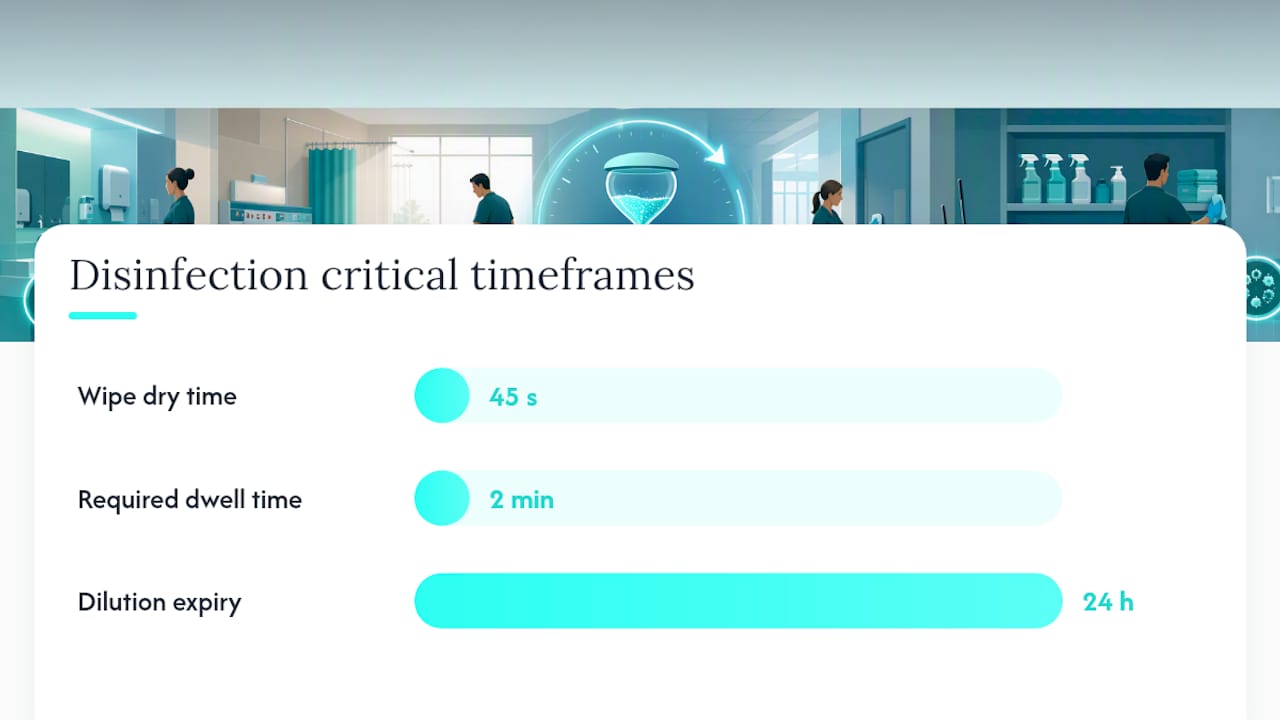
Contact time is the detail almost everyone skips. A wipe that dries in 45 seconds but requires a two-minute dwell time for full efficacy hasn’t done its job unless the surface stays visibly wet the entire time. Wipes work well for high-touch surfaces (bed rails, doorknobs) where speed matters. Sprays and concentrates make more sense for larger surfaces or terminal room cleaning, where dilution ratios and mop-bucket rotation matter more than single-swipe convenience.
Choose ready-to-use wipes for exam tables and equipment between patients; the labor savings usually outweigh the higher per-unit cost.
Stock concentrates for environmental services teams doing full-room turnover, where diluted solution stretches further.
Keep microfiber cloths and color-coded mop heads separated by zone (patient rooms versus restrooms versus offices) to avoid cross-contamination.
Confirm surface compatibility before bulk-ordering; some disinfectants degrade certain plastics or electronic equipment housings over repeated use.
Label every diluted solution with mix date and expiration, since most concentrates lose efficacy within 24 hours of dilution. Store disinfectants away from direct sunlight and extreme temperature swings, which shortens shelf life and can alter chemical stability.
Sterilization and Reprocessing Consumables
Instrument reprocessing runs on a chain of consumables that most patients never think about but that determine whether a “sterile” instrument actually is. Enzymatic detergents break down organic material before instruments ever reach an autoclave; skip this step and even a correctly run sterilization cycle can fail to achieve full decontamination. Stock brushes sized for lumens and channels, along with leak-test kits for any flexible endoscope your facility processes.
Autoclave consumables include chemical indicator strips, sterilization pouches, and wrap material rated for your specific sterilizer cycle (steam, ethylene oxide, or hydrogen peroxide plasma). Indicator tape confirms a load reached temperature; biological indicators confirm it actually achieved sterility, and facilities that skip biological indicator testing on a regular schedule are flying blind on their most critical safety control.
Stock single-use endoscope valves and channel-cleaning consumables sized to your specific scope models.
Keep sterilization logs, either paper or digital, tracking load number, cycle parameters, and indicator results for every run.
Maintain drying racks and covered storage for reprocessed instruments awaiting use, since exposed sterile packaging degrades sterility over time.
Order transport containers rated for contaminated instruments moving from point of use to the reprocessing area.
Documentation consumables, labels, log sheets, load record cards, matter as much as the chemical ones. An audit that finds a sterilization gap without a corresponding record is far worse than one that finds the gap and shows it was caught and corrected.
Sharps and Contaminated Waste Management Supplies
Sharps containers need to be sized for the actual volume your unit generates, and overfilled containers are one of the most common needlestick risk factors facility auditors flag. A container filled past the three-quarter mark should be swapped immediately, not “topped off” until end of shift.
Placement matters as much as size. Containers belong within arm’s reach of every point where a sharp is used, never requiring staff to carry an exposed needle across a room to dispose of it. Wall-mounted units near bedsides work for inpatient units; portable stands work for mobile phlebotomy carts.
Biohazard bags follow a color-coding convention, typically red, marked with the universal biohazard symbol, and rated for the weight and puncture resistance your waste stream requires. A biohazard waste bag rated for general clinical waste is not the same product you want for pathology or lab waste with higher fluid volume.
Stock spill kits at every nursing station and lab bench, including absorbent granules, scoops, and disposal bags.
Keep secondary containment liners in transport carts to prevent leaks during interfacility waste movement.
Assign a specific storage area for full biohazard containers awaiting pickup, temperature-controlled if local regulations require it.
Coordinate disposal timing with your regulated medical waste hauler; a good partner in medical waste disposal can help you set a realistic pickup cadence based on your generation volume.
Pro Tip: If your sharps containers are filling faster than your pickup schedule allows, that’s not a disposal problem, it’s a placement problem. Add a second container closer to the point of use before you assume you need more frequent hauling.
OSHA’s bloodborne pathogen standard ties directly into how these items get handled; keeping containers accessible and appropriately sized is part of demonstrating a compliant program, not just good housekeeping.
Isolation Supplies for Point-of-Care Protection
Contact, droplet, and airborne precautions each carry a slightly different supply footprint, but a few items show up across all three: dedicated patient-use linens that don’t leave the room until properly bagged, transport masks and gowns for moving patients between departments, and clear door or window signage identifying the precaution type in effect.
Stock disposable patient transport gowns separately from staff-use gowns to avoid mix-ups during a busy shift.
Keep antechamber supplies, extra PPE, a dedicated waste bin, stocked outside airborne isolation rooms so staff never have to leave to gear up.
Maintain signage kits that specify precaution type at a glance, since generic “isolation” signs without detail slow down staff response.
Airborne precautions deserve a separate note: supply stocking alone doesn’t solve the risk if the room lacks proper negative-pressure ventilation. Engineering controls come first here, PPE fills the gap engineering can’t close.
Inventory, Storage, and Procurement Best Practices
Running out of gloves mid-shift is rarely a purchasing failure. It’s usually a par-level failure that nobody caught until the shelf was empty. A two-tier stocking system fixes this by design.
Set an operational tier, the stock kept at point-of-care supply closets, sized for roughly one to two weeks of routine use.
Set a backstock tier, held in a central storage area, sized to cover lead time from your supplier plus a buffer for demand spikes.
Rotate stock using first-in-first-out (FIFO), placing new deliveries behind existing stock rather than in front of it.
Store temperature-sensitive items (certain reagents, some sterilization chemicals) according to manufacturer specifications; a storeroom that swings between 55 and 85 degrees will shorten shelf life on more products than most managers realize.
Run cyclical counts weekly on high-turnover items and monthly on lower-turnover specialty stock.
Build supplier lead-time buffers into your reorder trigger point, not just your par level; a 10-day lead time means your reorder point needs to sit 10 days of usage above zero, not at zero.
Facilities managing multiple sites benefit from a standardized inventory management approach and appropriate storage conditions across locations, since a template built once and reused everywhere beats reinventing par levels at every site. Smaller clinics and urgent care centers can lean on a two-tier printable supply list built specifically to prevent the kind of mid-surge stockouts that hit under-resourced sites hardest.
Where Queens Surgical Fits Into Your Supply Chain
Some medical supply providers map directly onto the categories in this checklist: surgical and procedure masks, isolation gowns, biohazard bags, and sharps-adjacent PPE are often categorized clearly, rather than buried in a generic “medical supplies” bucket. That structure matters when you’re trying to move fast during a reorder cycle rather than hunting through mismatched SKUs.
For facilities standardizing their own internal documentation, pairing a supplier relationship with a written PPE donning and doffing guide closes the gap between having the right supplies and using them correctly. A stocked supply closet with untrained staff is only half a solution. The other half is procedure, documented, practiced, and refreshed on a schedule.
Donning and Doffing: Sequence and Training
The sequence for putting on PPE follows a specific order for a reason: gown first, then mask or respirator, then goggles or face shield, then gloves last, so that the last thing touching a contaminated surface is also the first thing removed. Doffing reverses the risk logic entirely. Gloves come off first since they carry the highest contamination load, followed by goggles, gown, and mask last, with hand hygiene performed between each step, not just at the end.
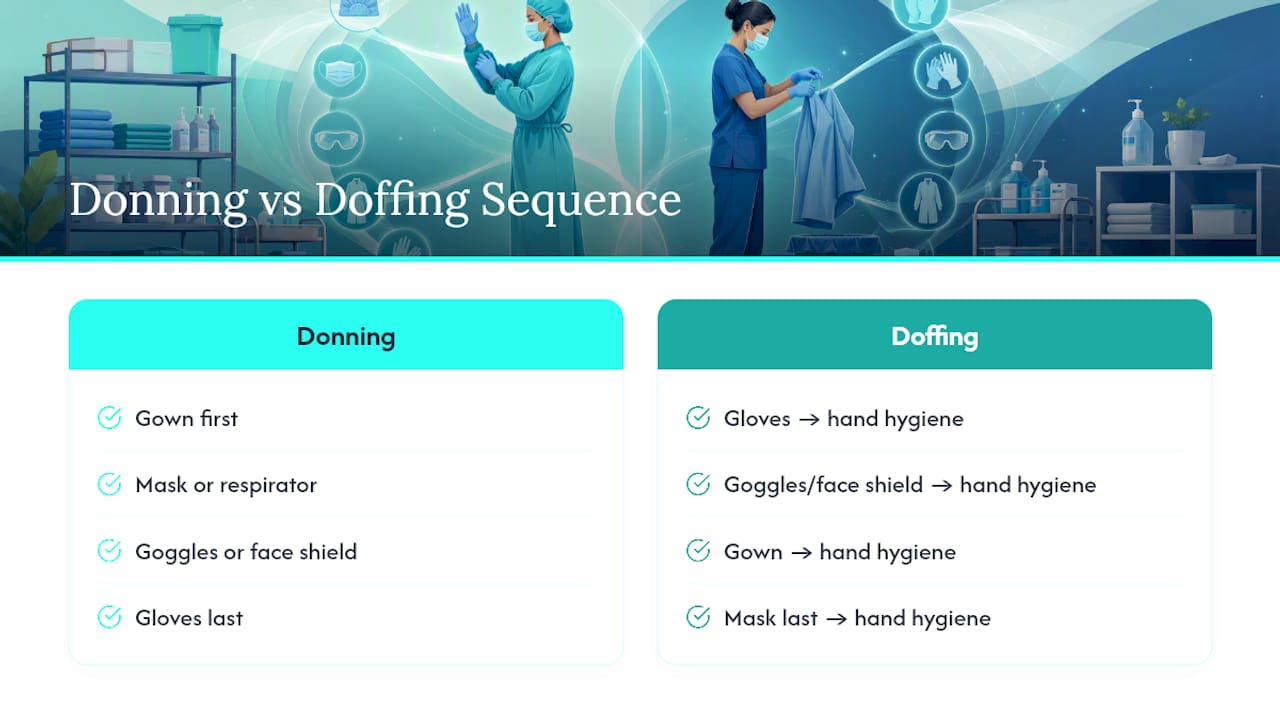
Skipping the mid-sequence hand hygiene is the most common shortcut staff take under time pressure, and it’s also the step most likely to cause self-contamination. A staff member who removes gloves correctly but then touches their gown ties with bare, unwashed hands has effectively undone the entire sequence.
Training references should include a printed sequence posted at every donning station, not just a one-time in-service session. Muscle memory built during a slow week can break down fast during a surge, when staff are moving quickly and skipping steps feels efficient. Facilities that run periodic doffing observation, watching staff remove PPE and correcting in real time, catch far more errors than facilities relying on annual competency checks alone.
New hires should practice the full sequence under supervision before their first unsupervised patient contact involving isolation precautions. A written guide helps, but a demonstrated, corrected practice run catches habits a document can’t.
Checklists and Quick Observation Tools for Ongoing Audits
The CDC’s Quick Observation Tools give facilities standardized, settings-specific checklists covering hand hygiene provision, PPE availability, environmental cleaning, and device-associated infection risks. These tools work because they’re built for quick, repeatable observation, not lengthy audits that only happen once a year.
Facility-specific checklists should supplement, not replace, these standardized tools. A QUOT tells you whether hand rub dispensers are stocked facility-wide; a facility-specific checklist tells you whether your particular high-traffic hallway dispenser gets refilled on the schedule your janitorial contract actually specifies.
Run observation checks on a rotating basis, different units each week, rather than announcing a full facility audit once a quarter. Staff behavior during an announced audit rarely matches behavior during a routine Tuesday shift, and the gap between the two is exactly what these tools are designed to surface.
Keep results documented and trended over time. A single low score on hand hygiene observation means little in isolation. Three consecutive months of declining scores on the same unit means something is breaking down, whether that’s staffing, training, or dispenser placement, and it’s worth investigating before it shows up in an infection rate.
Compliance Standards Behind Your Supply List
OSHA’s PPE standard requires employers to conduct a hazard assessment, select PPE that matches identified risks, and provide it at no cost to employees when the standard requires it. That last part surprises some smaller facilities: PPE cost cannot be passed to staff when OSHA mandates its use.
Respiratory protection carries its own layer of compliance under 29 CFR 1910.134: medical evaluation before fit testing, annual fit-test renewal, and a written respiratory protection program document that names responsible parties and outlines procedures. Facilities without this documentation on file are exposed during an OSHA inspection even if their actual PPE stock is adequate.
ANSI and ASTM standards govern specific product categories, eye and face protection under ANSI Z87.1, and gown protection levels under ANSI/AAMI PB70. Buying PPE that doesn’t carry the appropriate standard rating isn’t a cost-saving move, it’s a compliance gap waiting to surface during an audit or, worse, during an actual exposure incident.
State and local health department requirements sometimes layer on top of federal standards, particularly around medical waste handling and disposal documentation. A facility manager’s compliance checklist should track federal, state, and any accrediting body (Joint Commission, for example) requirements separately, since they don’t always align on timing or documentation format.
Matching Supplies to Setting and Risk Level
A primary care clinic and an intensive care unit are not shopping from the same list, even though both fall under “healthcare facility.” Risk level, not facility size, should drive your specific procurement decisions.
Low-risk outpatient settings (routine primary care, most specialty clinics) need reliable hand hygiene and standard PPE, examination gloves, surgical masks, but rarely need respirator programs unless they handle suspected airborne illness on a walk-in basis. Moderate-risk settings, urgent care, dialysis, wound care, need the same base plus more frequent surface disinfection and often gown protection for fluid exposure. High-risk settings, ICUs, EDs, surgical suites, need the full stack: respirator programs, sterile reprocessing consumables, and isolation supply stock sized for sustained precaution periods rather than occasional use.
The mistake facility managers make most often is copying a high-risk facility’s supply list onto a low-risk setting, which wastes budget on unused respirator stock, or copying a low-risk list onto a moderate-risk setting, which leaves gaps that surface exactly when patient volume spikes. Build your list from your own patient population and procedure mix, using standardized references like the essential IPC supply list as a baseline, then adjust categories up or down based on documented risk, not assumption.
Disposal Procedures by Waste Type
Not all infection control waste leaves your facility the same way, and mixing waste streams is one of the more expensive compliance mistakes a facility can make. Sharps waste goes into puncture-resistant containers and follows regulated medical waste channels exclusively; it never goes into general trash regardless of how “empty” a used syringe looks.
Biohazard waste, anything saturated with blood or bodily fluids, gets bagged in color-coded biohazard bags and stored in a designated area pending pickup by a licensed medical waste hauler. General facility trash, packaging, non-contaminated paper goods, follows standard municipal waste procedures and should never get mixed with regulated waste, since doing so can reclassify an entire load as regulated and dramatically increase disposal cost.
Chemotherapy and pharmaceutical waste, if your facility handles either, follows separate EPA-regulated disposal channels distinct from standard biohazard waste. Facilities that generate this waste stream need a specific contract and container type for it, not a general medical waste agreement.
Documentation matters here as much as the physical handling. Keep pickup manifests and disposal records on file, since regulators and accrediting bodies will ask for them during inspection, and a missing manifest is treated the same as improper disposal in most audits.
Building an Emergency Supply Contingency Plan
Every facility learned something about supply chain fragility over the past several years, and the lesson that stuck for the smartest procurement teams was this: a 14 day buffer that works fine in a normal month evaporates in a real surge. Contingency planning means building a separate reserve tier, sized for your facility’s realistic worst-case duration, not your average month.
Identify your highest-risk single points of failure first. If your facility relies on one supplier for N95 respirators, that’s a bigger risk than a facility splitting orders across two vendors, even if the single-supplier arrangement is cheaper on paper. Diversifying at least your highest-consumption items across more than one supplier relationship reduces the odds that one shortage takes down your whole program.
Build a tiered response plan tied to specific trigger points: a defined stock level that triggers a rush order, a lower level that triggers extended-use or reuse protocols for specific PPE items (following current CDC guidance for the specific scenario), and a lowest level that triggers activation of a formal shortage response plan. Having these triggers defined in advance, rather than decided in the moment, keeps a real shortage from becoming a chaotic one.
Review and update your contingency plan at least annually, and immediately after any real shortage event your facility experiences, since the gap between your plan and what actually happened is exactly the information you need for the next revision.
Training Resources for Proper Supply Use and Handling
Supplies sitting on a shelf don’t prevent infections; correctly trained staff using them do. Every item on this list needs a corresponding training reference, not just a purchase order.
New-hire orientation should include hands-on practice with your facility’s specific PPE, donning and doffing sequence, hand hygiene technique, and sharps handling, rather than relying on a video alone. Annual competency checks should test the same skills under observation, since skills drift over a year of habitual shortcuts even among experienced staff.
Manufacturer instructions for use (IFUs) should stay accessible at the point of use for any specialty item, sterilization chemicals, specific disinfectant dilution ratios, since IFUs sometimes change between product lots and staff working from memory can apply an outdated protocol without realizing it. Keep a binder or digital reference library organized by product category so staff can check an IFU in seconds, not minutes.
Peer-to-peer coaching during routine shifts catches more real-world errors than formal training sessions ever will, since it happens in context, with actual patients and actual time pressure, rather than in a classroom simulation. Facilities that build a light coaching culture around PPE use, rather than relying purely on annual mandatory training, tend to see fewer near-miss exposure reports over time.
What Actually Fixes Recurring Shortages
Rotate your stock so the oldest supply always ships first, and train new staff on this alongside their PPE training, not as a separate afterthought. Those two habits, followed consistently, prevent more shortages than any single big purchase ever will.
A recurring glove shortage on a busy unit almost always traces back to a par level set once, years earlier, that never got revisited as patient volume grew. Adjusting that single number, not adding new suppliers or ordering more frequently, is usually what actually fixes it.
— QB
Order Your Infection Control Supplies From Queens Surgical
Some suppliers stock the core categories covered in this checklist, masks, isolation gowns, and the PPE items facilities reorder most often, often offering bulk and wholesale pricing built for clinics, hospitals, and multi-site purchasing teams rather than one-off retail orders.
Instead of piecing together orders across multiple vendors during a busy reorder week, you can source your surgical masks and isolation gowns from one catalog built specifically for procurement teams who need predictable stock, not a consumer storefront designed around single units. Browse the full product catalog to check current availability for your facility’s par-level items, or request a quote directly for bulk orders sized to your reorder cycle.
This article is general information, not a substitute for advice from a qualified doctor. Consult a qualified healthcare professional about your own circumstances before acting on anything here.
Sources
Recommended
Comments