Stop Stockouts with a Two Tier Printable Urgent Care Supply List

Start with the core emergency formulary and room-level consumables, then build out from there. Download or copy the checklist below, walk it against your shelves this week, and set a recurring date for monthly expiry checks. Annual formulary review keeps the whole system honest.
TL;DR:
Proper inventory management requires setting fixed monthly audit dates and immediate restocking after use to prevent stockouts.
Stock levels should be based on actual usage data, with safety stocks distinct for fast-moving consumables versus slow-moving items.
The emergency kit must include pediatric supplies and be kept unlocked and accessible in the exam rooms for rapid response.
An annual review of core and expanded formulary lists ensures the inventory stays aligned with the clinic’s scope and practice changes.
Standardized SKUs and bulk purchasing help reduce ordering errors and minimize the time staff spend managing supplies.
Table of Contents
What’s in the downloadable urgent care supply list
The checklist comes as a printable PDF for wall clipboards and a CSV you can drop into most inventory platforms without reformatting. Either version maps cleanly onto a two-tier formulary: a core list every exam room and emergency kit must carry, and an expanded list you customize to your clinic’s actual scope of practice (orthopedic splinting, occupational health panels, IV hydration, whatever you run).
Before you file it away, do three things:
Assign a physical location to every emergency kit and write that location on the checklist itself.
Set a fixed monthly audit date (same day each month works better than “whenever there’s time”).
Flag reorder points next to each SKU so restocking doesn’t wait for someone to notice an empty shelf.
Import into your inventory app once the reorder points are set, not before. That order avoids re-tagging everything a second time.
Core supply categories every clinic needs
Five categories cover most of what moves through an urgent care on a given day. Getting the ratios right matters more than the raw item count.
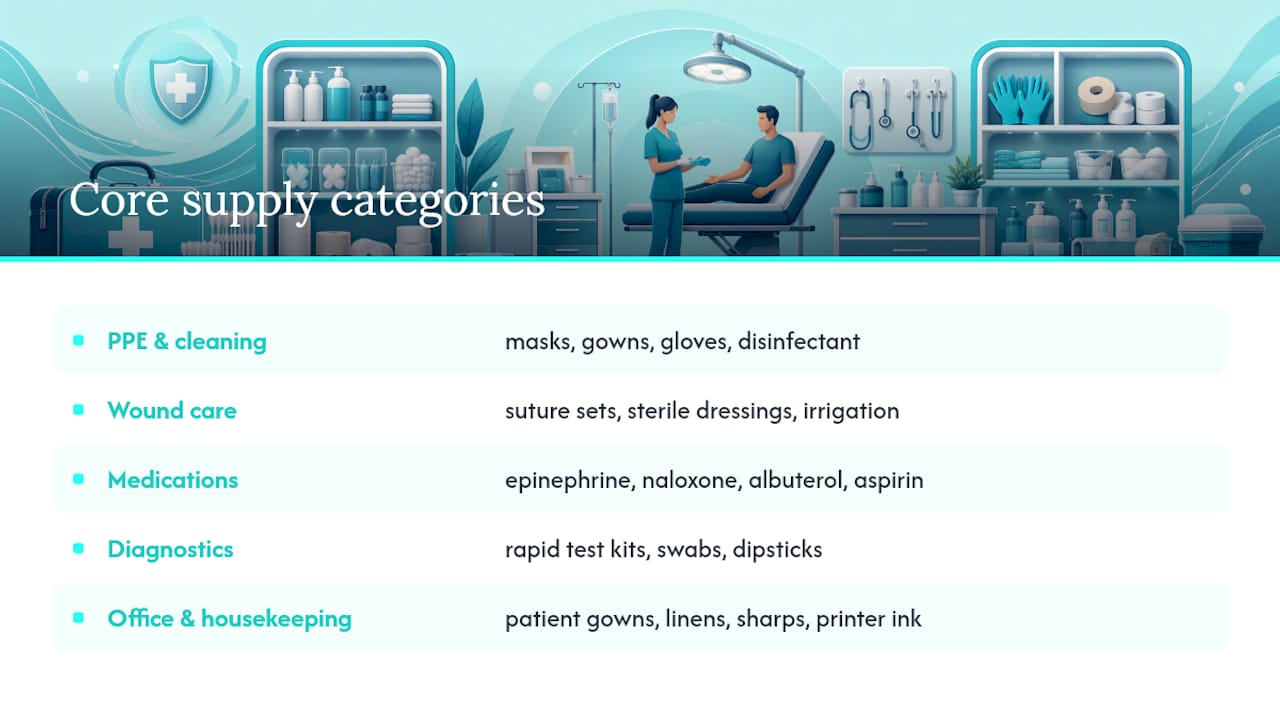
PPE and cleaning supplies carry the daily volume: surgical masks, isolation gowns, exam gloves in multiple sizes, eye protection, surface disinfectant, and sanitizer stations at every entry and exam room. This is also where infection control policy lives, and a clinical guide to isolation precautions is worth reviewing if your PPE tiers aren’t already matched to exposure risk.
Wound care needs suture sets in a range of gauges, sterile dressings, irrigation solution, and topical antibiotic ointment on hand for routine closures.
Medications split into two buckets. Core items include epinephrine (both IM and IV forms), naloxone, albuterol for inhalation therapy, oral glucose, aspirin, and a basic antiemetic. Everything past that, think antibiotics for specific conditions or specialty pain management, depends on your clinic’s scope-based formulary.
Diagnostic consumables include rapid test kits, swabs, and dipsticks, each requiring lot-number tracking.
Office and housekeeping rounds it out: patient gowns, linens, sharps containers, and yes, printer ink, because a supply list that stops at clinical items misses the stuff that actually stalls a shift when it runs out.
The emergency kit and core formulary: what has to be there
The Urgent Care Association’s guidance splits stocking into two tiers: a core emergency formulary required at every site regardless of specialty, and an expanded formulary built around each clinic’s actual scope of practice. The association recommends reviewing both annually, not just when an accreditation visit is coming up.
Minimum positive quantities are important: a kit with only one IV catheter and no backup is insufficient for urgent care needs.
Category | Items | Recommended minimum |
Airway | Oral/nasal airways, bag-valve mask | at least one set available per size range |
Circulation/IV | IV catheters (assorted gauge), normal saline, tourniquet | multiple catheters per gauge, saline bags |
Anaphylaxis | Epinephrine (IM auto-injector and vial) | sufficient doses stocked |
Overdose reversal | Naloxone | adequate number of doses stocked |
Hypoglycemia | Oral glucose, glucagon | sufficient supplies held |
Cardiac | AED with pads, spare battery | at least one AED with pads regularly checked |
Pediatric readiness deserves its own line item. Keep a Broselow tape or equivalent weight-based dosing tool in the kit, and stock a pediatric-sized airway and BP cuff separately from adult sizes. The CDC’s guidance for patients with special healthcare needs also recommends keeping a two-week medication supply on hand where feasible, a good reminder that emergency readiness isn’t only about the acute event.
Kits stay unlocked and positioned where staff can reach them in seconds, not in a locked supply closet down the hall. Check contents monthly and immediately after any use, restocking before the kit goes back on the wall.
Wound repair and IV-start supplies, item by item
Laceration repair and IV starts are two of the biggest differentiators between an urgent care and a general primary care office, according to startup supply guidance for the specialty. Stock these in enough depth that a busy Saturday doesn’t leave you scrambling:
Suture sets across a range of gauges (4-0 through 6-0 covers most facial and extremity work), plus tissue adhesive for low-tension closures where sutures aren’t necessary.
Local anesthetic options, typically lidocaine with and without epinephrine, stocked in single-dose vials to reduce contamination risk.
Irrigation supplies: sterile saline, splash shields, and irrigation syringes sized for wound depth.
IV start kits with catheters spanning 18 to 24 gauge, extension tubing, transparent securement dressing, and a sharps container within arm’s reach of every start.
Post-closure dressings matched to wound type, non-adherent for simple lacerations, more absorbent options for higher-drainage wounds.
Prepacked single-use procedural kits cut setup time during high-volume shifts. Reusable instrument sets cost less per use but require sterilization turnaround, so stock ratios should reflect your actual patient volume, not just what looks tidier on a shelf. A clinical guide to wound care supply selection breaks down which suture and dressing combinations fit which wound types.
Diagnostics and monitoring: what to stock, what to outsource
Every exam room needs a pulse oximeter, BP cuff, and thermometer at minimum, per general clinical preparedness guidance. CLIA-waived point-of-care tests (strep, flu, urinalysis, glucose) round out the diagnostic layer, but they come with an administrative catch: lot numbers and control solutions need tracking every time you rotate stock, or you risk running invalid tests without knowing it.
A 12-lead ECG belongs in at least one dedicated room, with an AED mounted somewhere central and checked on the same monthly cycle as your emergency kits.
On-site x-ray is the harder call. It differentiates urgent care from a standard primary care visit, but the decision hinges on patient volume, staffing licensure, and teleradiology access rather than a blanket recommendation. Lower-volume clinics often do better partnering with an imaging service than carrying the capital cost of an underused machine.
Keeping the list accurate: audits, reorder points, and storage rules
A checklist only works if someone actually checks it. Monthly documented audits, covering expiry dates and kit completeness, catch the gaps that get missed in daily rushes. Restock immediately after any kit use rather than waiting for the next scheduled check.
Build reorder points around real usage data, not guesswork:
Separate fast-moving consumables (gloves, masks, syringes) from slower-moving specialty items, and set different safety stock levels for each.
Rotate stock using first-expired-first-out (FEFO) rather than first-in-first-out, since shipment dates and expiry dates rarely line up.
Keep temperature-sensitive medications in monitored storage, and follow documented handling procedures for any controlled substances.
Label shelves and bins clearly enough that a substitute or new hire can restock correctly without asking.
Pro Tip: Run your monthly audit and your reorder review on the same day. Splitting them across the month means you catch expired stock without a matching plan to replace it, which just delays the problem by another cycle.
For a deeper process template, the expiration management playbook walks through documentation formats that hold up during accreditation review, and the clinic inventory management guide covers software integration if you’re moving off spreadsheets.
Why most supply lists fail before the first stockout
Most urgent care supply problems trace back to one habit: treating the checklist as a one-time setup task instead of a living document. Clinics build a beautiful list in their opening month, then let it fossilize while patient volume, staff turnover, and scope of practice all shift underneath it.
The two-tier formulary model solves a problem administrators often don’t see coming. A single master list, treated as one-size-fits-all, tends to either overstock low-volume clinics with items they rarely touch or under-stock high-acuity sites on the items that actually matter during a bad Tuesday. Splitting core from expanded forces a real conversation about scope, which is a conversation worth having annually, not just at accreditation time.
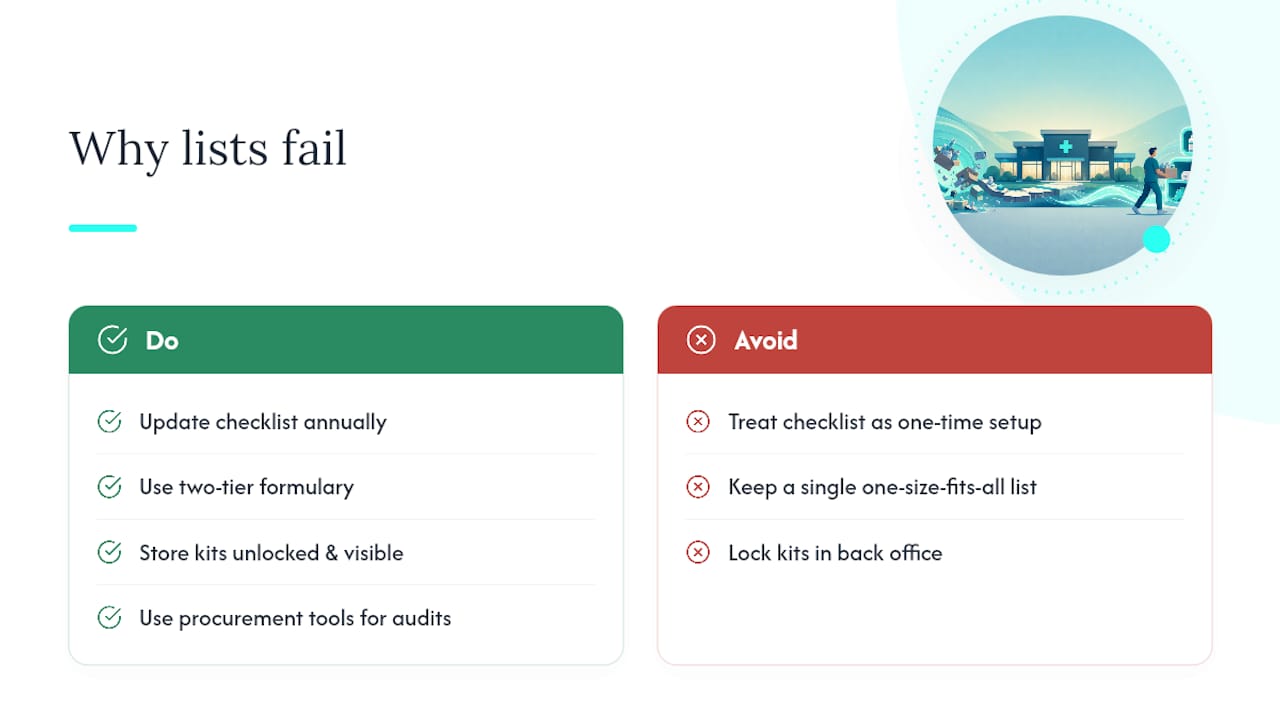
Placement matters more than most training programs suggest. A kit that’s technically “available” but locked in a back office might as well not exist during the ninety seconds that matter in an anaphylaxis case. Unlocked, visible, and near the workstation beats organized-but-inaccessible every time.
Procurement tools for stocking PPE, procedure kits, and fast-moving consumables play a key role in maintaining supplies for monthly audits.
— QB
Where Queenssurgical fits into your restocking plan
Queenssurgical exists for exactly the moment this checklist points to: the reorder click after the audit, not the theory before it. As a wholesale and retail supplier serving individual practitioners and larger purchasing organizations across the Americas, the catalog covers the categories this list just walked through, from isolation gowns and surgical masks with face shields to disposable medical face masks sized for both staff and younger patients.
Standardizing SKUs across sites, an approach detailed in this breakdown of fast-moving supply inventory, cuts the time staff spend guessing which brand or size to reorder. Even something as small as a BP cuff barrier sleeve fits into that same standardization logic: one consistent product, ordered in bulk, instead of three different vendors for the same line item.
If your monthly audit just turned up gaps, browse the full Queenssurgical catalog and place the reorder before next month’s check finds the same holes.
Sources
Recommended
Comments