Medical Supply Expiration Management: A Practical Playbook

The single control that keeps expired supplies out of patient care is this: capture lot number and expiration date at the moment a shipment arrives, enforce first expired, first out (FEFO) picking, and back it up with automated alerts and a working quarantine process for anything expired or short-dated. Everything else in medical supply expiration management, from cycle counts to recall response, builds on that one habit.
The Joint Commission expects documented tracking of sterile supplies, and FDA traceability expectations assume you can trace a lot forward and backward through your facility. Queenssurgical works with clinics and hospital systems every day that are rebuilding this exact process, and the fix rarely requires new headcount.
If you do nothing else this week, do this: pull a near-term expiry report from your inventory system right now, or if you don’t have one, walk your storage room and pull anything expiring soon.
Designate and label a physical quarantine shelf or bin today.
Assign one person to own the 90-day report going forward.
Flag any item without a recorded lot or expiry date for immediate review.
Key Takeaways
Consistent enforcement of one control, scanning lot and expiration data at receiving paired with FEFO picking, prevents more expired-supply incidents than any software purchase alone.
Point | Details |
Capture data at receiving | Scan or log lot and expiration date before any item reaches the shelf. |
Enforce FEFO, not FIFO | Arrange storage so the shortest-dated stock is always picked first. |
Set tiered alerts | Configure 180/90/60/30-day thresholds with a specific action at each stage. |
Quarantine immediately | Give expired or short-dated items a physical and digital hold the same day. |
Audit on a rolling cadence | Run weekly cycle counts, monthly short-life audits, and one annual reconciliation. |
Table of Contents
What Is Medical Supply Expiration Management?
Medical supply expiration management is the set of policies and workflows a facility uses to track expiration dates from receiving through disposal, so no expired item reaches a patient and every lot stays traceable. It’s the connective tissue between purchasing, storage, clinical use, and compliance.
The Joint Commission’s Quick Safety guidance treats expired sterile supplies as a patient safety failure, not a paperwork lapse, and surveyors check for documented tracking systems during accreditation visits. FDA traceability rules push in the same direction for drugs and many devices, requiring readable lot and expiration labeling all the way to the point of use.
A few terms get used loosely, so define them once and use them consistently:
Expiration date: the manufacturer-set date after which a product’s safety or efficacy is no longer guaranteed.
Sterility date: specific to sterile-packaged items, marking when packaging integrity can no longer be assured.
Lot or batch: a manufacturing group sharing the same production run, which is what a recall actually targets.
Short-dated shipment: stock arriving with less shelf life remaining than your policy allows for sale or use.
Quarantine: a segregated status, physical and digital, that blocks an item from being picked or dispensed.
Disposal authority splits differently than most managers expect. The EPA’s medical waste overview makes clear that Washington sets broad guardrails, but the actual rules on what gets incinerated, autoclaved, or landfilled come from your state environmental and health agencies. One clinic’s approved disposal vendor may not satisfy a facility two states over. Guides tracking clinic inventory losses estimate that expired items without controls can eat 3 to 5 percent of inventory value annually, which on a mid-size clinic’s supply budget adds up to real money walking out the back door in a biohazard bag.
How Do You Enforce FEFO at Receiving and on the Shelf?
FEFO beats FIFO for medical supplies because expiration dates don’t move in a predictable line with delivery dates. A shipment that arrives Tuesday can carry a shorter shelf life than one sitting in the back of the shelf since March. First in, first out assumes the oldest delivery is the soonest to expire. It often isn’t.
Here’s how to make FEFO the default instead of a policy nobody follows:
Scan at receiving, before shelving. Every incoming case gets its lot and expiration date recorded, whether by barcode scanner or manual entry, before it touches a shelf. Nothing goes into stock unlogged.
Reject or flag short-dated shipments on arrival. Set a minimum remaining shelf life, often a few months depending on turnover speed, and route anything below it to a supervisor for a decision rather than letting it slide into general stock.
Arrange shelves so the shortest-dated stock sits at the front, with new stock loaded from behind. Color-coded bin labels by expiration window (green, yellow, red) let staff make the right call in seconds without checking a printed date on every box.
Build a scan-before-use habit in procedure rooms. Pickers scan the item, the system confirms it isn’t flagged, and staff still glance at the printed EXP date as a manual backstop. Report any mismatch between scanned data and the printed date immediately.
Set min/max stock levels based on actual usage rates, not gut feel or “just in case” padding. Overstocking a slow-moving item is the single most common reason perfectly good supplies end up expired on a shelf.
Pro Tip: Audit your storage layout the same way you’d audit a chart: walk it monthly and confirm the shortest-dated boxes are physically in front. A perfect digital system means nothing if a tech grabs from the back row out of habit.
Which Technology Features Actually Prevent Expired Stock From Reaching Patients?
Not every inventory system earns its keep here. The dividing line is batch-level tracking: a system that stores more granular expiration data can tell you when multiple lots of the same SKU have differing expiration windows on the shelf. That’s the feature to check before you sign a contract, not after.
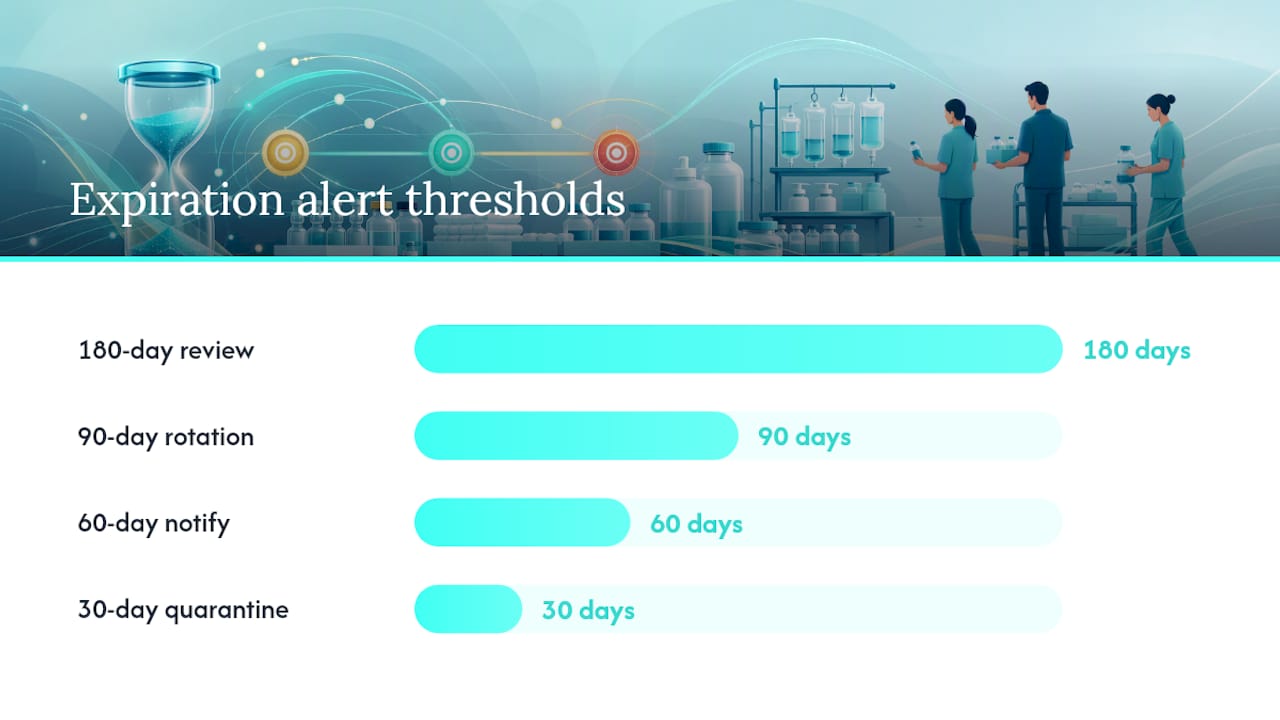
Alert tiers matter more than most managers realize. A workable structure looks like 180, 90, 60, and 30 days out, with a specific action attached to each threshold rather than a generic email nobody opens:
180 days: flag for review, no action required yet.
90 days: pull into a rotation-priority list, push to the front of FEFO order.
60 days: notify the department using it most, consider a use-it-or-return-it decision.
30 days: automatic quarantine hold, item removed from pickable inventory.
Mobile scanning at both receiving and point-of-use closes the loop, and offline-capable tools matter for basement storage or rural facilities where connectivity drops. Ventory’s research on healthcare expiry management found that embedding these controls into daily workflow, rather than treating them as a separate compliance task, is what actually reduces waste. Linking your inventory system to your EMR or warehouse management system lets an automated hold block a picker from pulling an expired lot in the first place, which beats catching the mistake after the fact every time.
How Often Should You Audit Inventory for Expired Stock?
Cycle counts work better as a rolling habit than an annual scramble. A workable cadence: rolling cycle counts weekly for high-turnover items, a monthly audit focused specifically on short-life stock, and one full annual reconciliation that ties your physical count to your system records.
Every audit and every transaction needs a documented trail, because that’s what turns a recall from a scramble into a controlled process:
Timestamp of receipt, use, or disposal.
Name of the receiving or handling staff member.
Lot number and expiration date.
Storage location at time of the event.
Disposal method and date, where applicable.
When a recall notice lands, the sequence is: identify the affected lot, quarantine remaining stock immediately, cross-check usage records or the EMR for any patient exposure, notify department heads and, where required, regulators, then document every step taken.
Three metrics tell you whether the whole system is working:
Metric | What it tells you |
Expired write-off percentage | Share of inventory value lost to expiration each period |
Average recall response time | How fast you can isolate and account for an affected lot |
Percent of inventory with recorded lot/expiry | How complete your traceability actually is |
How Should Expired Supplies Be Quarantined and Disposed Of?
Quarantine needs two layers working together: a physical space, secured and clearly labeled, and a digital hold status so the item can’t be picked even if someone misses the label. Mark every expired item “EXPIRED” with the date it was pulled, and remove it from available inventory in the system the same day, not at the next audit.
Disposal paths split by category. Controlled substances route through pharmacy and your environmental health and safety office under DEA and state pharmacy board rules. For general supplies and most drugs, state environmental and health agencies set the actual disposal requirements, and those rules vary enough that a method approved in one state may not be approved next door.
Before writing anything off, check whether your contract allows a return or credit for short-dated deliveries: suppliers cooperate on this more often than managers assume, and it’s a step institutional policies like UCSF’s expired materials policy explicitly build into their process.
Document every disposal action with a timestamp, and a witness signature where your facility policy requires one.
Keep your storage layout aligned with disposal zoning so quarantine stock never mixes with active inventory.
What’s the 30/60/90-Day Plan to Fix Expiration Management?
You don’t need a system overhaul to make progress. You need a sequence.
Days 1 to 30: Run a 90-day expiry report across your full inventory. Set up a labeled quarantine area if you don’t already have one. Train receiving staff to scan lot and expiration data on every incoming shipment before anything hits the shelf.
Days 31 to 60: Put a minimum remaining-shelf-life policy in writing for new receipts. Start monthly cycle counts focused specifically on short-life items. Configure your system’s alert tiers if it supports them.
Days 61 to 90: Review the causes behind your expired write-offs from the past quarter. Approach suppliers responsible for repeated short-dated deliveries about return or credit terms. Set your baseline KPIs so next quarter has something to measure against.
Assign clear ownership across four roles: someone owns receiving accuracy, someone owns the audit cadence, someone owns disposal and documentation, and someone owns supplier escalation when short-dated shipments keep showing up. Without a named owner for each, the plan quietly stalls around week three.
For facilities managing high-turnover categories specifically, inventory tips for fast-moving supply items can help set realistic min/max levels that don’t leave slow movers sitting until they expire.
How Does Queenssurgical Support Expiration Management for Buyers?
Queenssurgical supplies gloves, masks, instruments, and disposable consumables to clinics and hospital systems across the Americas, and expiration management starts before an order ever ships. Procurement decisions, like how much shelf life a supplier guarantees on delivery, directly shape how much quarantine and write-off work a receiving team faces later. Facilities that pair scanning at receiving with FEFO consistently report fewer expired write-offs and faster recall response, according to operational data from DataScan’s supply tracking use cases.
The gap between clinics that struggle with expired stock and those that don’t usually isn’t the software they bought. It’s whether one habit, scanning at the door, ever became automatic.
What Should You Stock First to Reduce Expiration Waste?
Start with your highest-turnover consumables, since these are where poor rotation causes the most waste and the biggest financial hit. Queenssurgical’s medical face masks and surgical masks with plastic shields ship with clear lot and expiration labeling, which makes scan-at-receiving straightforward for your team from day one. The same goes for disposable laboratory uniforms, a category clinics frequently overstock without realizing shelf life is finite.

If you’re managing expiration workflows for a specific patient population, resources like this guide to reducing diabetes supply waste walk through category-specific rotation challenges worth reviewing alongside your general FEFO policy.
Browse the full Queenssurgical catalog to compare shelf-life terms across product categories before your next order cycle.
An Honest Read on What Actually Moves the Needle
Most facilities I’d point to as struggling with expiration management don’t lack policy. They have binders full of it. What they lack is one enforced habit that survives contact with a busy Tuesday shift. The evidence backs a narrow focus over a broad one: get scanning-at-receiving genuinely consistent, and FEFO practically enforces itself because the data exists to support it.
Where conventional advice oversells itself is the software pitch. A platform with beautiful dashboards means nothing if nobody scans at the loading dock. Buy for batch-level expiry fields and alert automation, yes, but budget just as heavily for training the two or three people who touch every incoming shipment.
If you do only one thing after reading this, don’t buy anything. Pull your 90-day expiry report this week and see what’s already sitting there. That number will tell you more about your real risk than any policy document sitting in a drawer.
— QB
This article is general information, not a substitute for advice from a qualified doctor. Consult a qualified healthcare professional about your own circumstances before acting on anything here.
Sources
Recommended
Comments