The Role of Online Medical Retail Regulations in 2026

Online medical retail regulations define the legal and operational frameworks that govern how medicines and medical products are sold and distributed through internet channels, safeguarding public health and enforcing accountability at every step of the supply chain. The role of online medical retail regulations extends well beyond licensing paperwork. These rules govern prescription validation, pharmacist oversight, controlled substance handling, and cross-border fulfillment. Regulatory bodies including the FDA in the United States, China’s National Medical Products Administration (NMPA), and Nigeria’s Pharmacy Council enforce distinct but overlapping frameworks that share one core principle: patient safety cannot be delegated to convenience. For healthcare policymakers, legal professionals, and compliance officers, understanding how these frameworks operate in 2026 is not optional. It is the foundation of every defensible operating decision in online medical retail.
How do online medical retail regulations ensure patient safety and quality control?
The primary mechanism of patient protection in online medical retail is mandatory prescription verification backed by licensed pharmacist review. The FDA requires online pharmacies to hold valid prescriptions, employ licensed pharmacists, and display FDA-compliant safety warnings before dispensing any prescription drug. This means a platform cannot substitute a digital questionnaire for a clinical evaluation and call it compliant.
Quality control extends beyond the prescription itself. Traceability standards require that every prescription drug sold online be traceable from manufacturer to patient, with documented sourcing, storage conditions, and shipment records. China’s NMPA compliance guidelines specify that prescription review must be human, prohibiting AI from replacing pharmacist judgment. This is a direct regulatory signal that automation supports the process but does not own the decision.
The FDA’s BeSafeRx program gives consumers a verification tool to confirm whether an online pharmacy is legitimately licensed. For compliance officers, BeSafeRx is also a benchmark: if your platform’s practices would not survive BeSafeRx scrutiny, they will not survive a warning letter either.
Key patient safety mechanisms under current regulatory frameworks include:
Prescription authentication: Valid prescriptions must originate from a licensed prescriber with a documented patient relationship.
Pharmacist accountability: A licensed pharmacist must review and approve each dispensing decision, regardless of AI-assisted triage.
Storage and shipment standards: Temperature-controlled logistics and tamper-evident packaging are enforceable requirements, not optional quality upgrades.
Transaction monitoring: Platforms must flag and block suspicious purchase patterns, including quantity anomalies that suggest diversion.
Violation reporting: Serious compliance failures require immediate service suspension and regulatory notification.
Pro Tip: Map your platform’s prescription workflow against FDA warning letter patterns. Recurring violations cited in FDA letters involve missing pharmacist sign-off and absent safety labeling. Fixing these two gaps eliminates the most common enforcement triggers.
What are the unique challenges of controlled-substance prescribing and telehealth?
Controlled-substance prescribing through online channels operates under a separate and stricter legal layer than general prescription drugs. The Ryan Haight Act establishes the federal baseline: a valid in-person medical evaluation is required before any controlled substance can be prescribed via the internet. Pharmacist review alone does not satisfy this requirement. A telehealth encounter without a prior in-person exam is legally insufficient for Schedule II through V substances under federal law.

The COVID-19 pandemic created temporary exceptions. The DEA extended telehealth prescribing flexibilities through 2026, allowing certain controlled substances to be prescribed via telehealth without the in-person baseline. However, permanent rules remain pending, and organizations that have built workflows around these temporary exceptions face real legal exposure when they expire. Compliance officers should treat the 2026 deadline as a hard reset point, not a rolling extension.
The layering of federal and state law creates the most complex compliance challenge in this space. State-to-state variability in telehealth regulations demands jurisdiction-specific workflows rather than a single national protocol. A prescribing model that is compliant in Texas may violate New York’s telehealth statutes. The practical steps for managing this complexity are:
Audit every state in which your platform dispenses controlled substances and document the specific telehealth prescribing rules for each.
Confirm that your prescribers hold valid licenses in every state where they see patients remotely.
Verify that your platform’s intake process includes a mechanism to identify whether a prior in-person exam exists before a controlled substance prescription is generated.
Build a monitoring trigger for patients who receive controlled substance prescriptions through telehealth without documented in-person history.
Assign a compliance owner to track DEA rulemaking updates through 2026 and beyond, with authority to pause dispensing in affected states if rules change.
The most dangerous assumption in this area is that a questionnaire plus pharmacist review constitutes a compliant telehealth prescribing encounter for controlled substances. It does not. Telehealth-only encounters without the mandated in-person evaluation remain legally insufficient under the Ryan Haight framework regardless of how thorough the digital intake process appears.
How do regulatory approaches vary internationally?
Online pharmacy regulations differ substantially across jurisdictions, but three frameworks in 2026 illustrate both the diversity and the shared principles that define responsible e-commerce drug sales compliance globally.
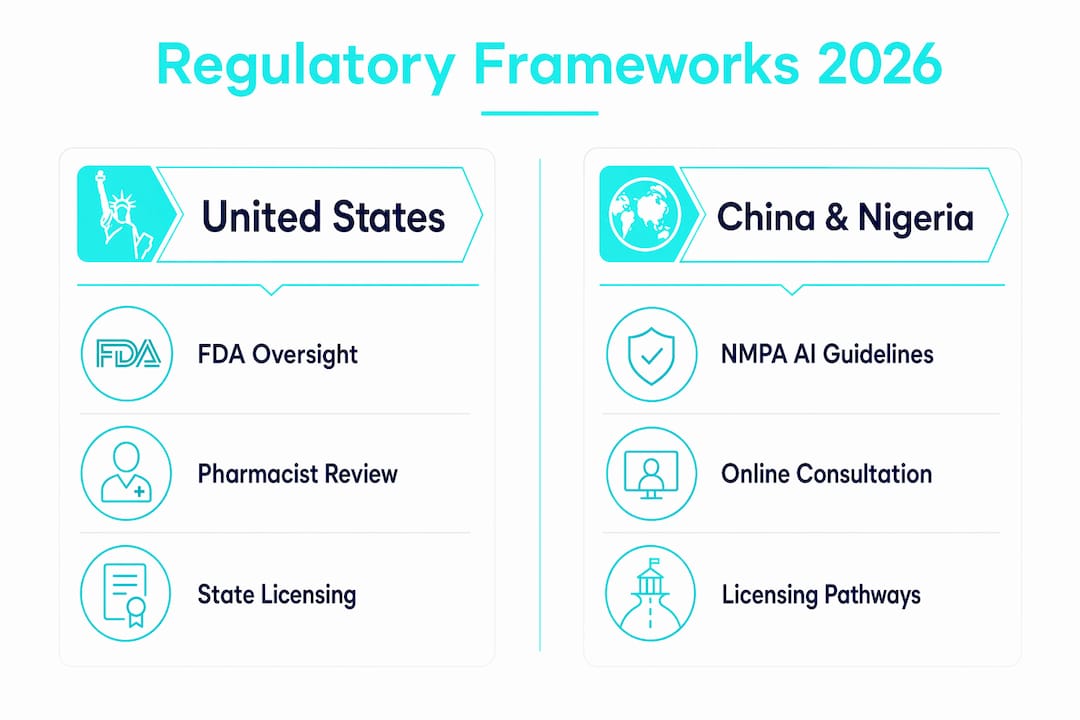
Jurisdiction | Regulatory Body | Key Requirements | Notable Restrictions |
United States | FDA / DEA / State Boards | Licensed pharmacist, valid Rx, BeSafeRx compliance, Ryan Haight Act for controlled substances | Telehealth-only Rx insufficient for controlled substances; state-by-state licensing required |
China | NMPA | Human pharmacist review mandatory, prescription traceability, risk-based transaction monitoring | AI cannot replace pharmacist judgment; immediate suspension for serious violations |
Nigeria | Pharmacy Council of Nigeria | Annual Electronic Pharmacy Licence, online consultation-based dispensing allowed | Registration distinct from authorization; strict renewal cycles enforced |
China’s 2026 NMPA guidelines represent the most explicit regulatory position on AI in pharmacy practice. The NMPA’s four core compliance principles are valid prescriptions, strict human review, full traceability, and active risk control. Platforms that fail to meet these standards face immediate service suspension and corporate liability. This is not a warning-first system. It is a suspend-first, investigate-second model.
Nigeria’s Electronic Pharmacy Regulations 2026 take a different approach. The framework allows dispensing based on online consultations, which is more permissive than the U.S. baseline for controlled substances. However, Nigeria’s rules draw a sharp distinction between registration and authorization. A pharmacy that is registered but whose Electronic Pharmacy Licence has lapsed is operating without authorization, a distinction that catches many operators off guard during renewal cycles.
The U.S. model relies heavily on FDA enforcement actions and state board oversight, creating a multi-jurisdiction licensing requirement for any platform operating across state lines. The FDA’s jurisdiction ends at its borders. State boards regulate within their own borders. Cross-border operations require a partner mapping strategy that verifies licensure at every fulfillment point.
Pro Tip: When entering a new jurisdiction, verify both the registration status and the active authorization status of every fulfillment partner. In Nigeria specifically, current Electronic Pharmacy Licence status and renewal compliance are two separate checks. Treating them as one is a common and costly error.
For a detailed breakdown of how these frameworks apply to medical device retail specifically, the regulated medical device retail guide from Queenssurgical covers the compliance distinctions that apply when products cross from pharmaceutical into device territory.
What compliance best practices should organizations adopt?
Effective compliance in online medical retail is not achieved by adding a verification step at the end of the transaction. Control points must be embedded throughout the entire workflow, from patient intake through dispensing and post-sale monitoring. Organizations that treat compliance as a final checkpoint consistently fail audits because violations occur upstream, not at the point of dispensing.
The following practices define a defensible compliance program for online medical retail in 2026:
Stepwise pharmacist review: Every prescription must pass through a documented pharmacist review stage with a timestamped approval record. This creates the audit trail that regulators examine first.
Prescription authenticity controls: Implement prescriber verification against state licensing databases at the point of order, not after. Fraudulent prescriptions are most effectively caught before they enter the fulfillment queue.
Quantity and frequency monitoring: Set automated flags for orders that exceed clinical norms for a given diagnosis. Diversion risk is highest when quantity controls are absent.
Multi-jurisdiction license mapping: Maintain a current register of all state and national licenses held by your platform and fulfillment partners. Map each license to the specific states or territories it covers and assign renewal alerts at least 90 days before expiration.
Staff training cadence: Regulatory frameworks change. Staff who were trained on 2024 rules may be operating on outdated assumptions in 2026. Quarterly training updates tied to regulatory change logs are the standard for defensible compliance programs.
Electronic prescription agreements: Formalize the terms under which electronic prescriptions are accepted, including authentication standards, prescriber identity verification, and acceptable prescription formats.
Pro Tip: FDA enforcement patterns show that recurring compliance failures cluster around two gaps: missing pharmacist documentation and absent safety labeling. Build your internal audit checklist around these two items first, then expand to secondary controls.
For organizations sourcing medical supplies to support compliant healthcare environments, understanding the difference between retail and wholesale procurement affects which regulatory obligations apply to your purchasing model.
Key takeaways
Online medical retail regulations function as the non-negotiable legal infrastructure that separates legitimate healthcare commerce from unsafe, unauthorized drug distribution.
Point | Details |
Pharmacist accountability is non-negotiable | Licensed pharmacist review is required by the FDA, NMPA, and Nigeria’s Pharmacy Council. AI cannot substitute for this judgment. |
Ryan Haight Act governs controlled substances | A valid in-person exam is the federal baseline for controlled-substance prescribing. Telehealth-only encounters do not satisfy this requirement. |
Jurisdictions require separate compliance strategies | U.S., China, and Nigeria each enforce distinct licensing and dispensing rules. A single compliance protocol does not cover all three. |
Control points belong throughout the workflow | Embedding verification at intake, review, dispensing, and post-sale monitoring is more effective than end-stage validation alone. |
Telehealth flexibilities expire in 2026 | DEA temporary extensions are not permanent. Organizations must prepare for stricter controlled-substance telehealth rules as the deadline approaches. |
Why I think the compliance conversation is asking the wrong question
Most compliance discussions in online medical retail center on whether a platform is technically legal. That is the wrong frame. The more useful question is whether the platform would remain defensible if every transaction were reviewed by a regulator tomorrow.
The AI debate in pharmacy practice illustrates this well. China’s NMPA has drawn an explicit line: AI supports pharmacists, it does not replace them. That principle is not unique to China. It reflects a broader regulatory consensus that clinical accountability requires a human decision-maker. Organizations that have invested heavily in AI-driven prescription triage are not necessarily non-compliant, but they are exposed if their workflows cannot demonstrate that a licensed pharmacist made the final call on every dispensing decision.
The telehealth prescribing situation in the U.S. is a case study in regulatory dependency risk. Platforms that scaled controlled-substance prescribing on the back of COVID-era DEA flexibilities built their business models on a temporary legal exception. That is not a compliance strategy. It is a bet that the exception becomes permanent. With permanent DEA rules still pending in 2026, that bet remains unresolved.
The organizations I find most credible in this space treat regulatory frameworks as design constraints, not obstacles. They build workflows that would be compliant under the strictest applicable standard, then document every decision point. When regulators arrive, they have nothing to hide because they built nothing to hide.
The future of online medical retail compliance will be shaped by three forces: AI integration that demands clearer human accountability standards, regulatory harmonization efforts that reduce jurisdictional fragmentation, and enforcement actions that set precedent for what “good enough” actually means. Policymakers who engage with these forces proactively will shape the standards. Those who wait for enforcement to define the floor will spend the next decade reacting.
— QB
How Queenssurgical supports compliant medical supply procurement
Compliance in online medical retail does not stop at the prescription. The physical environment where care is delivered must also meet safety and hygiene standards, and that requires reliable, regulation-grade supplies.
Queenssurgical supplies healthcare facilities across the Americas with products built for compliant clinical environments. The CPE Thumb Loop Isolation Gown meets protective standards for isolation settings. The nitrile examination gloves deliver consistent barrier protection for clinical staff. The disposable laboratory uniforms support hygiene compliance in lab and pharmacy environments. Queenssurgical’s catalog is built around the same principle that drives good regulatory practice: quality that holds up under scrutiny.
FAQ
What is the role of online medical retail regulations?
Online medical retail regulations govern prescription validation, pharmacist oversight, controlled substance handling, and platform licensing to protect patients from unsafe or unauthorized drug sales. They set the legal floor for every transaction in the online pharmaceutical and medical supply space.
How do online pharmacy regulations differ between the U.S. and China?
The FDA enforces prescription and pharmacist requirements with state-level licensing layered on top, while China’s NMPA mandates human pharmacist review, prohibits AI from replacing clinical judgment, and enforces immediate service suspension for serious violations. Both systems require valid prescriptions and traceability, but China’s enforcement posture is more immediate.
What does the Ryan Haight Act require for online controlled-substance prescribing?
The Ryan Haight Act requires at least one valid in-person medical evaluation before a controlled substance can be prescribed via the internet. Telehealth-only encounters, including questionnaire-plus-pharmacist models, do not satisfy this federal baseline requirement.
How does Nigeria’s Electronic Pharmacy Regulations 2026 differ from prior rules?
Nigeria’s 2026 regulations clarify licensing pathways, allow dispensing based on online consultations, and introduce annual renewal requirements that distinguish active authorization from mere registration. The prior 2021 rules left significant oversight gaps that the updated framework directly addresses.
What is the biggest compliance risk for multi-jurisdiction online pharmacies?
The biggest risk is assuming a single license or compliance protocol covers all operating states or countries. Multi-jurisdiction operations require partner-level license verification and fulfillment mapping for every jurisdiction where dispensing occurs, since regulators only have authority within their own borders.
Recommended
Comments