
Double Gloving Guidelines: What U.S. Teams Should Follow
What CDC, OSHA, AORN and WHO say about double gloving, when to do it, how to don two pairs, and what procurement teams should stock for compliance.


The right cuff is the one whose inflatable bladder covers about 75% to 100% of your mid-upper arm circumference, which usually falls into a small adult, regular adult, large adult, or extra-large category according to Mayo Clinic. Upper-arm cuffs are the preferred device type for accuracy over wrist or finger monitors. Measure your arm now using the steps below, then match that number to the size chart.
TL;DR:
Find the Right Cuff for Accurate Readings
Queens Surgical offers medical equipment and supplies for healthcare providers, clinics, and hospitals, including blood pressure monitoring accessories.
Getting an accurate reading starts with an accurate measurement, not the cuff that happens to be in the drawer.
A second person taking the measurement tends to produce a more reliable number than measuring your own arm, since you can hold the tape flat and read it straight on. If you only have an inch tape, multiply inches by 2.54 to get centimeters, since most cuff charts are labeled in centimeters. Many cuffs also print a range indicator, often a pair of arrows or a colored line, directly on the inside of the bladder: once wrapped around your arm, that marker should fall inside the printed range, not at or beyond either edge.
Pro Tip: Measure both arms once and use the larger circumference, since a small but normal difference between arms is common and you want the cuff sized for the bigger one.
Cuff labels like “regular” or “large” are not standardized across every manufacturer, so the printed circumference range on the cuff itself is what actually matters.
| Mid-arm circumference | Common cuff label |
|---|---|
| 22 to 26 cm | Small adult |
| 27 to 34 cm | Adult / regular |
| 35 to 44 cm | Large adult |
| 45 to 52 cm | Extra-large adult |
These ranges reflect common clinical guidance for mapping arm size to cuff category from the AMA’s cuff selection guidance. Home monitors typically ship with one of two bladder spans: a “standard” cuff covering roughly 22 to 32 cm, or a “wide-range” cuff stretching from about 22 to 42 cm. Both leave out some adults, since neither reaches the extra-large category, and the wide-range design is a compromise that fits more arms acceptably rather than any one arm precisely.
Using the wrong cuff does not just blur a reading, it can move it enough to change a diagnosis.
Those margins land squarely in the range that separates a normal reading from a hypertension diagnosis, which is why cuff fit is a clinical decision and not a cosmetic one.
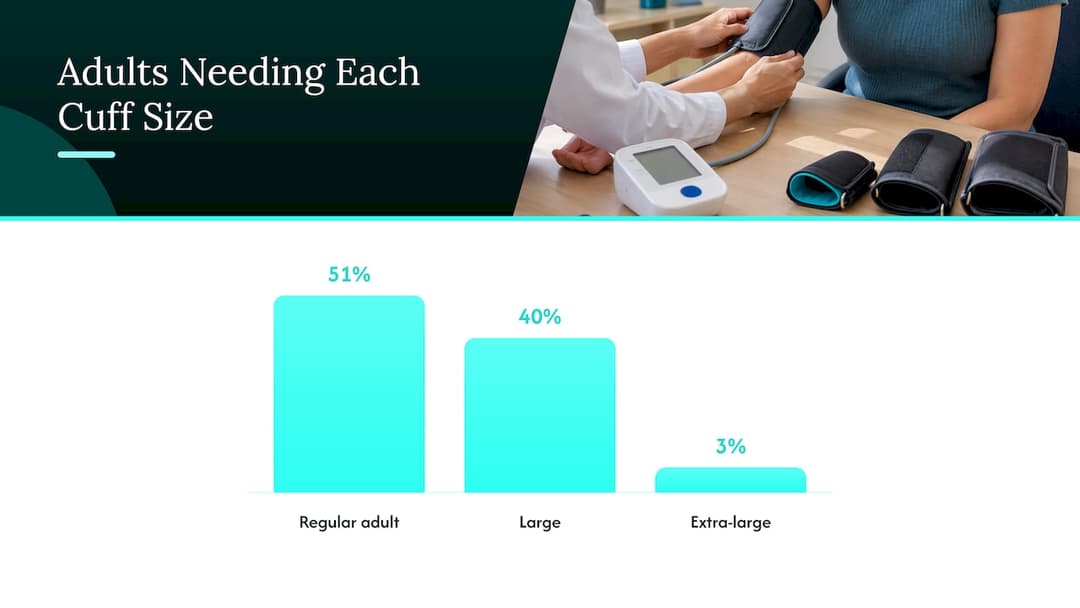
The stakes are higher than most people assume because so many adults fall outside the “one size fits most” assumption. NHANES data analyzed in the American Journal of Hypertension estimates that about 51% of US adults need a regular adult cuff, 40% need a large cuff, and 3% need an extra-large cuff, meaning a large share of the population is poorly served by a single standard-size cuff.
Home and clinic needs diverge here, even though the underlying measurement rule is identical.
Research on cuff mismatch in Hypertension Research found that common home device ranges leave out a meaningful minority of adults, which is why checking the printed range against your own measurement matters more than trusting the box label.
Pro Tip: Write your measured circumference and matching cuff size on a small label stuck to the cuff itself, so you or clinic staff never have to re-measure before every use.
The most common mistakes are simple: measuring over a sleeve, using one “universal” cuff for every patient, placing the cuff too high or low, or switching arms between readings without noting it.
None of this requires special training, yet it is the difference between a reading you can trust and one that sends you or your clinician down the wrong path.
— QB
Queens Surgical supplies the replacement cuffs and hygiene accessories you need once you know your correct size.

For a deeper look at how the inflation and bladder mechanism works, our post on how blood pressure cuffs work walks through the device mechanics behind the measurement.
This article is general information, not a substitute for advice from a qualified doctor. Consult a qualified healthcare professional about your own circumstances before acting on anything here.
Extra-large adult cuffs commonly cover arm circumferences up to about 52 cm (20.5 in), based on standard clinical sizing charts referenced by the AMA. Some manufacturers offer conical or thigh cuffs for arms larger than that, which should be matched to their own printed range rather than a generic “XL” label.
Systolic readings at or above a certain threshold generally fall into the hypertension range rather than normal or healthy. Because cuff size alone can shift systolic readings by several points in either direction, confirming the reading with a correctly sized cuff is a reasonable first step before drawing conclusions.
A cuff that is too large for your arm tends to underestimate systolic blood pressure, typically by about 1 to 6 mm Hg according to ACC. That can mask a genuine hypertension diagnosis, which is why matching the cuff to your measured arm circumference matters in both directions, not just against cuffs that are too small.
Retail and pharmacy shelves typically stock standard cuffs covering roughly 22 to 32 cm and wide-range cuffs covering roughly 22 to 42 cm, so checking the printed range against your own measurement is more reliable than trusting a package’s size name. If your arm falls outside what is available locally, ordering a validated cuff sized to your specific measurement is the more dependable option.
What CDC, OSHA, AORN and WHO say about double gloving, when to do it, how to don two pairs, and what procurement teams should stock for compliance.
Mayo and Metzenbaum scissors look alike but do different jobs. See how blades, shanks and tips differ, when to use each, and how to care for them.
Sterile water or saline? Learn the difference in tonicity, safe uses, wound irrigation evidence, and how to choose irrigation and dressing supplies.

