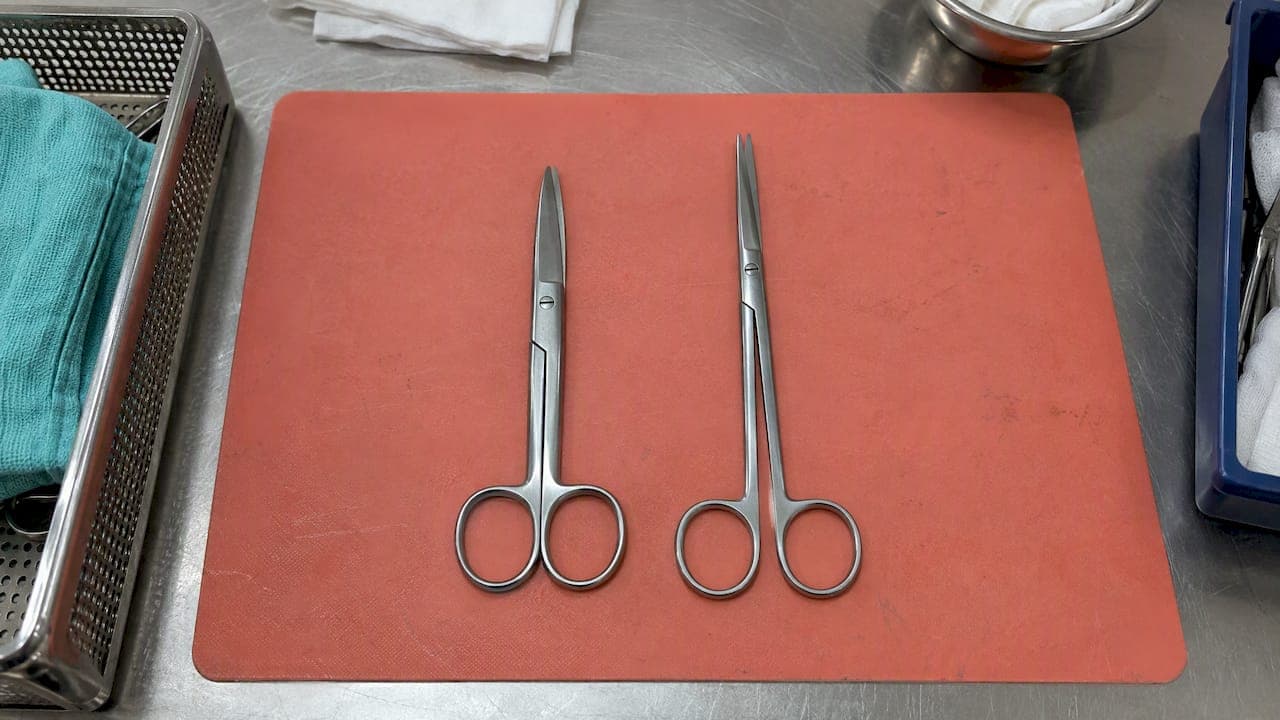
Mayo vs. Metzenbaum Scissors: How to Choose the Right Pair
Mayo and Metzenbaum scissors look alike but do different jobs. See how blades, shanks and tips differ, when to use each, and how to care for them.


No single U.S. rule tells every clinician to double glove. The CDC does not routinely recommend it for standard care, OSHA requires gloves but not two pairs, and AORN recommends it for scrubbed surgical team members. This guide sorts out who says what, when two pairs make sense, how to put them on, and what a purchasing team needs to stock so the practice actually happens.
Stock Gloves for Your Facility
Browse medical gloves and other supplies for healthcare professionals, clinics, hospitals, and healthcare facilities.
There is no single “double gloving guideline.” Several bodies speak to it, and they do not say the same thing because they cover different settings.
| Source | What it says | Where it applies |
|---|---|---|
| CDC | Does not routinely recommend double gloving under Standard or Transmission-based Precautions | General healthcare |
| OSHA | Requires gloves when contact with blood or other potentially infectious materials is anticipated; no blanket double-glove mandate | Employers covered by the Bloodborne Pathogens standard |
| AORN | Two pairs of sterile gloves with an indicator system for scrubbed team members | Perioperative practice |
| WHO | Its SSI guideline review notes that SHEA/IDSA guidance says the whole operative team should double glove, while other guidance is silent on single versus double | Surgery, worldwide |
The practical reading: in the operating room, two pairs is the professional standard of care. Outside it, double gloving is a judgment call tied to the task, the fluid exposure and your facility’s written policy.
The evidence for protecting the wearer is strong. The perforation findings are consistent across reviews.
Two takeaways. First, the outer glove takes the damage, and the inner one keeps a barrier. Second, a perforation you cannot see is a perforation you cannot act on, which is why indicator systems matter.
This is the clear case. Scrubbed team members in procedures with sharps, bone fragments, wire or long cases carry the highest risk of a glove breach. AORN’s position covers all scrubbed team members. The 2025 meta-analysis focused on high-risk surgeries, where exposure to bloodborne pathogens is greatest.
OSHA’s standard requires gloves whenever contact with blood or other potentially infectious material is anticipated, and it expects replacement as soon as feasible once a glove is contaminated, torn or punctured. Many facilities choose two pairs for high-splash or sharps-heavy tasks and write that into their exposure control plan. That is a facility decision, not an OSHA mandate.
Here the CDC position applies: not routinely recommended. Single gloves, changed between patients and between tasks on the same patient, plus hand hygiene, remain the baseline. For skilled nursing settings with multidrug-resistant organisms, CDC’s Enhanced Barrier Precautions guidance is the document to read, and it should be followed as written rather than stretched into a two-glove rule.
Cornell’s environmental health and safety manual describes double gloving as common practice with disposable gloves: if the outer glove is contaminated or starts to degrade, you remove it and still have a layer on. The same page explains that some workers pair different glove materials because no single material resists every chemical class. That is a chemical hygiene question, separate from surgical practice.
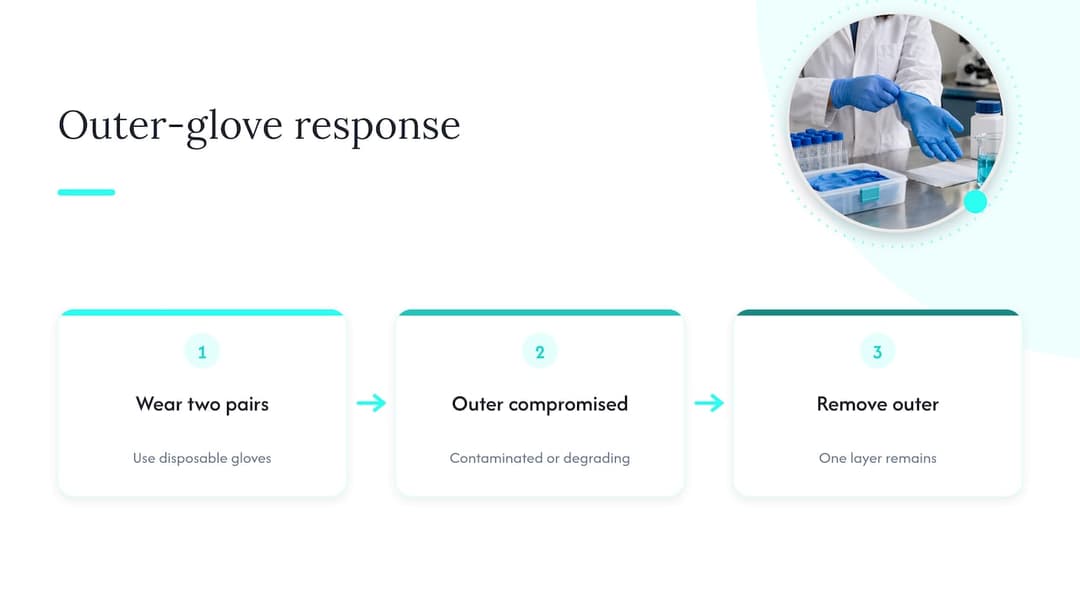
The sequence matters because every contact with the outer surface of a glove is a chance to contaminate your hands.
Outside the OR, the same removal discipline applies. Our PPE donning and doffing guide walks through the full gown, mask, eye protection and glove sequence.
A double gloving policy only works if the right gloves are on the shelf, in the right sizes, at the right time. Procurement managers should settle these questions before the policy goes live.
Indicator system or two standard pairs? The 2025 meta-analysis indicates indicator systems detect perforations during surgery much better. The trade-off is cost and surgeon preference. Run a trial with your surgical team before you standardize.
Sizing range. Two pairs need both a normal size and half sizes. Stocking only whole sizes quietly undermines compliance.
Material and allergy options. Keep a non-latex option, and a synthetic option for sensitive staff, in the same sizes.
Thickness and quality level. Thicker gloves reduce feel, thinner ones tear sooner. Our guide to nitrile glove thickness explains the 5 to 6 mil range, and the AQL levels explainer shows how to match pinhole defect limits to clinical risk. Our surgical glove selection guide covers the sterile side, and the examination glove overview covers non-sterile use.
Usage forecasting. Double gloving roughly doubles glove use in the cases where it applies. Budget for it, and see our nitrile glove price guide for market context. During shortages, the CDC’s conservation page is a reference point on prioritizing glove use.
Documentation. Tie the policy to your OSHA exposure control plan. Our OSHA PPE requirements guide lists the actions buyers should take, and biohazard bag color rules matter once you are disposing of twice as many gloves.
We supply gloves and other disposables to clinics, hospitals and resellers across the Americas, and the same pattern shows up in the buying conversations we have. Facilities write a double gloving policy, then discover the supply side was never lined up: half sizes missing, indicator pairs unavailable, or a single glove brand approved with no backup.
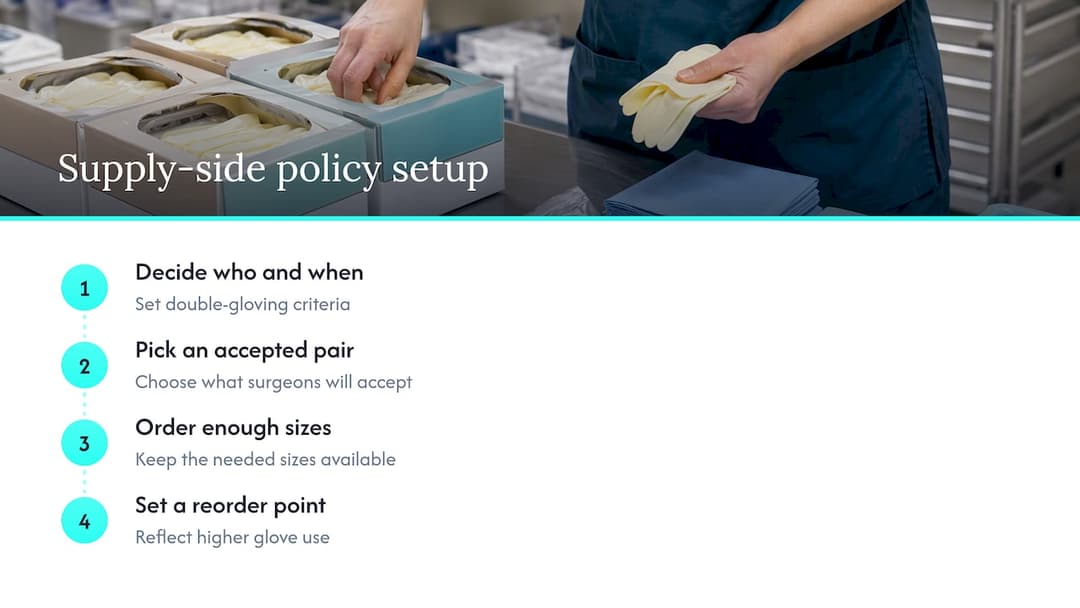
Our advice is to treat the glove as a system. Decide who double gloves and when, pick the pair that surgeons will accept, order enough sizes, and set a reorder point that reflects the higher use. A safe policy that runs out of stock in week three protects no one.
We would also keep the message simple for staff: two pairs lower the chance of a breach reaching skin, but they do not replace washing your hands or changing a glove when you should. Three decades in medical supply have taught us that policies stick when the product makes the right behavior easy.
— QB
If you are building or revising a double gloving protocol, Queens Surgical sells PPE, medical disposables, instruments, wound care and more, both wholesale and retail, so a clinic can start with a small order and a larger system can buy in volume. Browse the catalog, then match the glove types to your policy.
Not routinely. The CDC states that it does not routinely recommend double gloving as part of Standard or Transmission-based Precautions. That does not forbid it, and surgical teams follow AORN’s recommendation for two pairs.
No blanket requirement exists. OSHA’s Bloodborne Pathogens standard requires employers to provide appropriate PPE and requires gloves when contact with blood or other potentially infectious materials is anticipated. Disposable gloves must be replaced as soon as feasible when contaminated, torn or punctured.
Mainly for surgery and invasive procedures where sharps and blood exposure are likely. Facilities may also adopt it for specific high-exposure tasks in their exposure control plan. In routine patient care, single gloves with hand hygiene are the baseline.
The evidence is clearest for protecting staff. A Cochrane-based review found only two trials on patient surgical site infections, and both reported no infections, so it cannot show a patient benefit either way. Reduced perforations and blood contamination of the wearer’s hands are well documented.
With an indicator system, the darker underglove goes on first and the lighter outer glove goes over it. If fluid shows between the layers, the outer glove has been breached and should be changed.
Mayo and Metzenbaum scissors look alike but do different jobs. See how blades, shanks and tips differ, when to use each, and how to care for them.
Sterile water or saline? Learn the difference in tonicity, safe uses, wound irrigation evidence, and how to choose irrigation and dressing supplies.
Thumb vs locking, toothed vs smooth, Adson vs DeBakey, dressing vs tissue forceps: how each type works, when to use it and how to buy and reprocess…