
Double Gloving Guidelines: What U.S. Teams Should Follow
What CDC, OSHA, AORN and WHO say about double gloving, when to do it, how to don two pairs, and what procurement teams should stock for compliance.

OSHA requires U.S. healthcare employers to perform a written hazard assessment, provide required personal protective equipment at no cost, train staff, and maintain required written programs, specifically a Bloodborne Pathogens Exposure Control Plan and a Respiratory Protection Program. These four actions form the compliance baseline under 29 CFR 1910.132, 1910.1030, and 1910.134, alongside updated guidance on tuberculosis testing and precautions from WHO as the clinical reference.
TL;DR:
Source Essential Healthcare PPE
Browse gloves, masks, instruments, and medical equipment for healthcare professionals, clinics, hospitals, and other healthcare facilities.
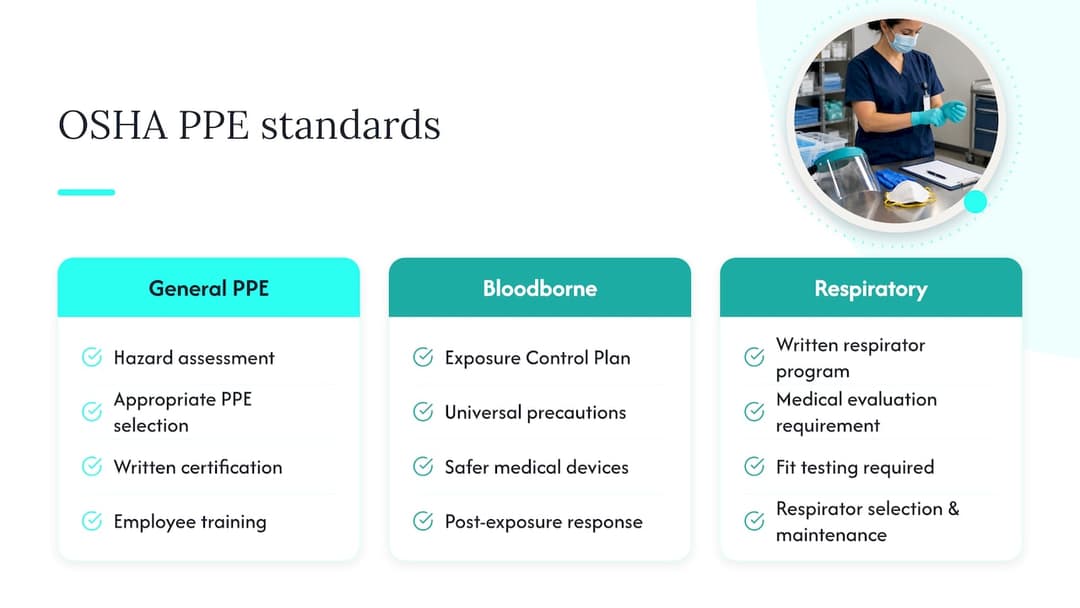
Three regulations anchor OSHA PPE requirements for healthcare facilities. The general PPE standard, 29 CFR 1910.132, requires a hazard assessment, appropriate PPE selection, written certification of that assessment, employee training, and payment for required equipment with narrow exceptions.
The Bloodborne Pathogens standard, 29 CFR 1910.1030, requires an Exposure Control Plan, adherence to universal precautions, safer medical devices where feasible, and a defined post-exposure response. Respiratory Protection, 29 CFR 1910.134, requires a written program covering medical evaluation, fit testing, and respirator selection and maintenance.
For plain-language explanations of these obligations, OSHA’s own PPE publication, OSHA3151, and its Employers Provide/Pay for PPE guidance are worth keeping on hand for training sessions and audits.
A compliant hazard assessment under 29 CFR 1910.132 is a documented, task-based exercise, not a verbal walkthrough. A standard interpretation from OSHA makes clear that a documented, task-based exposure determination is one of the first items inspectors request, and facilities that keep clear job-classification records reduce both inspection time and citation risk.
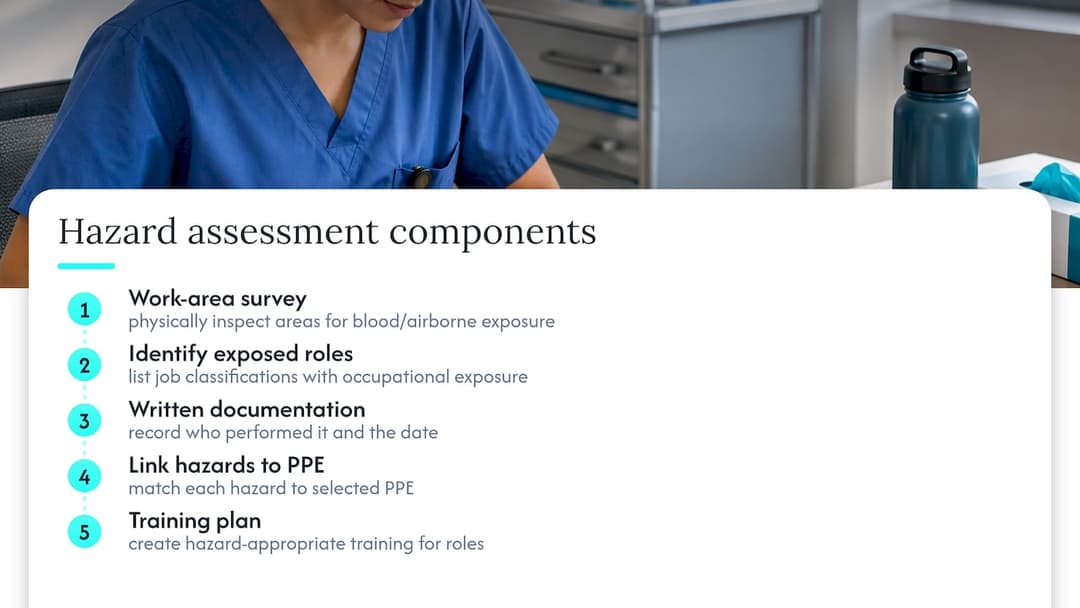
A thorough assessment typically includes a physical survey of each work area where exposure to blood, body fluids, or airborne hazards could occur, identification of roles with occupational exposure, written documentation of the assessment including who performed it and when, linkage of hazards to selected PPE, and a training plan appropriate for the identified hazards. Skipping the written certification step is a common compliance gap found by auditors.
Different tasks call for different protective equipment, and matching the two correctly is central to OSHA compliance:
Respirator selection should reference Assigned Protection Factors and NIOSH certification rather than comfort or cost alone, since the protection level has to match the actual exposure. For a closer look at glove categories and when each fits a given task, our glove selection guide breaks down material and thickness differences. Donning and doffing sequence also matters as much as the equipment itself, and our step-by-step donning and doffing guide covers the order that keeps contamination off skin and clothing.
29 CFR 1910.134 requires a written respiratory protection program with a named administrator, and the elements are specific:
Fit testing is not a one-time event. OSHA materials on respirator fit note that changes in facial structure, dental work, or weight can affect seal and trigger a new test, so a program built only around the annual calendar date will miss people who need retesting sooner.
Pro Tip: Tie fit-test records and medical evaluation dates to employee ID numbers in one tracking sheet so a surveyor can verify compliance for any staff member in seconds.
For the mechanics of the test itself, see our mask fit testing steps for a walkthrough U.S. teams can follow during annual retesting.
29 CFR 1910.1030 requires a written Exposure Control Plan, reviewed and updated annually, that identifies exposure risks and the controls in place to reduce them. OSHA’s own guidance stresses that engineering and work-practice controls come before PPE in the hierarchy, with PPE serving as the last line of defense rather than the first.
Sharps handling carries specific obligations: a sharps injury log, documented input from frontline staff on device selection as required under the Needlestick Safety and Prevention Act, and proper sharps container sizing to prevent overfill. Our guide to sharps container sizing covers how to match container size to unit volume. After any exposure incident, employers must provide prompt medical evaluation, make the hepatitis B vaccine available at no cost, and follow up according to the plan.
OSHA’s payment rule is direct: employers pay for required PPE, with narrow exceptions such as ordinary clothing and certain non-specialty footwear, according to the Employers Provide/Pay for PPE guidance. That same guidance states that reusable PPE needing laundering cannot be sent home with staff; the employer must arrange cleaning or replacement.
Beyond payment, several obligations round out the compliance picture:
Building or auditing a program is easier with a fixed sequence:
Pro Tip: Run the annual program review a month before your busiest audit season so corrections land before an inspector’s visit, not after one.
As QB, I’ve seen how often PPE compliance gaps trace back to procurement decisions made without documentation in mind. Choosing NIOSH-certified respirators and ANSI-rated eyewear with the paperwork attached saves safety officers hours during an audit. Clear specification sheets and supplier certificates turn a hazard assessment into a straightforward purchase order rather than a guessing game.
— QB
We supply gloves, respirators, gowns, and eye protection sourced to meet relevant safety expectations, so procurement teams can match a hazard assessment to a purchase order without chasing certificates after the fact. For bulk orders, we help document compliance details directly with your purchasing team.

Reach out to our procurement team for bulk pricing or compliance documentation on any item in our catalog.
Standard healthcare PPE includes gloves, fluid-resistant gowns, eye and face protection, and masks or NIOSH-certified respirators, selected based on the specific task and exposure risk. CDC’s standard and transmission-based precautions guide which combination applies in a given clinical scenario.
Yes, PPE is required under 29 CFR 1910.132 whenever a workplace hazard assessment identifies exposure risks that engineering or administrative controls cannot eliminate. Employers must provide, maintain, and generally pay for this equipment.
Fit-testing guidance continues to stress that respirator fit checks are triggered by changes in facial structure or respirator model, not just an annual calendar date, based on OSHA’s respirator fit testing materials. Facilities should review their respiratory protection program against this guidance rather than assuming last year’s schedule still covers every employee.
What CDC, OSHA, AORN and WHO say about double gloving, when to do it, how to don two pairs, and what procurement teams should stock for compliance.
Mayo and Metzenbaum scissors look alike but do different jobs. See how blades, shanks and tips differ, when to use each, and how to care for them.
Sterile water or saline? Learn the difference in tonicity, safe uses, wound irrigation evidence, and how to choose irrigation and dressing supplies.

