
Double Gloving Guidelines: What U.S. Teams Should Follow
What CDC, OSHA, AORN and WHO say about double gloving, when to do it, how to don two pairs, and what procurement teams should stock for compliance.
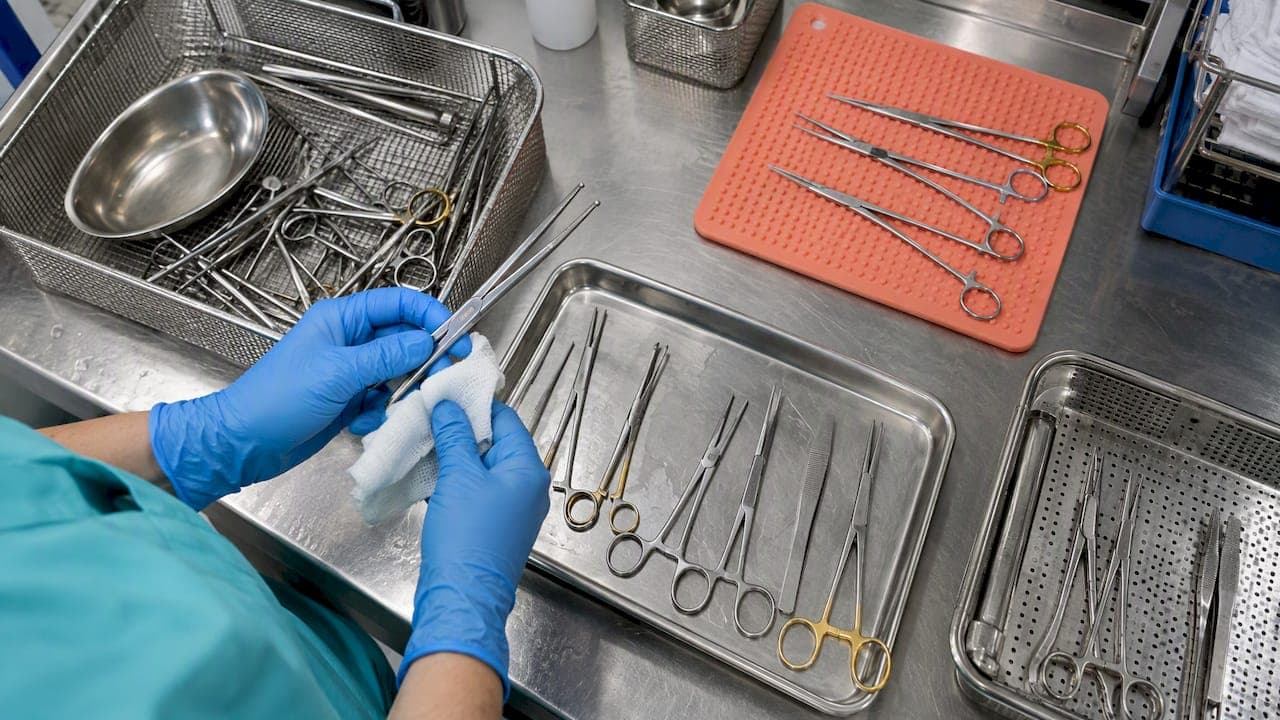
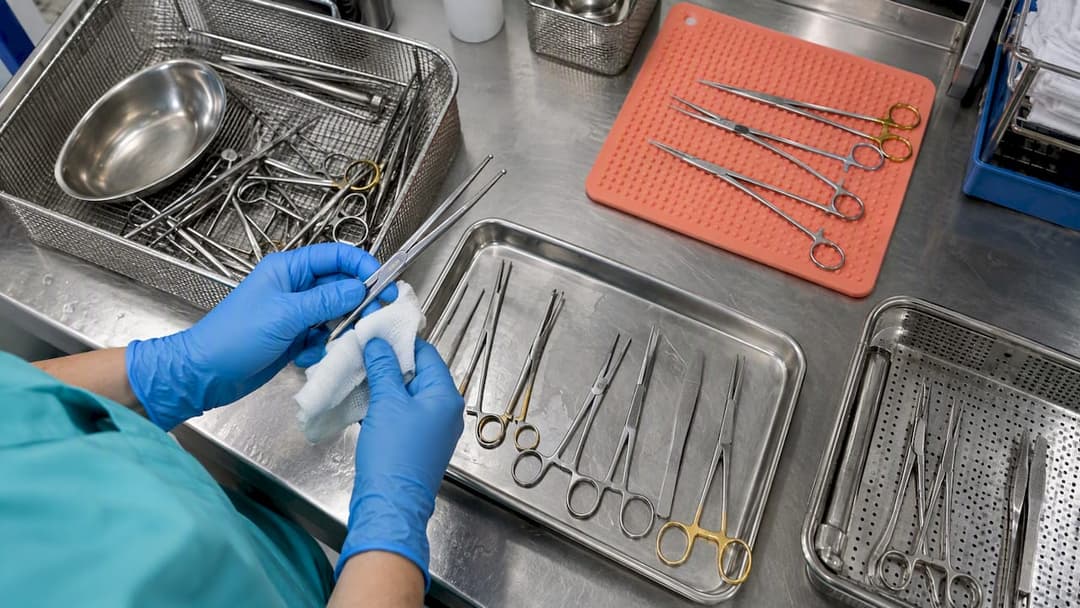
Surgical forceps fall into two families: non-locking forceps (thumb forceps, pick-ups, tissue and dressing forceps), which you hold closed with finger pressure, and locking forceps (hemostats, Kocher, Allis-style clamps), which hold with a ratchet. Within each family, the tip decides the job. Toothed tips grip firmly. Smooth or finely serrated tips spare tissue. This guide sorts the common patterns, settles the usual comparisons (Adson vs DeBakey, toothed vs non-toothed, dressing vs tissue forceps) and covers what procurement and sterile processing teams should weigh before ordering.
Find Forceps for Your Clinical Needs
Browse Queens Surgical’s medical instruments and supplies, with products for healthcare professionals, clinics, hospitals, and other facilities.
Every forceps type starts with one question: does it lock? Non-locking forceps are held closed by finger pressure, while locking forceps such as hemostats use a box-lock ratchet. The same source describes thumb forceps as an extension of the surgeon’s fingers for handling tissue, and locking forceps as the choice when a grip must be held securely for a long time, such as when clamping vessels.
| Family | Examples | Held by | Typical use |
|---|---|---|---|
| Non-locking | Adson, Adson-Brown, DeBakey, dressing forceps, splinter forceps | Finger pressure | Handling tissue, skin edges, dressings, needles |
| Locking (ratcheted) | Crile, Kelly, Rochester-Pean, Kocher, Rochester-Ochsner | Box-lock ratchet | Clamping vessels, holding tissue or drapes, hemostasis |
A third group, sponge and ring forceps, uses ratchet handles too. Many catalogs call all ratcheted instruments “ring forceps”, which is why the names overlap so much online.
Thumb forceps (also called pick-ups) are the instrument most people picture. Two kinds are easy to confuse, and the difference is the tip.
Tissue forceps have teeth, usually a small number of interlocking points at the tip. Dressing forceps have serrated or grooved tips with no teeth. A veterinary surgical teaching lab describes thumb forceps as having small grooves but no teeth on the tips, and notes that the amount of crushing depends on how hard you squeeze and on the design of the tips and grooves.
| Tissue forceps | Dressing forceps | |
|---|---|---|
| Tip | Toothed (1x2 and similar patterns) | Serrated or grooved, no teeth |
| Grip | Secure with light pressure | Relies on friction and pressure |
| Best for | Skin edges, fascia, firm tissue | Dressings, packing, gauze, delicate handling |
| Risk | Puncture or local damage if over-specified | Slippage on tough or wet tissue |
In practice, “best dressing forceps” is a question of length and tip finish. A longer pair reaches into wounds and packing without crowding your hand. A shorter, finer pair suits small dressings and cleaner field work. Check that the serrations meet evenly when closed, because misaligned tips are the usual reason a pair slips.
This is the choice that matters most clinically. Traumatic (toothed) forceps give a firm grip on tough tissue but cause more local damage from tooth penetration, while atraumatic forceps spread pressure over a wider surface. The same guide says atraumatic types are the standard for delicate structures such as vessels and bowel.
The less obvious point is that teeth can actually protect tissue. A Boston University surgical training page recommends small toothed forceps, such as the Adson pattern, to grasp skin edges during suturing, because teeth provide a secure grasp with minimal pressure, avoiding crushing of the skin edge. Smooth tips on skin force you to squeeze harder, and that crushes.
A workable rule:
The same guide warns about error in both directions: over-specifying teeth on delicate tissue raises trauma risk, while atraumatic forceps on dense tissue may not hold.
“Rat tooth” is a loose name for forceps with sharp interlocking teeth, and it is often used for the Adson pattern. Adson forceps are a slim, short pick-up, commonly 4¾ inches, with a narrow tip and a fine 1x2 tooth arrangement: one tooth on one jaw fitting between two on the other. That is the classic instrument for skin closure, and it is the one the training page above shows.
Adson-Brown (sometimes just called Brown forceps) is a close relative. It generally has a wider tip with several rows of fine teeth, which spreads the grip over more skin edge. Many surgeons reach for it on thin or fragile skin where a single point of contact would be more than they want. Tip dimensions and tooth counts vary by manufacturer, so check the catalog specification instead of relying on the name alone.
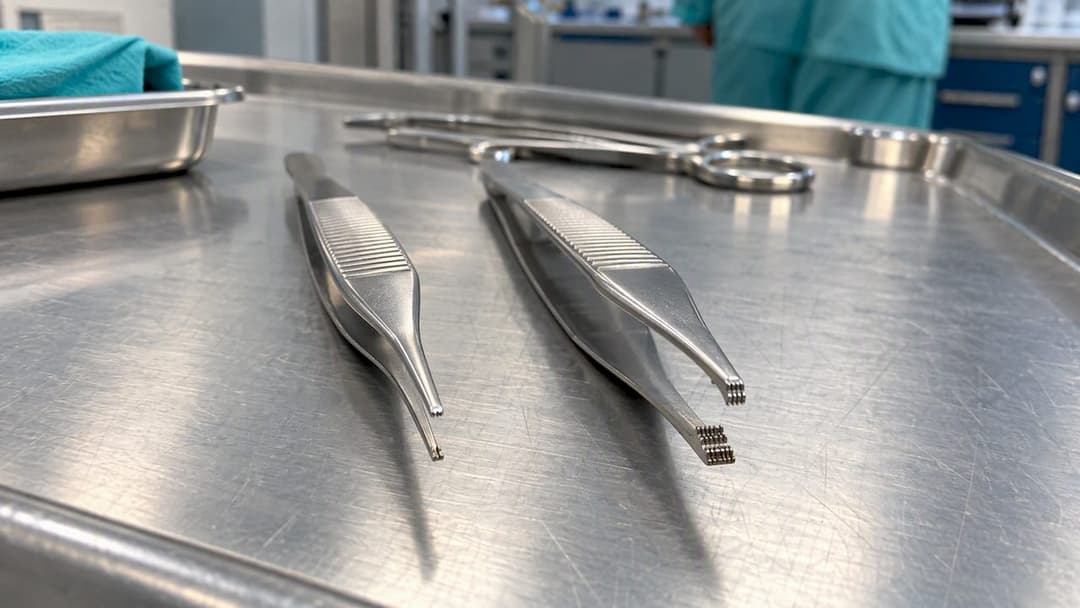
If you need the standard toothed pick-up, our Adson Thumb Tissue Forceps are the place to start, and we also list general tissue forceps.
DeBakey forceps are atraumatic tissue forceps used in vascular procedures to avoid tissue damage. They tend to be long, some more than 12 inches, and they have a distinct, coarsely ribbed grip panel rather than the finer ribbing on most other tissue forceps. They were developed by Michael DeBakey during his time at Baylor College of Medicine.
The tips carry fine, longitudinal serrations rather than teeth, so they hold a vessel wall or bowel loop without puncturing it. That is why they appear in vascular, cardiac, thoracic and bowel work.
| Adson | DeBakey | |
|---|---|---|
| Tip | Toothed (1x2), narrow | Smooth, fine longitudinal serrations |
| Class | Traumatic | Atraumatic |
| Length | Short, around 4¾ in. | Longer, from about 6 to 12 in. and up |
| Used for | Skin, subcutaneous tissue, fascia | Vessels, bowel, delicate organ handling |
| Main risk | Puncture if misapplied | Weak hold on dense tissue |
So “Adson vs DeBakey” is not a question of which is better. One is for firm tissue at a shallow depth, the other for fragile tissue, often deeper in the field. Most surgical trays that handle both skin and deeper dissection carry both.
The word “atraumatic” also turns up in nursing care. If you want to see how the concept carries beyond the operating room, this piece on atraumatic care in pediatric nursing explains the principle of minimizing physical and emotional distress during procedures.
Locking forceps hold without constant finger effort. Their jaws are serrated across the tip, and a ratchet on the handles sets the closing pressure. The common patterns differ in length, jaw serration and curve.
A reminder when browsing: serrated hemostats such as Crile crush tissue inside the jaws by design. They are for clamping what you intend to tie or remove, not for gentle handling.
Start from the tissue, not the catalog name.
One safety habit belongs here too. Boston University’s suturing guidance points out that handling suture needles with forceps rather than fingers reduces the risk of needlestick injury. A good pair of Adson-type forceps earns its place on that point alone.
Forceps contact tissue, so they are reprocessed after every use. The AORN instrument guide notes that forceps are used to grasp tissue atraumatically and hold it in place while dissecting or suturing, and that is exactly why their condition matters. As one example of the rule, Florida’s administrative code states that instruments that normally penetrate soft tissue or bone, including forceps, must be sterilized after each use. That is a Florida rule for dental and similar practices. Your own state, facility policy and the manufacturer’s instructions for use (IFU) govern your process, so confirm them with your infection prevention lead.
Design affects how hard that job is. A Pennsylvania Patient Safety Authority advisory says that box-locks, hinges, ratchets and narrow channels are harder to reprocess and carry a higher risk of retained bioburden. It also stresses that reprocessing should start at the point of use, because dried debris, especially inside box-locks, is a leading cause of failure. Even delicate patterns such as the Pratt hemostat can have intricate parts that make cleaning demanding.
What that means for buyers:
For a practical walkthrough, a dental clinic has published a step-by-step instrument sterilization workflow (in Romanian) that shows the sequence from pre-cleaning to storage. For care standards in hospital and sterile processing settings, see our own guide to IFU and AORN surgical instrument care.
We have supplied medical products for three decades, and the same pattern repeats with forceps. Facilities rarely run into trouble because they picked the wrong famous name. They run into trouble because every department orders a different pattern for the same job, and sterile processing then has to track a dozen near-duplicates.
Our advice is to define the task list first: skin closure, fascia, vessel handling, dressings, clamping. Pick one pattern per task, write it down, then buy enough pairs to cover turnover through reprocessing. Include both toothed and atraumatic choices, because the tissue sets the requirement, not the habit of the surgeon.
Because we sell both retail and wholesale, a clinic can order a single pair to test the feel in hand and then move to volume once the team agrees. We also encourage buyers to ask us about regulatory and IFU questions before they order, which is part of how we support procurement.
— QB
If you are stocking trays or replacing worn pairs, our catalog covers medical instruments and tools, alongside PPE, disposables, wound care and equipment, so a clinic can consolidate an order in one place. Start with the thumb and locking forceps linked above, and contact us if you need help matching a pattern to a procedure.
Tissue forceps have teeth at the tip for a firm hold on skin and fascia. Dressing forceps have serrated tips without teeth and are meant for handling dressings and packing. Using toothed forceps on dressings is unnecessary, and using dressing forceps on tough tissue often means squeezing too hard.
Neither is better overall. Adson forceps are toothed and short, which suits skin and firm tissue. DeBakey forceps are atraumatic and longer, which suits vessels and bowel. Choose by the tissue and depth of the field.
Traumatic forceps have teeth and grip firmly, at the cost of more local damage. Atraumatic forceps have smooth or finely serrated tips that spread pressure over a larger area. Atraumatic types are generally non-toothed, and toothed types suit high-tension tasks.
Yes, in standard practice. Forceps contact tissue, so they are cleaned and sterilized between patients. Florida’s code is one example of a rule requiring it, and your facility policy and the manufacturer’s IFU set the exact steps. Ask your infection prevention lead if you are unsure.
What CDC, OSHA, AORN and WHO say about double gloving, when to do it, how to don two pairs, and what procurement teams should stock for compliance.
Mayo and Metzenbaum scissors look alike but do different jobs. See how blades, shanks and tips differ, when to use each, and how to care for them.
Sterile water or saline? Learn the difference in tonicity, safe uses, wound irrigation evidence, and how to choose irrigation and dressing supplies.

