
Double Gloving Guidelines: What U.S. Teams Should Follow
What CDC, OSHA, AORN and WHO say about double gloving, when to do it, how to don two pairs, and what procurement teams should stock for compliance.
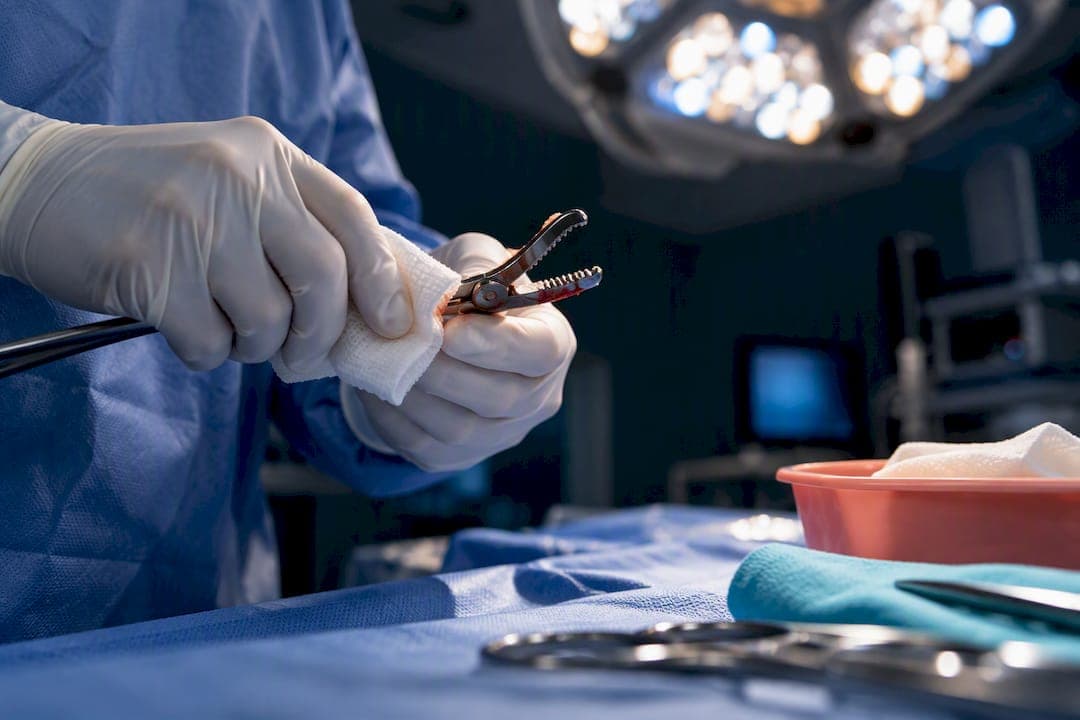
Safe reprocessing follows one fixed sequence: point-of-use precleaning, manual or automated cleaning, inspection and function testing, lubrication with a steam-permeable oil, packaging, validated sterilization, and dry storage. Skip a step or reorder it, and instrument failures, corrosion, or sterilization failures follow. The rule that overrides every generic protocol: always defer to the instrument manufacturer’s IFU alongside current AORN and AAMI guidance, and apply lubricant only after cleaning and rinsing, never before sterilization.
TL;DR:
Source Reliable Instrument Care Supplies
Queens Surgical supplies medical instruments, equipment, gloves, masks, and wellness products for healthcare professionals and organizations.
Surgical instrument care starts the moment an instrument leaves the sterile field, not when it reaches sterile processing. Blood, tissue, and saline dry fast under OR lighting, and dried bio-burden is dramatically harder to remove than fresh soil. That single fact drives every point-of-use rule that follows.
Gross soil comes off immediately with a saline-moistened sponge or spray gel, and lumens get flushed so channels don’t clog before they ever reach the sink. Instruments with box locks, ratchets, or multiple parts should be opened or disassembled per the manufacturer’s IFU so soil trapped in hinges doesn’t bake on during transport.
Timing matters more than most staff realize. The goal is decontamination within 30 minutes of use; when that’s not possible, instruments should at minimum be rinsed or kept moist with a foam, gel, or damp towel to prevent drying. Rinse water, where used at this stage, should stay under 95°F (35°C), since heat sets protein soil the same way it sets an egg.
Transport requires a closed, leak-proof, labeled container, never an open tray riding loose on a cart. That single practice prevents cross-contamination between sets and protects transport staff from exposure.
Instrument care is a shared responsibility across OR staff, transport personnel, and sterile processing, and that handoff is exactly where soil gets baked on or trays get mixed if nobody owns the correct solutions and separate handling steps.
Manual cleaning, ultrasonic cleaning, and automated washer-disinfectors each solve a different problem, and most sets need at least two of the three before they’re truly clean.
Manual cleaning handles delicate, cannulated, or complex instruments that automated equipment might damage or fail to reach. The process runs in a defined order:
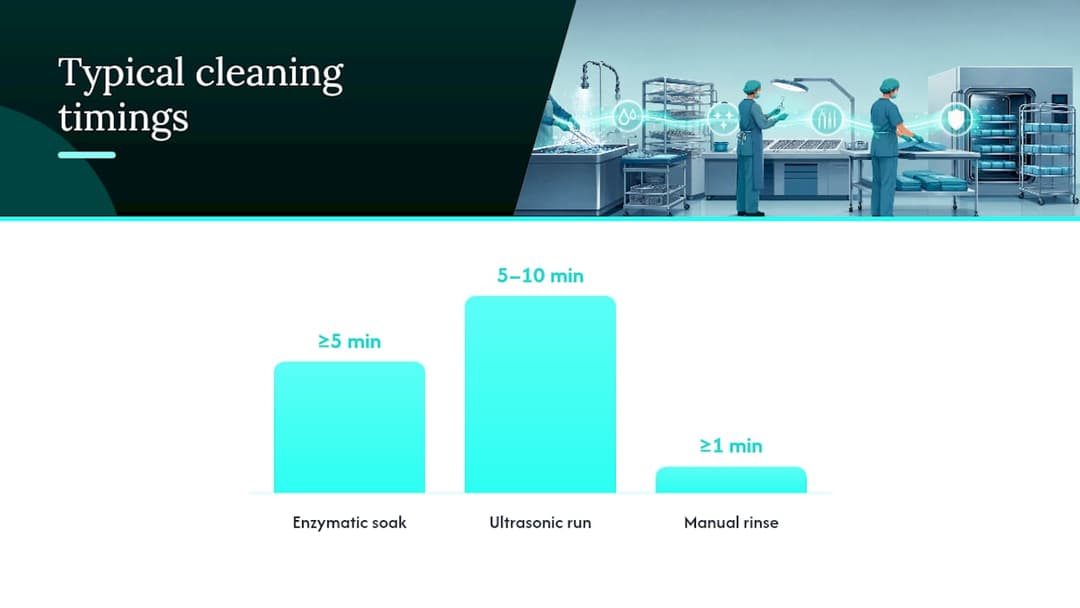
Ultrasonic cleaning works through cavitation: sound waves generate microscopic bubbles that implode against instrument surfaces, dislodging soil from crevices no brush can reach. It’s a strong second stage after gross soil removal, not a substitute for it. Instruments should be fully submerged, opened, and never touching each other or the tank bottom, since contact interferes with cavitation and can chip delicate edges. Run times of roughly 5 to 10 minutes are typical, though the instrument IFU sets the final word.
Washer-disinfectors are the preferred method whenever equipment allows it, because validated cycles built to ISO 15883 remove human variability from the process. A standard cycle runs prewash, enzymatic wash, rinse, thermal disinfection, and drying, and loading trays correctly (open jaws, no nesting, lumens connected to irrigation ports) is what separates a passed cycle from a failed one.
Detergent choice ties all three methods together: stick to neutral or enzymatic formulations in the 6 to 8.5 pH range, and never mix in chlorine-based or oxidizing agents, which pit stainless steel over time.
Pro Tip: Run your final rinse with deionized or reverse-osmosis water whenever your facility’s plumbing allows it. Tap water minerals leave spotting that mimics corrosion and can trigger unnecessary instrument rejection during inspection.
Every instrument gets a visual and functional check before it’s packaged, and this step catches problems that cleaning alone won’t reveal. A bright light and magnification lens turn up more failures than the naked eye ever will.
Anything that fails gets logged, tagged, and routed to repair or retirement according to the manufacturer’s IFU, never returned to service on a supervisor’s judgment call alone.
Lubrication happens here, after cleaning and rinsing are complete and before packaging, never earlier. Applying oil to a soiled instrument just traps bio-burden underneath it. The lubricant itself matters as much as the timing: water-based, steam-permeable formulas free of silicone and mineral oil are the standard, since silicone and petroleum-based oils can block steam penetration during sterilization and leave residue that interferes with future cleaning cycles.
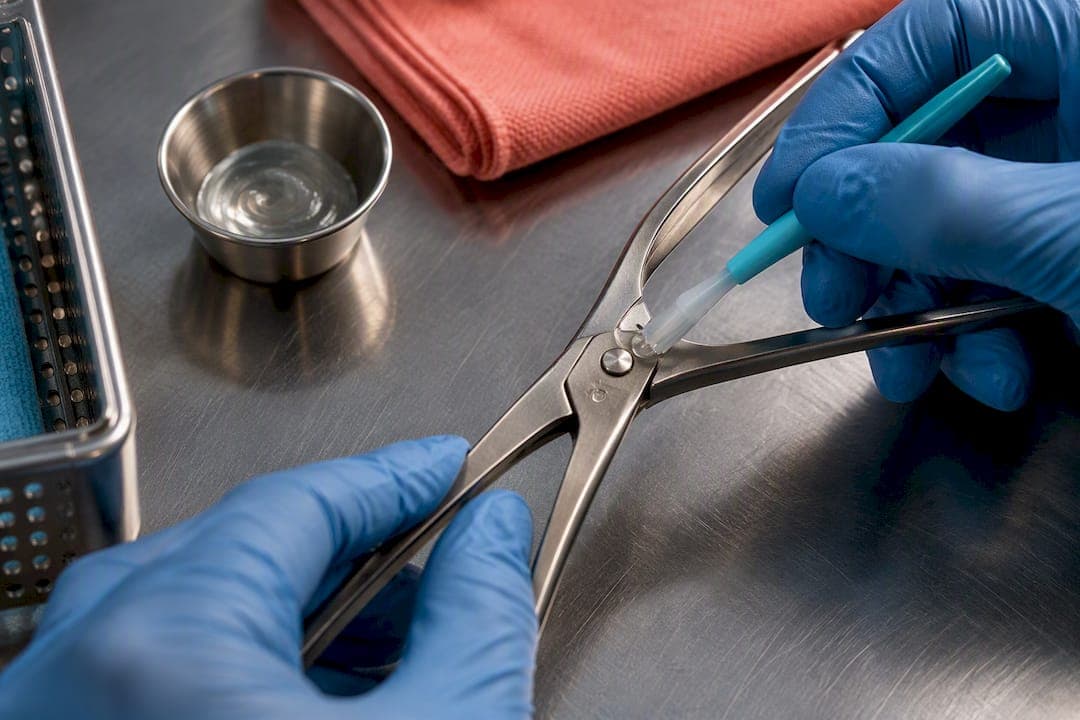
Dosing depends on the delivery method. Automated systems that inject lubricant into the final rinse cycle typically run at 0.05 to 0.13 oz per gallon (0.4 to 1.0 ml/L), while a manual immersion bath calls for a stronger concentration, generally 20 to 40 ml per liter, according to Getinge’s product guidance for its steam-permeable lubricant line. Queenssurgical’s guide to instrument milk walks through how these products fit into a typical SPD workflow if your facility is still choosing between automated dosing and manual bath application.
Log every lubrication cycle alongside inspection results. That record is what tells you, six months from now, whether a particular tray is wearing out faster than it should.
Packaging choice depends on the instrument and the sterilizer, but the underlying rule never changes: whatever wraps the instrument has to let steam in and keep contamination out until the moment of use.
Reusable instruments require pre-vacuum, dynamic-air-removal steam cycles in nearly every modern sterile processing department, since gravity-displacement cycles struggle with lumens and dense trays. The exact cycle time, temperature, and dry time come from the sterilizer manufacturer and the instrument IFU together, not from a generic chart on the wall.
Cleaning adequacy determines sterilization success more than any other variable. Effective cleaning and disinfection is indispensable to sterilization, since residual bio-burden shields microorganisms from steam contact regardless of cycle length or temperature. Residual detergent or excess lubricant creates the same problem, forming a barrier steam can’t penetrate.
Validation is a facility responsibility, not a manufacturer guarantee. IQ/OQ/PQ documentation (installation, operational, and performance qualification) has to reflect your actual sterilizer, your actual loads, and your actual water quality. A cycle validated on a half-empty chamber somewhere else doesn’t automatically transfer to your fully loaded rigid containers. Queenssurgical’s overview of cleaning versus disinfection versus sterilization breaks down where each step’s responsibility starts and ends if your SOP documentation needs that distinction spelled out for staff training.
Sterile storage protects everything the previous six steps accomplished, and it’s often where facilities lose ground through simple neglect. Sterile packages belong in a dry, ventilated area, shielded from direct sunlight, temperature swings, humidity, and pest access. A storage room next to a loading dock door or under a leaking pipe undoes hours of careful reprocessing.
A tray that’s been autoclaved 400 times behaves differently from one autoclaved 40 times, even if both look clean and pass a visual check. That’s why cycle counts and repair logs matter as much as the daily inspection checklist.
Manufacturer IFUs take precedence over generic protocols every time they conflict, because the company that built the instrument knows its tolerances better than any general guideline can. That said, IFUs work alongside broader standards, not instead of them.
Every SOP should cite the specific IFU it’s built from, and every validation record, maintenance log, and competency check needs a retrievable file. An auditor asking “show me” should never be met with a shrug.
Sourcing the right consumables is part of getting instrument care right, not separate from it. Queenssurgical’s instrument milk guide and lubricating jelly product page give sterile processing teams practical references for the steam-permeable lubricants this guide recommends, without asking you to compare five vendors to find one that meets IFU standards.
SPD leaders get the most value from this guide by treating it as an audit tool, not a one-time read. Build competency checks around IFU alignment, schedule quarterly spot audits against the checklists above, and require supplier validation documentation before any new lubricant or detergent enters the department.
— QB
Queenssurgical’s advantage isn’t a longer catalog. It’s thirty years of supplier relationships that keep the steam-permeable lubricants, enzymatic detergents, and consumables this guide recommends in stock and competitively priced for facilities of every size, whether you’re ordering one case or outfitting a hospital system.

The Queenssurgical catalog covers medical instruments and tools, wound care, PPE, and disposables alongside the lubricants and cleaning consumables sterile processing departments burn through weekly. Wholesale accounts get volume pricing without a long-term contract, and retail orders ship the same way. If you’re stocking a full SPD line or just need a reliable second source for lubricant when your current supplier runs short, browse the current catalog or contact the sales team directly for bulk quotes and validated-supplier documentation.
The core principles are prompt point-of-use precleaning, correct cleaning method selection, thorough inspection and function testing, appropriate lubrication, proper packaging, validated sterilization, and controlled dry storage. Every step depends on following the instrument manufacturer’s IFU rather than a generic protocol.
The AORN Guideline for Care and Cleaning of Surgical Instruments, effective October 16, 2025, provides current, evidence-reviewed recommendations covering point-of-use treatment, cleaning verification, and inspection practices. Most sterile processing departments build their written SOPs directly from this guideline alongside their instrument IFUs.
Instruments get lubricated after every cleaning cycle and before sterilization, not on a calendar schedule. Automated systems typically dose lubricant into the final rinse at 0.05 to 0.13 oz per gallon (0.4 to 1.0 ml/L), while manual immersion baths run stronger, around 20 to 40 ml per liter.
A good cleaner is a neutral or enzymatic detergent in the 6 to 8.5 pH range, free of chlorine, oxidizing agents, or harsh solvents that pit stainless steel. Facilities should also use softened water for the initial rinse and purified water for the final rinse to avoid mineral deposits that mimic corrosion.
Yes, Queenssurgical stocks lubricating jelly and related consumables referenced in standard sterile processing workflows, alongside its broader medical instruments and tools category. Current pricing for these items is listed directly on the product pages.
What CDC, OSHA, AORN and WHO say about double gloving, when to do it, how to don two pairs, and what procurement teams should stock for compliance.
Mayo and Metzenbaum scissors look alike but do different jobs. See how blades, shanks and tips differ, when to use each, and how to care for them.
Sterile water or saline? Learn the difference in tonicity, safe uses, wound irrigation evidence, and how to choose irrigation and dressing supplies.

