Double Gloving Guidelines: What U.S. Teams Should Follow
What CDC, OSHA, AORN and WHO say about double gloving, when to do it, how to don two pairs, and what procurement teams should stock for compliance.
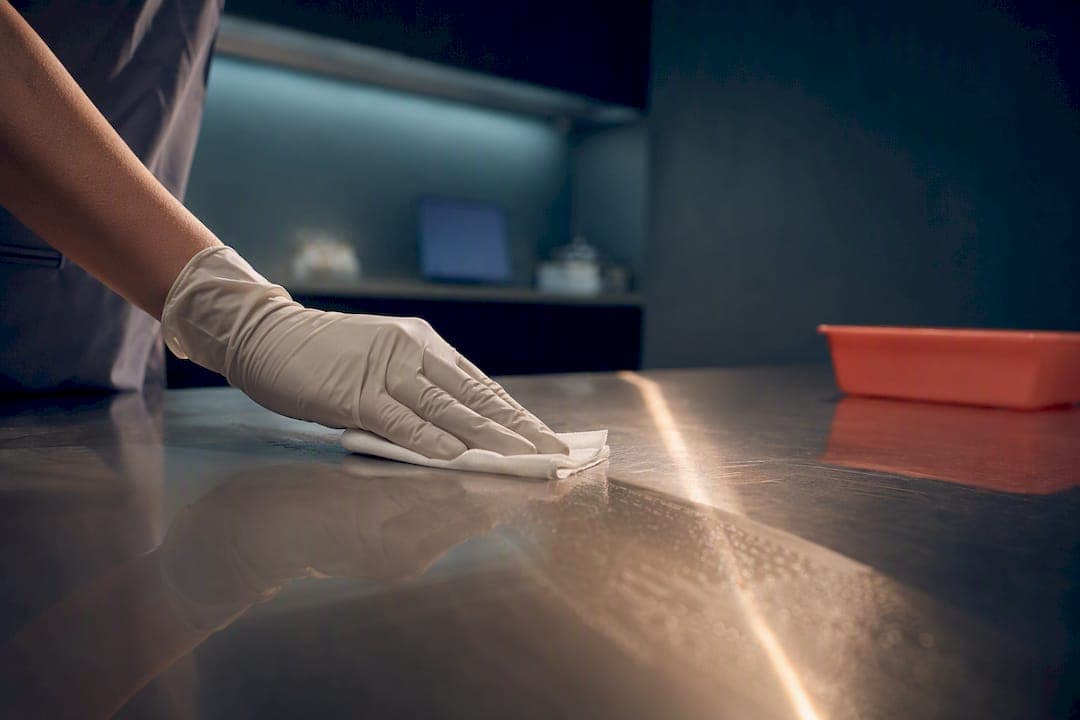
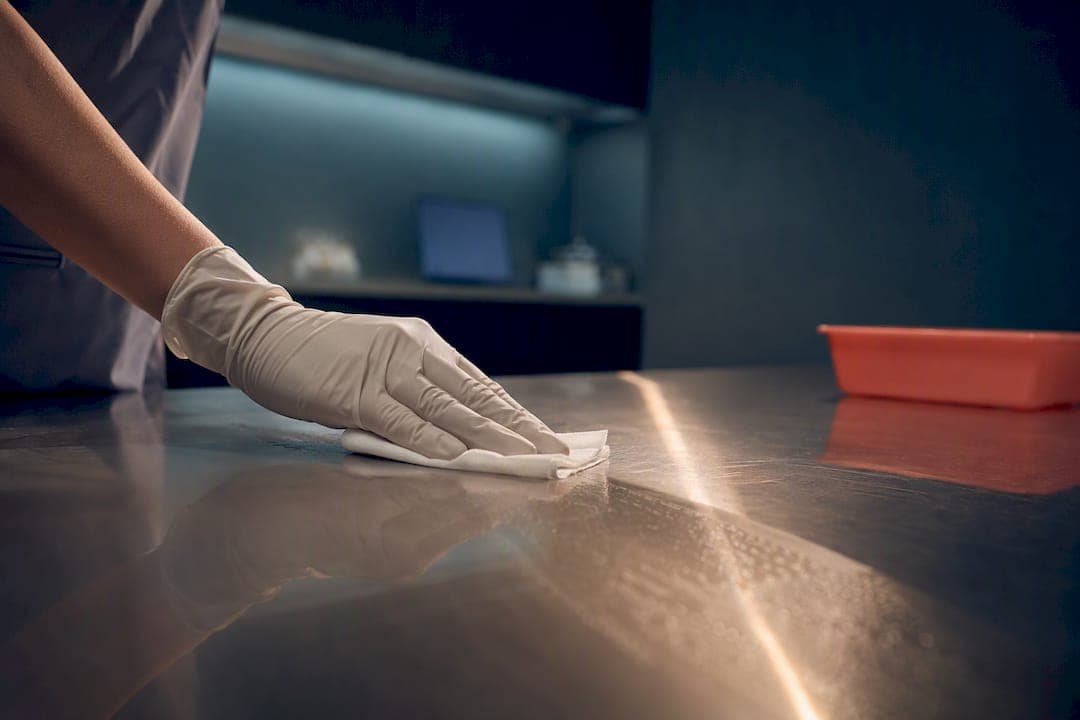
Contact time, also called dwell time or wet time, is the length of time a surface must stay visibly wet with a disinfectant to achieve the labeled kill claim. If the surface dries before that window closes, the disinfection is incomplete, regardless of which product you used. The operational rule is simple: check the label, keep the surface wet for the full stated time, and reapply if it flashes dry, following EPA guidance on registered disinfectants and CDC’s cleaning and disinfecting protocols.
TL;DR:
Find Supplies For Safer Disinfection
Browse medical supplies, equipment, and wellness products for clinics, hospitals, and healthcare professionals across the Americas.
Contact time isn’t a marketing suggestion. It’s a number generated during EPA registration testing, where a manufacturer proves a specific formulation kills specific organisms under specific conditions. Change the organism, the temperature, or the soil load, and the required time changes too.
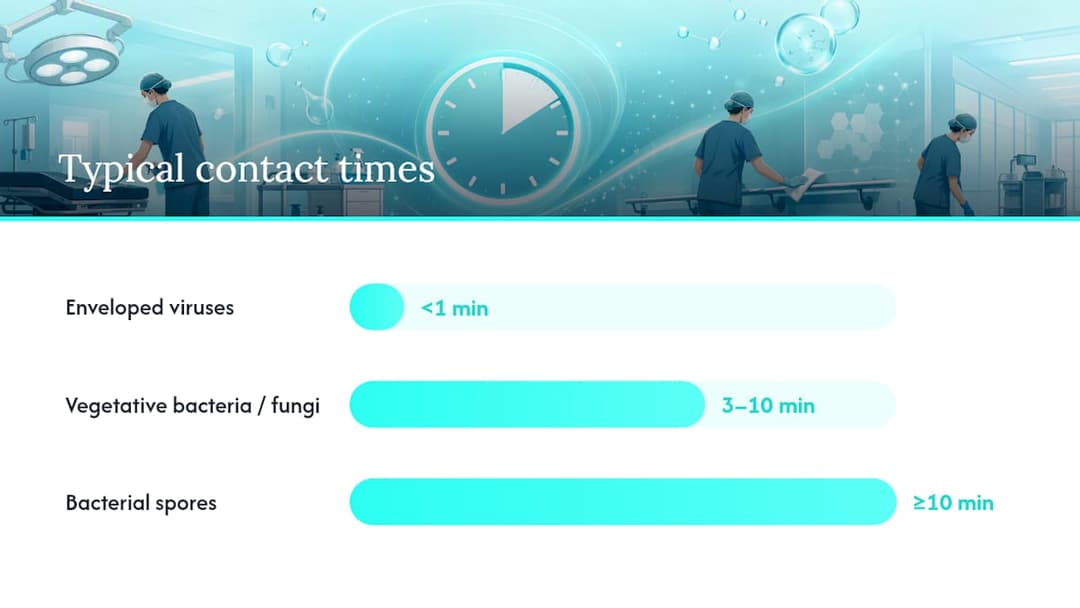
Most EPA-registered disinfectants are tested against a defense of indicator organisms: Staphylococcus aureus, Salmonella enterica, and Pseudomonas aeruginosa. These three cover the base case for “general disinfection” claims. A product might advertise a 30 second kill time against a specific virus while requiring 3 to 10 minutes for its broader bacterial claims. That gap is where a lot of facilities get tripped up: staff see the flashy number on the front of the bottle and assume it applies to everything the product touches.
A few terms get used almost interchangeably in the field, but they mean slightly different things:
The reason one bottle lists several numbers comes down to biology. Enveloped viruses tend to break down fast, sometimes in under a minute, because their lipid membranes are fragile. Vegetative bacteria and fungi typically need several minutes of exposure. Bacterial spores, if the product even makes a sporicidal claim, can require ten minutes or longer, and often a completely different chemistry altogether. The CDC’s guideline on chemical disinfectants walks through how concentration, temperature, and exposure time interact for each disinfectant class, and it’s worth keeping on hand for any facility writing its own SOPs.
The contact time printed in bold on the front label is a starting point, not always the complete picture. Verifying it takes three steps, in order.
If a product’s label lists organism-specific times but no single “general disinfection” figure, use the contact time associated with the EPA indicator organisms as your default. That’s the conservative baseline regulators expect facilities to fall back on when the label is ambiguous, a point confirmed by state environmental health guidance on determining contact time.
Whatever number you land on, write it into your facility’s SOPs by name, product, and minute count, not as “follow label instructions.” Auditors and surveyors ask staff to recite the contact time from memory during infection-control rounds. A vague answer, even from a competent tech, reads as a training gap on paper.
Getting the labeled contact time in real clinical conditions takes more than pouring on solution and waiting. It takes a workflow, and the workflow starts before the disinfectant ever touches the surface.
Environmental conditions push against you the whole time. Heat and airflow from HVAC vents or open windows accelerate evaporation. Low humidity does the same. In rooms with heavy air turnover, staff sometimes need to choose a slower-evaporating chemistry or apply a second, deliberate reapplication partway through the contact window.
Pro Tip: Turn “wetness checks” into a two-second habit staff perform out loud during rounds, saying “still wet” or “reapplying” as they work. Verbalizing it turns a passive assumption into an active checkpoint, and it trains new staff faster than any written SOP does.
Format matters more than most buyers assume when they’re comparing options like pre-wetted wipes, ready-to-use sprays, and concentrates that require dilution.
Routine surface disinfection, high-level disinfection, and chemical sterilization aren’t interchangeable terms, and confusing them is a real patient-safety risk on semicritical or critical devices.
Temperature and immersion aren’t optional details here. A glutaraldehyde solution that’s fallen below its validated temperature range won’t reach its labeled kill within the stated time, even if the clock says the minutes have passed. Always follow the device manufacturer’s Instructions for Use (IFU) first, and cross check against your specialty society’s reprocessing guidelines when the two seem to conflict.
Most contact time failures trace back to a short list of repeat offenders.
When disinfection results look questionable, re-clean and reapply rather than assuming the first pass worked. Document what happened, and if the concern is recurring rather than a one-off, consider ATP or swab testing to confirm surfaces are actually clean before your next round of retraining.
A workable checklist doesn’t need to be complicated. It needs six steps staff can run through without thinking twice:
Queenssurgical’s guides on cleaning versus disinfection versus sterilization and UV sterilization evidence for clinics go deeper on adjacent workflow questions. Stock enough wipes and solution to avoid running dry mid-shift; a facility supplies par-level guide helps set reorder points before that becomes a problem.
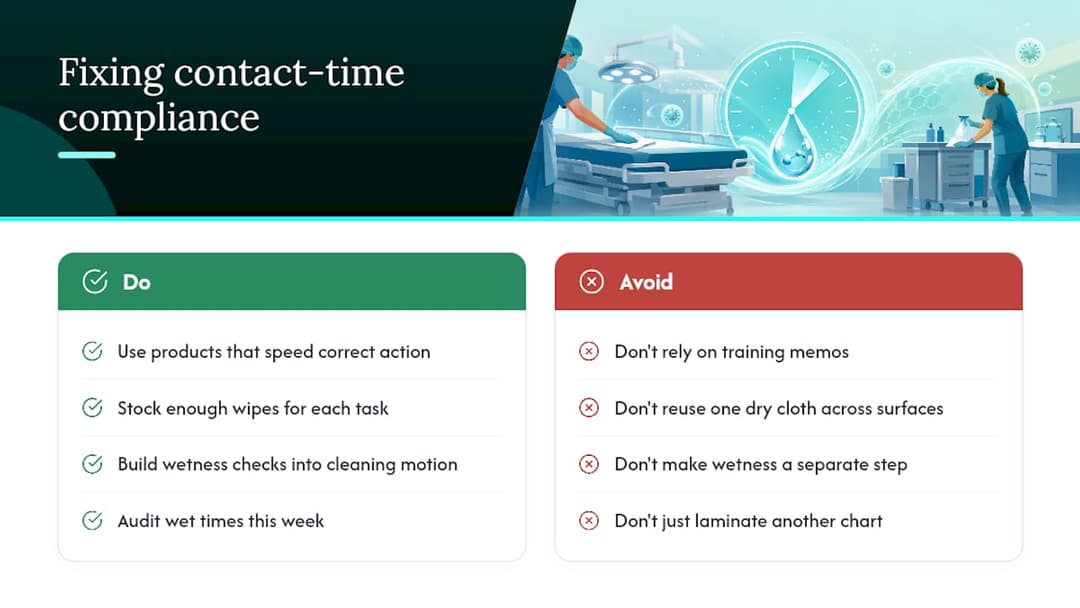
The gap between a disinfectant’s label and what actually happens on a busy unit isn’t a knowledge problem. Most clinical staff know contact time exists. It’s a time-pressure problem: a nurse with four rooms to turn over in fifteen minutes isn’t going to stand and watch a wet surface for the full labeled window, and no amount of poster signage changes that math.
The fix isn’t more training memos. It’s picking products and formats that make the correct behavior the fastest behavior, stocking enough wipes that nobody stretches one dry cloth across three surfaces, and building wetness checks into the physical motion of cleaning rather than treating them as a separate mental step. Facilities that treat contact time as a supply chain and workflow design problem, not just an education problem, get better real-world compliance than ones that just laminate another chart. If your unit hasn’t audited actual wet times in the last quarter, that’s a fifteen-minute walk worth doing this week.
— QB
Getting contact time right consistently comes down to having the right product on hand in the right format, not just knowing the rule. Queenssurgical stocks disinfectant sprays, pre-wetted wipes, and concentrates alongside the PPE and training resources that support a full infection-control program, including options like the Lysol multi-surface disinfectant spray for teams standardizing their supply cart.
If your facility is running short mid-shift or rebuilding par levels after an audit finding, that’s exactly the kind of procurement problem a wholesale medical supplier solves better than piecemeal retail ordering. Browse the infection-control catalog at Queenssurgical or reach out directly for bulk pricing and par planning support, so the correct contact time practice stays the easy option, not the one your staff skip when the unit gets busy.
This article is general information, not a substitute for advice from a qualified doctor. Consult a qualified healthcare professional about your own circumstances before acting on anything here.
It means the disinfectant must remain visibly wet on the surface for a full two minutes to achieve its labeled kill claim; if it dries sooner, reapply and restart the clock.
Check the product label directions first, then the SDS, and if either is unclear or missing, search the EPA’s Pesticide Product and Label System using the registration number on the bottle.
The chemical needs sustained exposure to break down microbial cell walls or proteins, and cutting that exposure short, by wiping dry too early, leaves organisms alive on a surface that looks clean.
It ranges widely: some virus claims take as little as 30 seconds to a few minutes, general bacterial disinfection often runs 1 to 10 minutes, and high-level disinfection or sterilant processes can take 12 minutes to several hours depending on the chemistry.
Alcohol in the 60% to 80% range, including 70%, typically outperforms 90% or 99% concentrations because the added water content supports the protein denaturation that actually kills organisms, and it evaporates more slowly.
What CDC, OSHA, AORN and WHO say about double gloving, when to do it, how to don two pairs, and what procurement teams should stock for compliance.
Mayo and Metzenbaum scissors look alike but do different jobs. See how blades, shanks and tips differ, when to use each, and how to care for them.
Sterile water or saline? Learn the difference in tonicity, safe uses, wound irrigation evidence, and how to choose irrigation and dressing supplies.