
Double Gloving Guidelines: What U.S. Teams Should Follow
What CDC, OSHA, AORN and WHO say about double gloving, when to do it, how to don two pairs, and what procurement teams should stock for compliance.
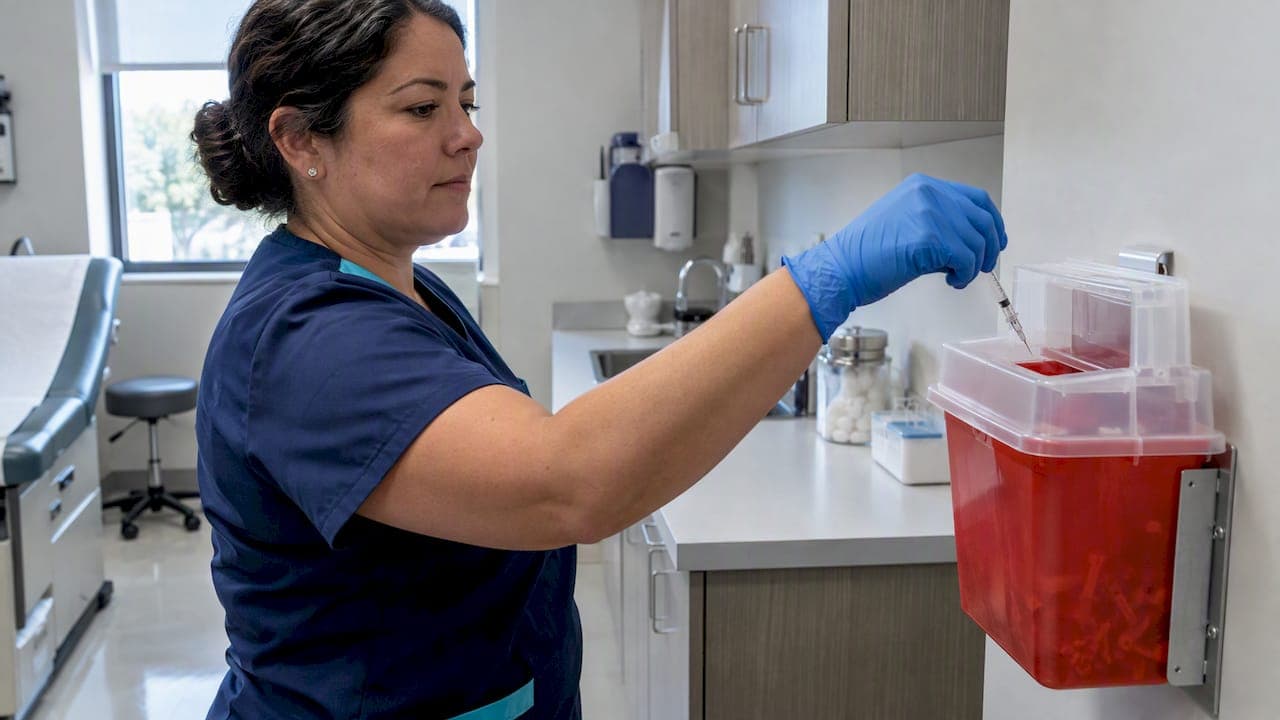
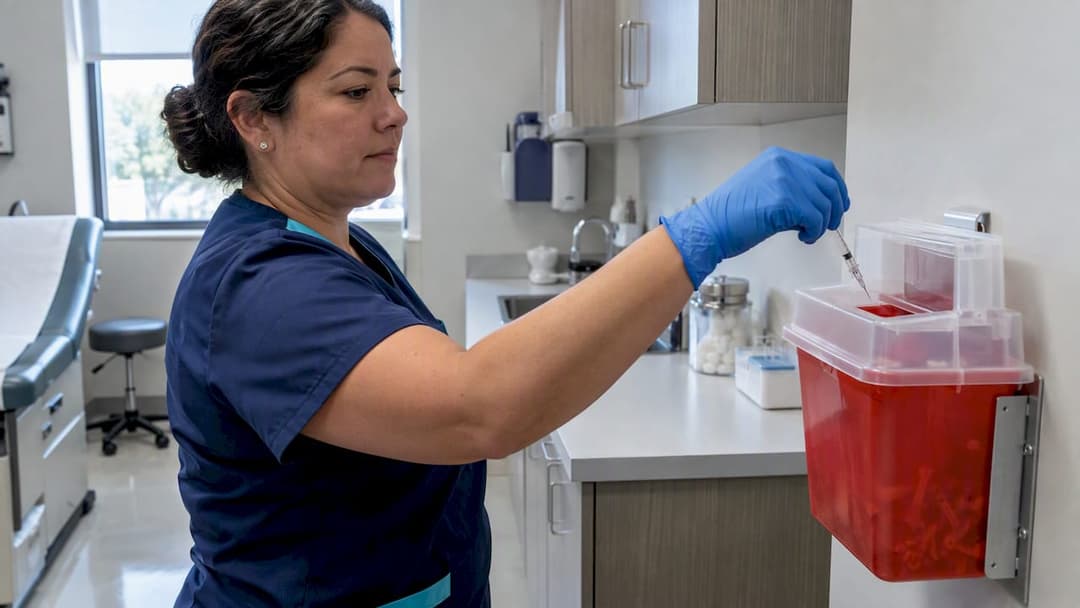
Federal rules require every healthcare facility to use closable, puncture-resistant, leakproof, labeled sharps containers placed as close as feasible to the point of use. Containers must be closed at the manufacturer’s fill line, generally set below full capacity to prevent overfilling, and never opened or emptied by hand. Beyond that federal floor, facilities need to confirm their own state’s disposal pathway with their medical waste vendor, since pickup, transport, and permitting rules vary by state.
TL;DR:
Equip Safer Sharps Disposal
Browse medical supplies and equipment for healthcare settings as you review your facility’s sharps container needs.
Before your next audit or vendor visit, verify the basics on the floor rather than on paper. A short walk-through catches the gaps that written policies miss.
Pro Tip: Keep a laminated one-page version of this checklist in each unit’s supply closet so any staff member can self-audit between formal reviews.
Document anywhere staff admit to recapping needles, bending them, shearing them, or manually emptying a container. Those practices are prohibited outright, and a single documented instance should trigger retraining, not just a note in a file.
No single container works for every unit in a hospital. The CDC’s guidance on selecting sharps disposal containers frames container choice as a hazard analysis, not a catalog pick, and procurement teams get better results when they treat it that way.
Our guide to matching container sizes to clinical workflow walks through sizing math for common unit types if you want to go deeper on the volume calculation.
Containers that are compliant at the point of use can still create risk between the exam room and the loading dock. Operational discipline during removal and transport closes that gap.
Our notes on biohazard bag color coding and storage requirements for healthcare facilities cover the labeling and storage pieces in more depth if your current documentation has gaps.
Reusable sharps containers can work, but only when the reprocessor backs them with documentation. Require vendors to provide sterilization and decontamination records for every return-to-service cycle, along with verification that the container still meets its original performance specifications, closable, puncture-resistant, leakproof, after reprocessing.
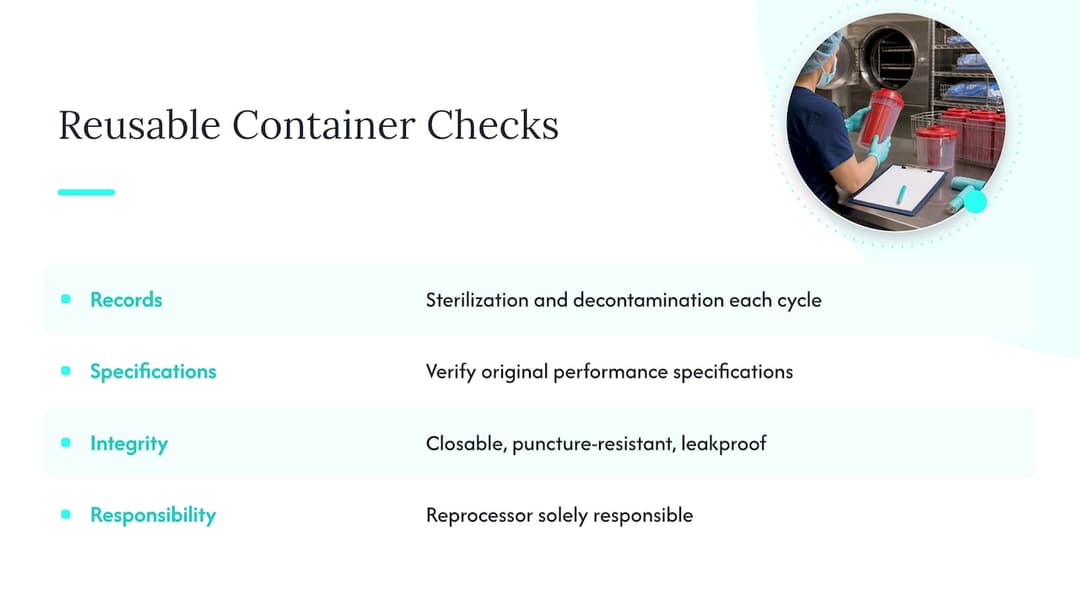
OSHA prohibits staff from manually opening, emptying, or cleaning containers at any point. That responsibility belongs entirely to the reprocessor, and your contract language should say so explicitly rather than leaving it implied.
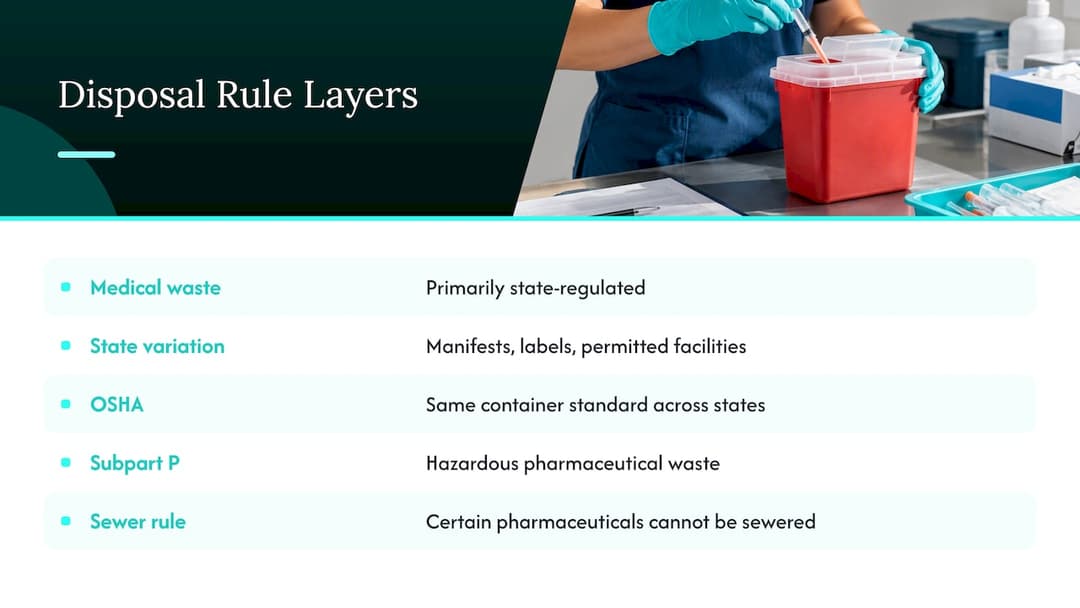
Medical waste disposal is primarily regulated at the state level, not federally, so the EPA’s medical waste resources point facilities toward their state environmental and health agencies for the specific rules that govern disposal pathways. Two facilities in different states can have different manifest forms, labeling conventions, and permitted treatment facility lists even while both follow the same OSHA container standard.
RCRA Subpart P adds a layer of federal rules on top of that for hazardous pharmaceutical waste, including a nationwide prohibition on sewering certain pharmaceuticals. If any of your sharps carry pharmaceutical residue, check whether your state has adopted Subpart P and whether your waste stream needs dual handling.
Keep a current contact list: your state environmental agency, your permitted treatment, storage, and disposal facility, and your hauler. Note any state-specific labeling or manifest forms directly in your Exposure Control Plan so the information doesn’t live only in someone’s inbox.
Once your hazard analysis is done, the next step is turning it into a procurement document your suppliers can actually quote against.
We carry biohazard medical waste bags and related disposables that fit directly into a sharps and contaminated waste procurement plan, and our infection control supplies guide is built for teams setting par levels across multiple units. Pairing a clear spec with a supplier who already stocks the right SKUs cuts the back-and-forth that usually slows down a tender process.
Budget pressure tempts procurement teams to chase the lowest unit cost on containers, but a cheaper container that increases needlestick risk costs more in the long run through exposure follow-up and lost staff confidence. During shortages, document any temporary container substitution clearly and switch back to an FDA-cleared option the moment one is available. Lock vendor pickup cadence and training obligations into the contract itself rather than trusting verbal commitments; a contract clause survives staff turnover, a handshake doesn’t.
— QB

We supply clinics and hospitals with disposables and equipment that keep compliance programs running, and our catalog of PPE, medical disposables, and instruments supports the kind of procurement spec outlined above. Whether you’re setting par levels for a single clinic or sourcing for a multi-site health system, our team can help match product selection to your hazard analysis and shipping needs. Browse our full product catalog to request a quote or sample, or check a product page like our self-adherent bandage listing to see the level of spec detail we provide on every SKU.
This article is general information, not a substitute for advice from a qualified doctor. Consult a qualified healthcare professional about your own circumstances before acting on anything here.
OSHA requires sharps containers to be closable, puncture-resistant, leakproof, labeled, and placed as close as feasible to the area where sharps are used, ideally within arm’s reach, according to OSHA’s Bloodborne Pathogens standard. Facilities should also confirm containers remain accessible and aren’t moved to locations that force staff to carry exposed sharps.
Containers should be closed and replaced once they reach roughly three-quarters full, the fill line referenced in FDA guidance on sharps containers and reinforced by CDC/NIOSH operational guidance. Overfilling increases the risk of needlestick injury during closure and handling.
No. OSHA prohibits manually opening, emptying, or cleaning sharps containers, including reusable ones; that responsibility belongs to a reprocessor who documents sterilization and return-to-service verification. Facilities should require this documentation directly in their vendor contracts.
No. Federal OSHA and FDA requirements set the baseline for container design and handling, but EPA resources on medical waste confirm that disposal pathways, manifests, and permitted treatment facilities are primarily governed by state agencies. Facilities should confirm their specific state’s requirements with their environmental agency and waste hauler.
During documented shortages, facilities can use alternative containers that still meet OSHA’s performance criteria, heavy-duty, puncture-resistant, leakproof, with an opening too small for a hand, per CDC/NIOSH shortage guidance. Facilities should document the substitution and return to FDA-cleared containers as soon as they’re available.
What CDC, OSHA, AORN and WHO say about double gloving, when to do it, how to don two pairs, and what procurement teams should stock for compliance.
Mayo and Metzenbaum scissors look alike but do different jobs. See how blades, shanks and tips differ, when to use each, and how to care for them.
Sterile water or saline? Learn the difference in tonicity, safe uses, wound irrigation evidence, and how to choose irrigation and dressing supplies.

