Double Gloving Guidelines: What U.S. Teams Should Follow
What CDC, OSHA, AORN and WHO say about double gloving, when to do it, how to don two pairs, and what procurement teams should stock for compliance.


Surgical drapes fall into two broad categories: reusable woven textiles and single-use nonwoven disposables, split further into subtypes like fenestrated, incise, laparotomy, and specialty drapes for cardiovascular or ophthalmic work. Systematic review evidence and CDC guidance show no clear advantage of disposable over reusable drapes for preventing surgical site infection, and adhesive incise drapes aren’t routinely recommended either. That leaves barrier rating, fluid handling, and procedure fit as the real deciding factors for procurement.
TL;DR:
Source Surgical Drapes With Confidence
Browse medical supplies from Queens Surgical, including quality products for healthcare professionals, clinics, hospitals, and procurement teams.
Reusable drapes are made from tightly woven cotton or cotton-polyester blends, treated with a fluid-repellent finish, then laundered and steam-sterilized between cases. A single drape can survive dozens of processing cycles before it’s retired, which is the entire economic argument for keeping a reusable inventory. Single-use drapes, by contrast, are built from nonwoven materials like spunbond-meltblown-spunbond (SMS) polypropylene or film laminates, used once, and disposed of as regulated medical waste or, in some facilities, recycled through specialized waste streams.
Neither category wins outright on infection prevention. A systematic review comparing disposable and non-disposable drapes found no consistent difference in surgical site infection rates between the two, which means the choice usually comes down to logistics, cost structure, and clinical fit rather than a proven safety edge.
Within both categories, several clinical subtypes cover distinct procedural needs:
Getting the subtype wrong doesn’t just create inconvenience. A drape with the wrong fenestration size forces circulating staff to improvise coverage mid-case, which is exactly the kind of sterile-field compromise infection control teams want to avoid.
The material determines the barrier, and the barrier is what a test report actually measures. Nonwoven disposables generally use SMS or SFSMS (spunbond-film-spunbond-meltblown-spunbond) constructions, where the meltblown layer provides the microbial and liquid barrier while the spunbond layers add strength and abrasion resistance. Film-laminated composites bond a continuous polyethylene film to a nonwoven substrate for areas expecting heavy fluid exposure, like the area around a laparotomy incision. Woven reusable textiles rely on tight thread counts plus a fluid-repellent treatment, and that treatment is exactly what degrades with repeated laundering.
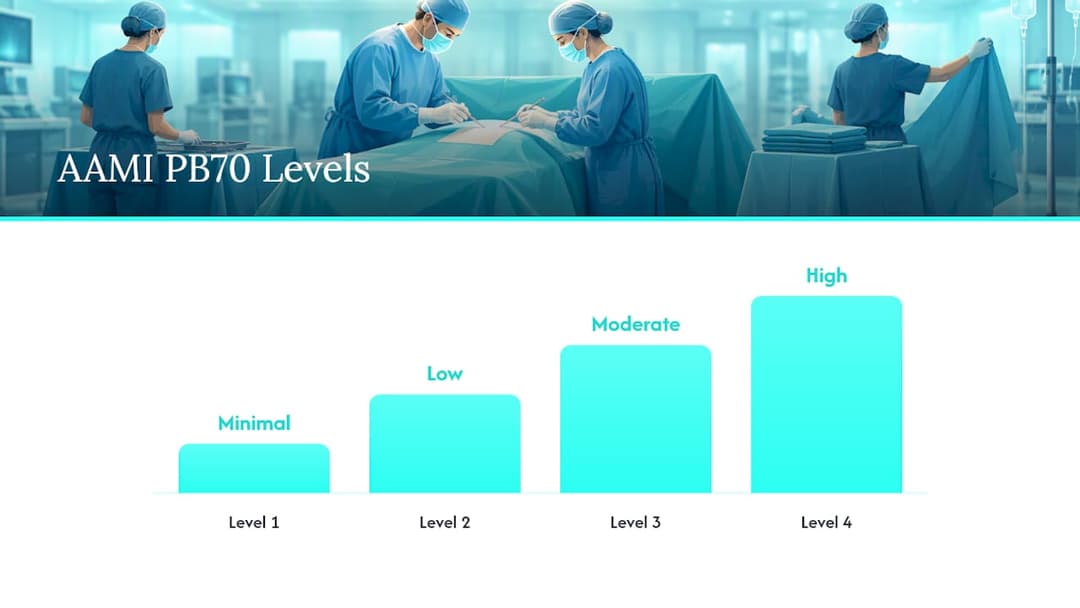
ANSI/AAMI PB70 is the standard that actually defines liquid barrier performance for drapes and gowns, classifying products into four levels based on resistance to fluid penetration under increasing pressure and volume. Level 1 offers minimal fluid resistance suited to low-risk procedures; Level 4 is rated for high-fluid, high-pressure exposure, the kind seen in orthopedic and trauma cases. ASTM F1670 and F1671 are the underlying test methods AAMI PB70 references, measuring resistance to synthetic blood penetration and to viral penetration respectively.
Pro Tip: Never accept a marketing claim of “Level 3” or “Level 4” barrier protection without the actual ASTM F1670/F1671 test report behind it. A basis-weight number on a spec sheet tells you the material’s density, not its verified barrier performance.
When evaluating a manufacturer’s claims, ask for these specific data points:
A 510(k) summary for a Kimberly-Clark surgical drape claiming AAMI Level 4 performance illustrates the pattern: the filing ties a specific material construction to a specific barrier classification, which is precisely the kind of documentation a buyer should request rather than relying on a catalog description alone.
Fenestration sizing isn’t a minor detail. A laparotomy drape needs a fenestration wide enough to accommodate large abdominal incisions and instrument traffic, while a microsurgery or ophthalmic drape needs a fenestration measured in centimeters, not inches, to keep the sterile field tight around a small operative site. Get the sizing wrong in either direction and you either expose unprepped skin or restrict the surgeon’s access.
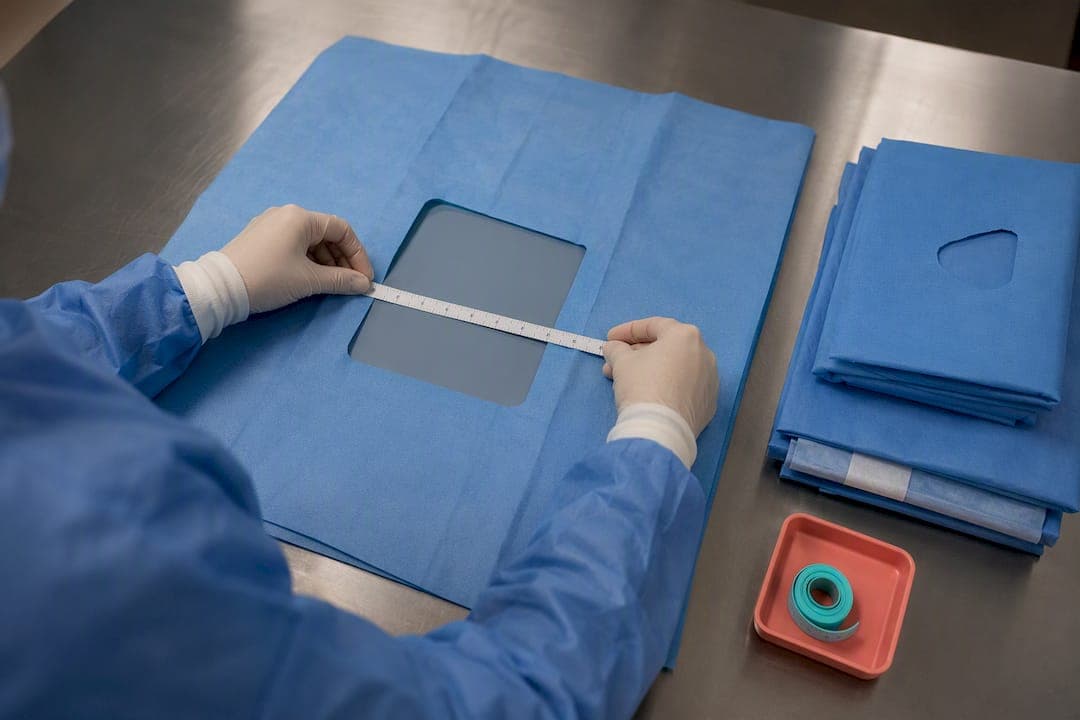
Beyond fenestration size, modern disposable drapes increasingly bundle features that speed up setup rather than improve infection outcomes directly. Manufacturer selection guides describe integrated pouches, adhesive tabs, and tubing organizers as workflow tools, and that operational value is often the real justification for choosing one drape design over another even when the infection-prevention case is unproven.
Common built-in features worth checking during procurement:
Staff preference matters more than most procurement teams admit. A drape that technically meets every barrier spec but tears easily during application, or whose adhesive releases under normal handling, gets worked around by OR staff, and workarounds are where sterile-field integrity actually breaks down.
Adhesive incise drapes don’t have a strong evidence base behind routine use. Cochrane and related systematic review data report no reliable reduction in surgical site infection when incise drapes are added to standard skin prep, and the overall quality of that evidence is rated low to very low due to inconsistent study design across trials. The CDC’s 2017 SSI prevention guideline goes further, stating plastic adhesive drapes, with or without antimicrobial treatment, are not necessary for SSI prevention. That’s a Category II recommendation, meaning it’s a weak but still evidence-based position, not an outright prohibition.
Iodophor-impregnated incise drapes complicate the picture slightly. Some facility policies specify iodophor drapes for high-risk cases, and there’s a legitimate argument for selective use where local infection rates or specific patient factors warrant extra caution. Routine use across all case types, though, isn’t what the guidance supports.
Practical downsides show up in the OR regardless of the SSI question:
Pro Tip: If your facility uses incise drapes selectively, document the clinical rationale (patient risk factors, procedure type) rather than applying them as a blanket default. That documentation matters if infection control audits ever ask why a specific product was used.
Every wash-and-sterilize cycle chips away at a reusable drape’s barrier performance. The fluid-repellent finish that gives woven textiles their protective quality breaks down with repeated laundering, and industry practice standards recommend tracking reuse counts precisely because that degradation isn’t always visible to the naked eye. Lint generation also increases as fabric ages, raising the risk of fiber shedding into the sterile field, an underappreciated contamination pathway.
A defensible reprocessing program follows a few consistent steps:
Pro Tip: Facilities that skip step 3 and rely purely on visual inspection tend to keep drapes in circulation well past the point where barrier performance has quietly dropped below spec.
Lifecycle cost comparisons need to go beyond the sticker price of a disposable versus the purchase price of a reusable drape. Processing labor, water and energy use, storage space, and repair labor all factor into the real cost of a reusable program, while disposables carry no processing cost but generate a continuous waste stream and per-use purchase cost. Depending on a facility’s local utility rates and case volume, the economic case can tip either direction, which is one more reason the SSI-risk argument alone shouldn’t drive the decision.
Buying the right drape starts with matching the barrier level to the actual fluid exposure risk of the procedure, not the procedure’s general reputation for being “high risk.” A checklist keeps that matching process consistent across a purchasing team instead of depending on individual judgment call by call.
Run every drape purchase through these questions before finalizing an order:
Red flags worth walking away from include vague barrier language like “fluid-resistant” without a specified AAMI level, suppliers unable to produce any ASTM test data, and pricing that seems too low relative to the stated barrier class, which often signals an unverified claim rather than a genuine deal.
| Decision Factor | Critical/High-Risk Procedures | Routine/Economy Procedures |
|---|---|---|
| AAMI PB70 level | Level 3 or 4 with verified test reports | Level 1 or 2 generally sufficient |
| Fenestration type | Procedure-specific custom fit | Standard fenestration acceptable |
| Adhesive incise use | Selective, with documented rationale | Rarely necessary |
| Documentation required | Full 510(k) and ASTM reports on file | Supplier spec sheet with AAMI level stated |
| Reuse policy (if reusable) | Strict cycle tracking, low retirement threshold | Standard facility tracking protocol |
Building procedure-specific kits around this matrix, rather than buying a single drape type facility-wide, tends to reduce both overspending on unnecessary barrier levels and underprotection on genuinely high-fluid cases. A procurement guide to surgical suite consumables can help structure par levels once the kit composition is set.
Surgical draping wasn’t always about infection prevention at all. Early modern surgery in the late 1800s used simple cotton or linen sheets primarily to define a work area and maintain a degree of modesty, with germ theory still gaining acceptance among surgeons. As antiseptic and later aseptic technique took hold in the early 20th century, drapes shifted toward reusable woven cotton, laundered and steam-autoclaved between cases, a practice that remained the surgical standard for decades.
The real material shift came with the rise of nonwoven synthetics in the 1970s and 1980s. Spunbond and meltblown polypropylene fabrics offered something woven cotton couldn’t: a consistent, engineered barrier that didn’t depend on a fluid-repellent finish wearing off over repeated laundering cycles. That development coincided with growing hospital concern over reprocessing costs and cross-contamination risk in central sterile departments.
Fenestrated and procedure-specific designs emerged alongside the shift to disposables, since manufacturers could mold nonwoven materials into shapes and features that woven textiles couldn’t easily replicate; think integrated pouches or pre-formed extremity sleeves. The standards infrastructure caught up later. AAMI PB70 wasn’t formalized until the 2000s, giving the industry a common language for barrier claims that had previously varied wildly between manufacturers. Today’s drape market reflects that history directly: a reusable segment built on decades of laundering infrastructure, and a disposable segment built on synthetic material science that keeps adding procedure-specific features.
Disposable drapes generate a continuous, visible waste stream. Every case produces regulated medical waste that requires incineration or specialized disposal, and that volume adds up fast in a high-throughput surgical facility running dozens of cases daily. Reusable drapes avoid that per-case waste entirely but shift the environmental cost elsewhere: water use, detergent chemicals, and energy consumption for industrial laundering and steam sterilization, all recurring rather than one-time.
Neither option is environmentally neutral, and the honest comparison depends heavily on a facility’s specific infrastructure. A hospital with efficient, high-volume laundering equipment and access to renewable energy sources may find reusable drapes clearly favorable on a lifecycle basis. A facility with older, water-intensive laundering equipment or unreliable utility access might find the environmental math less favorable for reusables than it initially appears.
Some facilities are pursuing middle-ground approaches: recycling programs for nonwoven polypropylene waste, hybrid drape systems that pair a reusable base sheet with disposable fenestrated inserts, and sourcing decisions that favor suppliers with documented waste-reduction programs. None of these fully resolve the trade-off, but they reflect a growing recognition that the sustainability conversation around drapes is now a real procurement criterion, not just a clinical afterthought. Facilities weighing this decision often find it useful to model both waste volume and utility cost per case rather than defaulting to whichever category their facility has always used.
Drape shifting during a procedure is one of the most common practical complications, and it’s almost always a mechanical failure rather than a material one. Inadequate adhesive contact, drape sizing that doesn’t match the patient’s body habitus, or improper application technique can all cause a drape edge to lift mid-case, exposing unprepped skin near the incision. The fix is usually procedural: verify adhesive contact immediately after application, choose drape sizing based on actual patient measurements rather than a one-size default, and train staff on proper application pressure and sequence.
Fluid pooling and strike-through represent a different failure mode. When a drape’s barrier level doesn’t match the actual fluid volume of a procedure, saturation can occur, and once a nonwoven or treated woven barrier is saturated, it stops functioning as a barrier at all. This is precisely why matching AAMI PB70 level to real procedural fluid exposure matters more than defaulting to a mid-range product across every case type.
Contamination from lint shedding, torn packaging, or compromised sterility during storage rounds out the most frequent issues. Reusable drapes nearing the end of their reprocessing life shed more fiber; disposable drapes with damaged outer packaging may have compromised sterility before they ever reach the field. Visual inspection immediately before draping, consistent storage conditions that avoid moisture and temperature extremes, and a clear retirement policy for aging reusable stock address most of these failure points before they become clinical problems.
Antimicrobial-treated nonwoven fabrics represent one of the more active areas of material development, with manufacturers experimenting with silver-ion or other antimicrobial coatings integrated directly into the drape material rather than relying solely on adhesive incise layers. The evidence base for these coatings translating into measurable SSI reduction is still developing, and buyers should apply the same scrutiny to antimicrobial claims that they’d apply to any barrier claim: ask for the underlying test data.
Smart material research is pushing toward drapes with better breathability without sacrificing barrier performance, addressing a long-standing complaint that high-barrier nonwovens can trap heat and moisture against staff and patients during long procedures. Some newer laminate structures aim to solve this with microporous films that block liquid strike-through while allowing vapor transmission.
Radiolucent and imaging-compatible materials continue to improve as well, driven by the growing share of procedures that combine open surgery with intraoperative fluoroscopy or navigation systems. And on the sustainability front, some manufacturers are piloting take-back recycling programs for used polypropylene drapes, converting surgical waste into other plastic products rather than sending it straight to incineration. None of these innovations have fully displaced the core reusable-versus-disposable decision, but they’re gradually narrowing the gap between what each category can offer.
Most procurement teams don’t need another lecture on infection control theory. They need a supplier who can produce a test report on request, ship a sample before a full order, and answer a direct question about AAMI level without a runaround. That’s the gap Queenssurgical is built to close for surgical drapes and related consumables.
The evidence in this guide points to a clear operating principle: since disposable and reusable drapes perform comparably on infection outcomes, the decision should hinge on documentation quality, procedure fit, and total cost, not brand reputation alone. Queenssurgical’s role is making that documentation easy to get, whether a buyer is comparing barrier claims across drape materials or assembling procedure-specific kits for a new service line.
— QB
Requesting a sample before committing to a par-level order isn’t extra caution. It’s the fastest way to confirm a drape actually performs the way its spec sheet claims before it’s on your shelf in bulk.

A reputable supplier working across the Americas can provide both wholesale and retail options, enabling buyers ranging from small clinics to large hospital systems to access test documentation and sample requests. Ask for the AAMI PB70 level and any available ASTM F1670/F1671 or 510(k) reference documents before finalizing a category-wide switch, and consider trialing a new drape line on a limited case mix before rolling it out facility-wide.
Browse the full medical disposables and PPE catalog to compare drape options alongside related items like disposable coveralls and nonwoven self-adherent bandages for building out a complete procedure kit. Request a quote or sample directly through the site to get your par-level order started.
The main types include fenestrated drapes, incise (adhesive) drapes, laparotomy or full-sheet drapes, and specialty designs for ophthalmic, cardiovascular, urology, and arthroscopy procedures. Each is built as either a reusable woven textile or a single-use nonwoven disposable, chosen based on procedure fit and required barrier level.
Standard technique involves draping from the incision site outward, using a fenestrated drape to expose only the prepped surgical field while covering the rest of the patient and adjacent equipment. Adhesive incise drapes add a sealed film layer directly over the skin within the fenestration, though CDC guidance does not recommend this as a routine step for infection prevention.
High-fluid-exposure areas call for drapes rated at AAMI PB70 Level 3 or Level 4, which are tested under ASTM F1670/F1671 methods for resistance to blood and viral penetration under pressure. Orthopedic, trauma, and cardiovascular cases typically fall into this category and often use drapes with integrated fluid-collection pouches.
Nursing and outpatient settings more often use lighter-weight, lower-barrier disposable drapes for minor procedures, dressing changes, and exam-table coverage, where fluid exposure risk is lower than in the operating room. These typically sit at AAMI PB70 Level 1 or 2, sufficient for routine clinical use without the heavier barrier requirements of surgical suites.
No. Systematic review evidence shows no consistent difference in surgical site infection rates between disposable and reusable drapes. The choice should be based on barrier rating, procedure fit, and lifecycle cost rather than an assumed safety advantage for either category.
Queenssurgical’s catalog includes medical disposables and related consumable categories sourced to match documented barrier and procedure requirements. Current product availability and pricing are listed directly on the site.
What CDC, OSHA, AORN and WHO say about double gloving, when to do it, how to don two pairs, and what procurement teams should stock for compliance.
Mayo and Metzenbaum scissors look alike but do different jobs. See how blades, shanks and tips differ, when to use each, and how to care for them.
Sterile water or saline? Learn the difference in tonicity, safe uses, wound irrigation evidence, and how to choose irrigation and dressing supplies.