
Double Gloving Guidelines: What U.S. Teams Should Follow
What CDC, OSHA, AORN and WHO say about double gloving, when to do it, how to don two pairs, and what procurement teams should stock for compliance.


An each is the single sellable unit with its own barcode, the thing a customer actually receives, while a case pack is the fixed count of those eaches inside one shipping carton and the conversion factor you apply across inventory, shipping, and receiving. The practical rule: stock and ship by eaches when a channel demands flexibility, like direct-to-consumer orders, and lean on case packs when wholesale efficiency or retailer mandates take priority. Get the pack count wrong across your product data, labels, and advance ship notices, and you invite receiving errors and chargebacks.
TL;DR:
Source Medical Supplies With Confidence
Browse gloves, masks, instruments, equipment, and wellness products for your clinic, hospital, or healthcare organization.
An each is the smallest unit a buyer can purchase on its own, carrying its own UPC or GTIN-12. A case pack is the number of those eaches packed into one master shipping carton, and it becomes the multiplier you use whenever you move between selling units and shipping units. Between the two sits the inner pack, sometimes called a warehouse pack: a bundle of eaches grouped inside the case but smaller than the full case, built so a store or distribution center can break bulk without tearing open the whole carton.
The math only works when everyone uses the same numbers. Say a case pack holds 24 eaches, as in one common example from GS1 pack-count conventions: a pallet of 48 cases then contains 1,152 eaches. That single multiplier, 24, has to appear identically in your product master, on the case label, and in every purchase order line that references the item.
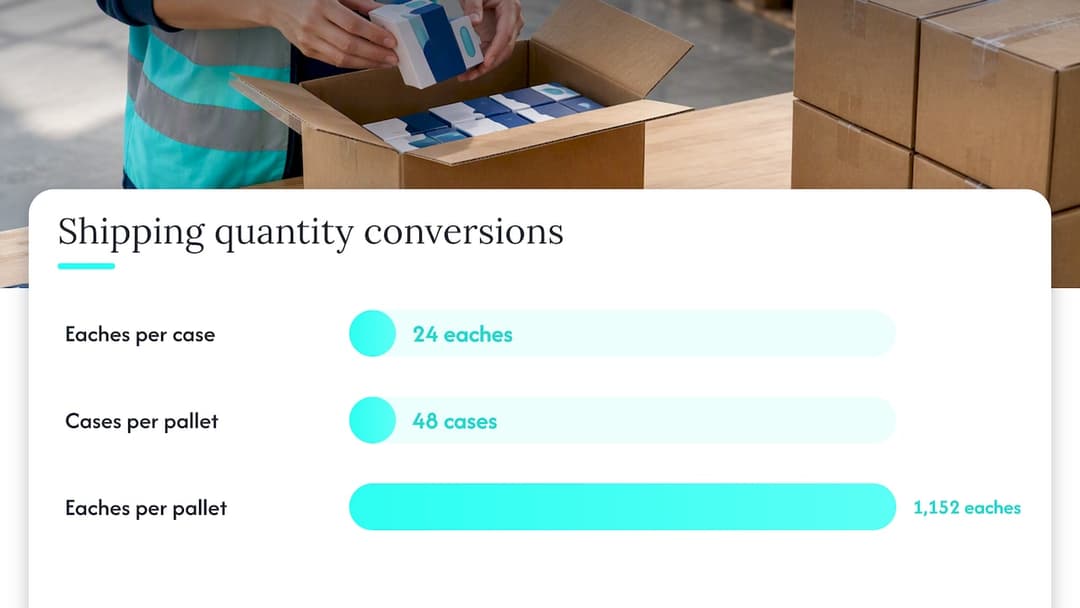
Retailers and distributors routinely place purchase orders in case quantities, while your sales reports, POS feeds, and consumption data run in eaches. Skip the conversion step and your reconciliation breaks immediately; a buyer who orders 10 cases expecting 240 units but receives a system record showing “10 units” will flag a shortage that never existed.
Keep these three levels distinct in your own records:
Every packaging level needs its own identifier, and mixing them up is one of the most common causes of warehouse receiving errors. The each carries a UPC or GTIN-12. The case carries a GTIN-14 (sometimes printed as an ITF-14 barcode or encoded in GS1-128), a separate number from the each-level code. Pallets carry an SSCC, a serial shipping container code that ties the physical load to its advance ship notice.
GS1’s GTIN management guidelines are explicit on when a new case-level GTIN is required: any change to the quantity inside a case, say a shift from 8 units to 12, forces a new GTIN at that packaging level. The each-level code generally stays the same since the consumer unit hasn’t changed, but the case identity has, and systems downstream need to see that difference to avoid pulling stale pack-count data.
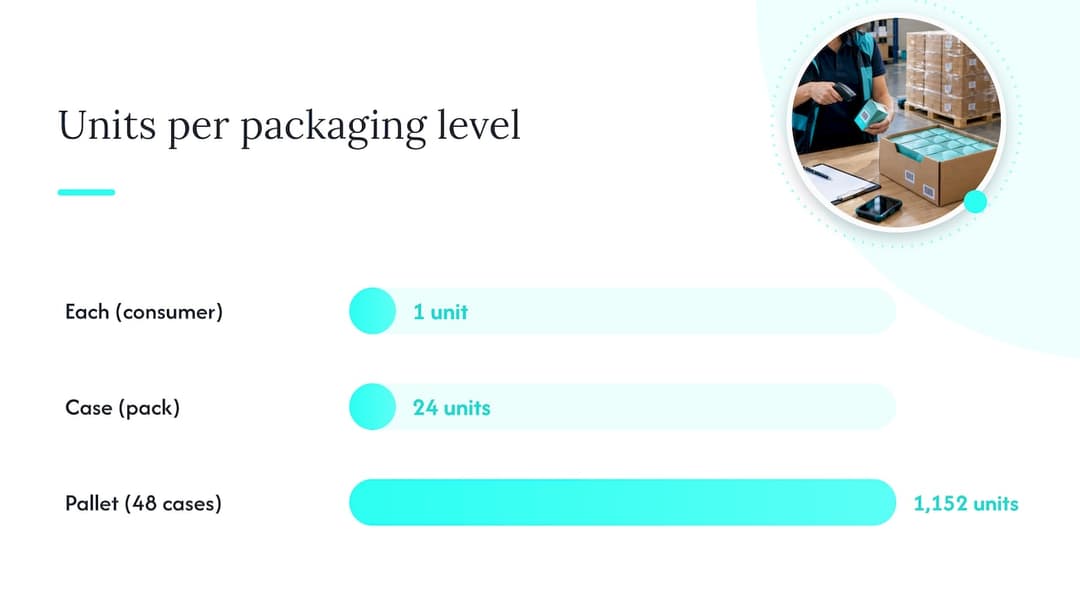
A pallet of 48 cases at 24 eaches per case works out to 1,152 individual units, a figure that only holds true as long as the case-level GTIN still matches a 24-unit pack. Change the case contents without issuing a new GTIN and every downstream system, from your WMS to the retailer’s receiving dock, is working off a number that no longer reflects reality.
Common mistakes that cause real damage:
Any of these can trigger a chargeback or a misreceipt at a retailer’s dock, since the barcode scanned on arrival won’t match what the purchase order expected.
The most frequent inventory error in wholesale happens when one team records transactions in cases and another records them in eaches, and nobody applies the conversion consistently. According to practitioner guidance on case-pack reconciliation, this mismatch in units of measure is the root cause behind most of the off-by-multiples errors that show up in sell-through and velocity reports.
The fix is mechanical once you see it. If a purchase order shows 50 cases at a 24-unit case pack, that’s 1,200 eaches entering inventory, and every sell-through calculation after that needs to reference eaches, not cases, or the numbers drift. Our guide on inventory turnover for medical supplies walks through weeks-of-cover math using the same each-level basis.
A quick worked example: say a SKU sells 180 eaches a week, you hold 720 eaches on hand, and the case pack is 24. That’s 4 weeks of cover, and a reorder point set at 2 weeks of cover means triggering a new order once stock drops to 360 eaches, which rounds to 15 full cases.
Four fields in your product master deserve a dedicated audit, not a one-time entry:
Pro Tip: Lock the units-per-case field at the SKU level in your ERP and require a dated revision log whenever a supplier changes case contents, so old purchase orders don’t get reconciled against the wrong multiplier.
Retailers and fulfillment partners enforce their own rules for how case-packed inventory arrives, and most of those rules exist to prevent exactly the reconciliation errors described above. Operational guidance on pack hierarchy points to a consistent pattern: case contents must match what the label and ASN declare, every case in a shipment should hold the same quantity unless clearly marked otherwise, and pallet labels need an SSCC that lines up with the shipment’s advance ship notice.
Typical channel-level expectations include:
Inner packs earn their keep in 3PL and retail environments because they let a warehouse pull a smaller bundle for replenishment without cracking open a full master carton, which case-pack configuration research describes as a deliberate compromise, often a vendor pack of 48 split into warehouse packs of 12. Breaking a sealed case that wasn’t designed to be split adds labor time and repackaging cost that a well-planned inner-pack structure avoids.
Before shipping inbound: confirm barcode placement on each case face, verify the barcode type matches what the receiving partner scans, and make sure the ASN states the case-pack count explicitly rather than assuming the receiver will infer it.
Choosing a pack configuration per SKU comes down to weighing handling cost against order flexibility, and the right answer changes by channel and by product.
Run each SKU through this checklist:
At a glance: eaches win on flexibility and lose on handling cost per unit; case packs win on handling efficiency and lose on order flexibility; labeling complexity tends to rise with serialized or regulated products regardless of which pack level you choose.
A direct-to-consumer seller generally wants eaches available even when case packs exist upstream. A big-box retailer will often mandate case-level shipping outright. A healthcare or sterile-product buyer needs to check MOQ against case pack size before assuming they can order below it, something our piece on retail versus wholesale medical supply differences covers in more depth.
Pro Tip: When a product carries both a sterilization-driven MOQ and a standard case pack, confirm in writing whether the MOQ equals one case or several, since suppliers sometimes quote MOQ as a multiple of case pack rather than the case pack itself.
Across our catalog of medical equipment, wound care, respiratory, urology, and disposable supplies, we list pack-level details on individual product pages so buyers can see unit counts before ordering. We work with both individual medical professionals placing smaller orders and larger purchasing organizations that need wholesale case quantities, and our customer service team fields questions on MOQ and case-pack specifics directly. When a buyer needs a custom pack configuration or label requirement that isn’t listed on a product page, we recommend reaching out to our sales team before placing the order so expectations match what ships.
If a SKU moves fewer than a handful of units a week at a given location, stock it in eaches; once weekly demand per location climbs past a full case, switch to case-level replenishment and never look back. The real risk isn’t picking the wrong pack level once, it’s a supplier changing case contents without telling anyone and nobody updating the GTIN or the dated revision log to match.
— QB
Ordering medical consumables shouldn’t mean guessing whether a listed quantity means one unit or a full case. We supply gloves, wound care, respiratory, urology, PPE, and instrument lines in pack sizes that fit both single-clinic orders and larger wholesale purchases, and our medical supply categories show pack details on the product page itself.

If your procurement team is still deciding between stocking by the case or by the each, start by checking current pack sizes on our category pages and reach out with your specific volume needs.
A case pack is the fixed number of individual sellable units, or eaches, packed into one master shipping carton, and retailers often use it as the standard quantity for purchase orders. It’s set by the manufacturer or supplier and typically stays fixed until a pack-count change triggers a new case-level identifier.
Packaging refers to the hierarchy of containers holding a product as it moves from manufacturer to shelf: the each, the inner pack, the case, and the pallet. Each level typically carries its own identifier, since GTIN management rules require pack-level barcodes to reflect what’s actually inside.
An inner pack is a smaller bundle of eaches nested inside the master carton, letting a warehouse or retailer break bulk without opening the full case. The master carton, or case pack, is the complete shipping unit and the one most purchase orders reference directly.
The common hierarchy runs each, inner pack, case (master carton), and pallet, with each level carrying a distinct barcode such as a UPC on the each and an SSCC on the pallet. Not every product uses all four; smaller SKUs sometimes skip the inner-pack level entirely.
Multiply the number of cases by the units-per-case figure listed in the product master or on the case label. A shipment of 48 cases at 24 units per case works out to 1,152 eaches, and that same multiplier should carry through to every sell-through and reorder calculation afterward.
What CDC, OSHA, AORN and WHO say about double gloving, when to do it, how to don two pairs, and what procurement teams should stock for compliance.
Mayo and Metzenbaum scissors look alike but do different jobs. See how blades, shanks and tips differ, when to use each, and how to care for them.
Sterile water or saline? Learn the difference in tonicity, safe uses, wound irrigation evidence, and how to choose irrigation and dressing supplies.