
Double Gloving Guidelines: What U.S. Teams Should Follow
What CDC, OSHA, AORN and WHO say about double gloving, when to do it, how to don two pairs, and what procurement teams should stock for compliance.


Use a group purchasing organization as your baseline for standardized commodities and pursue direct negotiations for high-volume, specialized, or service-sensitive purchases. A GAO pilot study found GPO-contract prices ranged from significantly lower to notably higher than prices hospitals obtained on their own, so neither route wins by default. A hybrid approach, benchmarked SKU by SKU, is the defensible position for most buyers, including those we work with at Queens Surgical.
TL;DR:
Compare Medical Supply Options
Browse medical products and equipment for hospitals, clinics, and healthcare organizations evaluating direct procurement options.
Direct purchasing means your organization negotiates price, terms, and service levels straight with a manufacturer or distributor, with no intermediary contract or bundled fee structure involved. Your team owns the relationship: you write the RFP, run the negotiation, manage the contract, and hold the vendor accountable when performance slips.
Procurement teams typically reach for direct sourcing in a few recurring situations:
The tradeoff is operational. Direct deals demand sourcing time, in-house contract management, and ongoing vendor performance oversight, work a GPO contract typically absorbs on your behalf. Our guide to sourcing wholesale medical equipment suppliers walks through what that groundwork looks like in practice.
Direct sourcing gives you leverage, but it is not free leverage. Weigh these before committing a category to it:
Rather than fixing a hard spend threshold for when direct wins, test it: run a bid against your current GPO price and let the numbers decide.
A group purchasing organization aggregates demand from many member hospitals, clinics, and health systems, then negotiates contracts with suppliers on their behalf. Members opt into pricing without running their own RFP for every category.
The fee mechanism matters because it shapes incentives. A GPO earning a percentage fee from the awarded vendor has some interest in contract volume and renewal, which is exactly why disclosure and audit rights belong in your governance checklist.
The core finding from federal oversight is that GPO pricing is not uniformly better or worse than direct pricing: it depends on the product and the market.
A GAO pilot study covering three medical-device product types, eight GPOs, and 18 hospitals found GPO-contract prices ranged from up to 26% lower to up to 39% higher than prices hospitals obtained without a GPO contract. That spread alone argues against treating any GPO contract as automatically competitive.
Scale can help, but contract design, category competitiveness, and commitment terms shape whether that savings potential reaches your invoice. The practical takeaway is to measure landed price, rebates, service levels, and switching costs, not just the quoted unit price.
Apply this sequence to each category rather than deciding once for your entire catalog:
To test this without disrupting supply, run a short pilot: pick your top 10 SKUs by spend in a category, record landed cost under current GPO pricing, invite three direct bids with matching service clauses, then track total landed cost and service performance over a 3-month window. A benchmark audit framework can help structure that comparison with consistent metrics.
Before signing or renewing any GPO contract, demand written disclosure of vendor administrative fees, rebate mechanics and timing, contract ownership, audit rights, and defined exit costs.
Pro Tip: Run your benchmark pilot during a contract renewal window so you have real leverage to act on what you find.
We vet suppliers across our network before any product reaches our catalog, covering categories from PPE and medical disposables to wound care and medical instruments. For institutional buyers, we provide documentation, inventory visibility, and dedicated account support so procurement teams can manage direct orders with the same rigor as a formal contract. We also encourage buyers to use our published pricing as one data point in a SKU-level benchmark against their current GPO terms, which is how a direct relationship earns its place in your sourcing mix rather than being assumed into it.
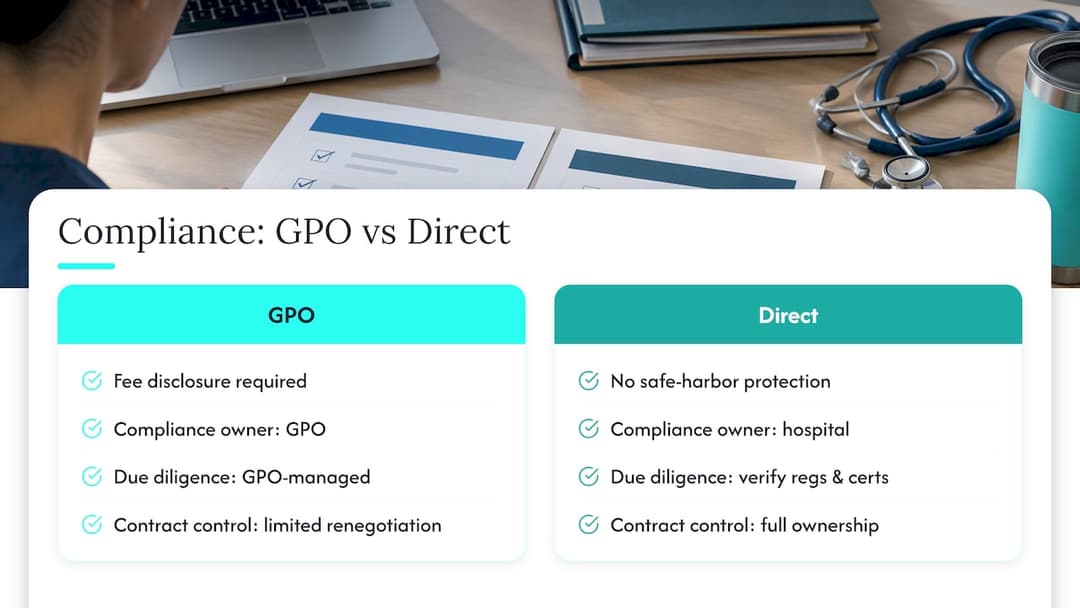
GPO relationships operate under a federal safe-harbor framework that permits vendor-paid administrative fees without triggering anti-kickback liability, provided those fees are properly disclosed. GAO-15-13 raises transparency and reporting questions about how these fees flow and what implications they carry for Medicare cost reporting, which means your compliance team should treat fee disclosure as a standing requirement, not a one-time check.
For direct purchasing, the compliance burden shifts to your own organization. You are responsible for verifying vendor registrations, product certifications, and any state or federal licensing requirements tied to the category, since no intermediary contract is absorbing that diligence. Medical device and PPE purchases in particular carry documentation obligations around FDA clearance and quality certifications that your procurement file needs to show on request.
Contract ownership differs sharply between the two models. A GPO contract is typically owned and administered by the GPO, which limits your ability to unilaterally renegotiate terms mid-term. A direct contract is yours outright, giving you more control but also full responsibility for enforcement if a vendor underperforms.
Audit rights deserve explicit attention in either model. Ask any GPO for documented conflict-of-interest controls and member distribution policies, and build audit clauses into direct contracts from the start rather than trying to add them after a dispute arises. Neither model eliminates compliance work: it just relocates where that work happens.
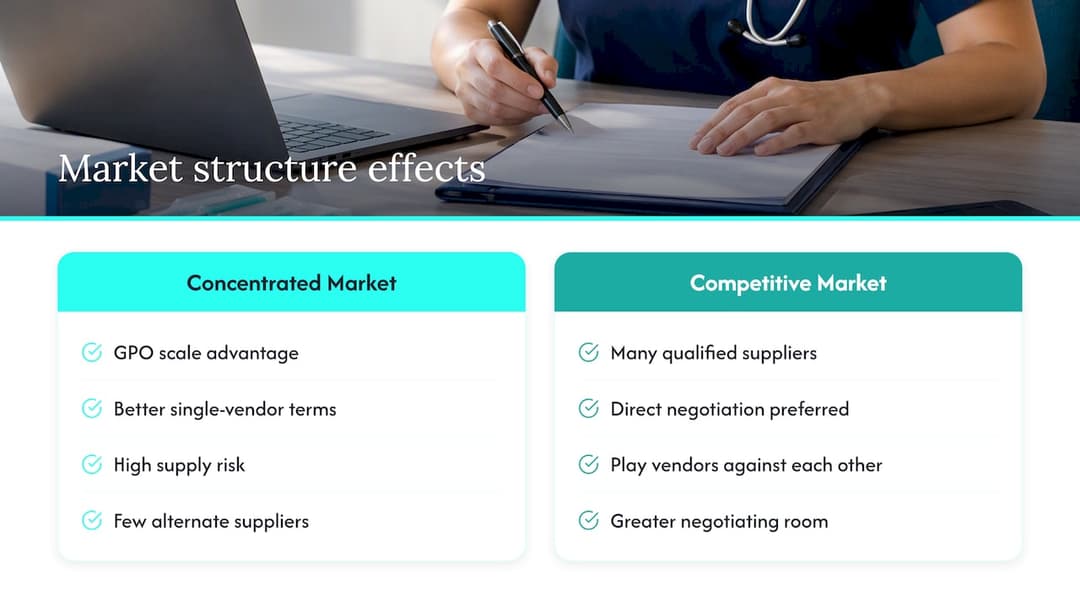
How many viable suppliers exist in a category changes the math on GPO versus direct sourcing more than almost any other factor. In a concentrated market with only a handful of manufacturers, a GPO’s aggregated volume can secure better single-vendor terms than most individual buyers could negotiate alone. That same concentration, though, increases supply risk: if a sole-source GPO contract vendor faces a shortage, your options for an alternate supplier shrink.
In a competitive market with many qualified suppliers, direct negotiation tends to perform better, because you can play vendors against each other without needing a GPO’s scale to get attention. This is common in categories like basic disposables and commodity PPE, where supplier diversity gives any buyer real negotiating room.
Supplier diversity also affects innovation access. A bundled, multi-year GPO contract can lock a health system into a narrow vendor set, which slows adoption of newer products or formulations that arrive after the contract term begins. Direct relationships let you evaluate new entrants as they appear, which matters more in categories where product innovation moves quickly.
The practical guidance here is to favor multi-source clauses or category carve-outs for critical items, even within a GPO relationship, so a single vendor’s shortage does not become your shortage. For categories with genuine supplier depth, treat the GPO price as a floor to beat rather than a ceiling to accept.
The hybrid model holds up because the evidence does not support a universal winner. Use your GPO as the baseline for standardized commodities, and test direct bids on high-volume or service-sensitive categories where the math might favor you. Governance, measurement, and fee transparency are what actually separate a good contract from a costly one. Start with a single SKU-level benchmark against your current GPO pricing this quarter.
— QB
When your benchmark shows direct sourcing wins for a category, we offer a practical next step. We carry PPE, medical disposables, respiratory supplies, and medical equipment built for institutional procurement, with wholesale pricing, documentation support, and dedicated account service for clinics, hospitals, and healthcare facilities.
If you want a concrete place to start a comparison, look at items like our self-adherent bandage or sterile urine container against your current contract pricing. Request a wholesale quote and run the same landed-cost comparison you would apply to any GPO contract. For background on how direct and GPO pricing typically compare on disposables, our piece on wholesale medical purchasing for hospitals walks through the details.
Vizient, Premier, and HealthTrust are commonly cited as among the largest group purchasing organizations serving U.S. hospitals, based on aggregated member purchasing volume. Market share estimates vary by source and year, so procurement teams should verify current standing directly with any GPO they evaluate.
Rankings shift depending on the metric used, whether it is member hospital count, total purchasing volume, or contract portfolio size. Rather than relying on a single “largest” label, compare the specific contract terms and fee structures a GPO offers for your actual purchasing categories.
Vendors, not member hospitals, typically pay administrative fees to GPOs under a federal safe-harbor framework, as GAO reporting documents. These fees are built into vendor pricing, which is why benchmarking against direct quotes is the only way to see their real cost impact.
Common procurement method categories include direct purchasing, group purchasing through a GPO, competitive bidding or RFP processes, and consortium or cooperative purchasing among affiliated organizations. Most healthcare procurement teams use a mix of these rather than relying on just one.
No. A GAO pilot study found GPO-contract prices ranged from 26% lower to 39% higher than prices hospitals obtained independently, depending on the product. Benchmarking specific SKUs against both options remains the only reliable way to know which route costs less.
What CDC, OSHA, AORN and WHO say about double gloving, when to do it, how to don two pairs, and what procurement teams should stock for compliance.
Mayo and Metzenbaum scissors look alike but do different jobs. See how blades, shanks and tips differ, when to use each, and how to care for them.
Sterile water or saline? Learn the difference in tonicity, safe uses, wound irrigation evidence, and how to choose irrigation and dressing supplies.