
Double Gloving Guidelines: What U.S. Teams Should Follow
What CDC, OSHA, AORN and WHO say about double gloving, when to do it, how to don two pairs, and what procurement teams should stock for compliance.


When an ordered item is out of stock, a proper substitution policy means the supplier notifies you before shipping a replacement, documents the manufacturer and lot details of the new item, holds pricing steady or issues a credit for any difference, and accepts a return if the substitute does not meet your needs. Anything less than that combination leaves your facility exposed to compliance gaps and unplanned costs. Some suppliers outline substitution practices for procurement teams who ask before placing large or recurring orders.
TL;DR:
Source Medical Supplies With Confidence
Browse medical products and equipment from Queens Surgical, serving healthcare professionals, clinics, hospitals, and organizations across the Americas.
A substitution policy is only useful if it answers specific operational questions before an order ships, not after a nurse opens the box. Vendors that take this seriously put these elements in writing rather than leaving them to a phone call with a sales rep.
The FDA recommends that health care providers maintain contingency communication plans with distributors covering availability, allocation limits, and viable alternatives, which puts the burden partly on the buyer to ask these questions up front rather than assume they are covered. Traceability deserves particular attention: our UDI tracking guide walks through the errors that show up in GUDID records when substitution details get logged incorrectly.
Reading a policy document is one thing. Testing it against a real conversation with an account rep is what actually reveals how a supplier behaves under pressure.
Score each answer green, amber, or red: green means the policy is documented and specific, amber means the rep gave a verbal answer with no written backup, and red means the question went unanswered. A supplier scoring mostly amber or red on documentation and UDI questions is one to watch closely before committing to a large order.
Pro Tip: Keep a running scorecard across your top five suppliers so a pattern of weak answers shows up before a shortage forces your hand.
A substitution event follows a fairly predictable sequence once you know what to look for, and mapping it out in advance keeps a shortage from turning into a scramble.
Emergency items, such as airway or hemorrhage control supplies, generally warrant a pre-approved substitution list so clinical staff are never waiting on a manual sign-off mid-crisis. Routine consumables can tolerate a slower manual review. Our urgent care supply list guide covers how to build that kind of two-tier list for fast-moving items. Logging matters as much as the swap itself: without a reason code and UDI reference attached to the record, nobody can later tell whether a batch of complaints traces back to a single substitution decision.
Some substitutions are routine. Others should stop an order in its tracks until someone with clinical or regulatory authority signs off.
FDA’s 506J guidance requires manufacturers to notify the agency about interruptions likely to cause a device shortage, and the agency tracks these notifications to assess pressure across the supply chain, according to FDA’s medical device shortage guidance. When a substitute fails any of these checks, pause acceptance and route the item to your clinical engineering or value analysis committee before it reaches a patient.
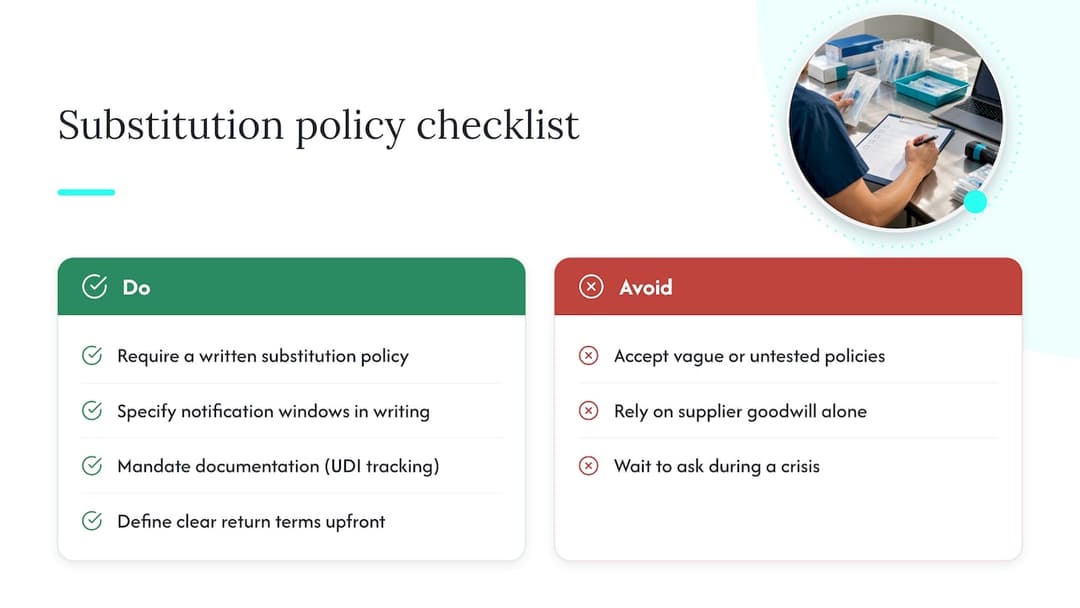
Some suppliers build their procurement guidance around extensive experience supplying medical products across broad regions, shaping a practical view of substitution: it should never surprise the buyer. Our blog covers the mechanics of this in more depth, including UDI tracking and return handling for procurement teams who want the documentation habits to match the policy language.
The honest take is that most substitution problems are not caused by bad-faith suppliers. They come from vague policies that nobody tested until a shortage hit. A written policy with specific notification windows, documentation requirements, and return terms protects both sides of the transaction, and any supplier reluctant to put that in writing is telling you something. Ask for the document before you need it, not during a crisis.
— QB
Some suppliers work with clinics, hospitals, and individual providers who want a straightforward answer when an item runs short: notification first, documented alternatives second, and a return option if the substitute does not fit. Customer service teams may walk procurement staff through sample UDI and manufacturer documentation before a first order is placed.
| What to check | Where to look |
|---|---|
| Notification method and timing | Written policy or account rep response |
| UDI and lot documentation | Sample product page or invoice |
| Return and credit terms | Written policy or return guide |
For teams evaluating how automation affects approval speed on substitutions, Prior Authorization Automation covers how automated workflows can cut the time between a flagged shortage and an approved replacement.
This guidance draws on AHRMM’s resiliency framework for pre-vetted substitution lists, its item master substitution metric, and FDA’s supply-chain and 506J shortage guidance.
A solid policy spells out notification timing, an approval process for clinical versus low-risk items, pricing or credit terms, and documentation requirements including manufacturer name, UDI-DI, and lot number. It should also state who pays for return shipping if the substitute does not work for your setting.
Check that the manufacturer, UDI-DI, and lot information match what your facility requires for traceability, and confirm no material or design change occurred without disclosure. If any of that information is missing, hold the item and route it to clinical or value analysis review before use.
A supplier should hold the original price or issue a credit for any difference rather than billing you more for a substitute you did not choose. If pricing terms are not addressed in the written policy, ask for clarification before your next order.
It is a pre-vetted list of equivalent products that purchasing staff can use without repeated clinical committee approval, a practice AHRMM recommends for speeding procurement during shortages. Facilities typically build these lists for high-turnover consumables and emergency items first.
Queens Surgical provides substitution and documentation details to procurement teams on request, including manufacturer and UDI information for replacement items. Contact customer service directly for the current written policy before placing a standing order.
What CDC, OSHA, AORN and WHO say about double gloving, when to do it, how to don two pairs, and what procurement teams should stock for compliance.
Mayo and Metzenbaum scissors look alike but do different jobs. See how blades, shanks and tips differ, when to use each, and how to care for them.
Sterile water or saline? Learn the difference in tonicity, safe uses, wound irrigation evidence, and how to choose irrigation and dressing supplies.