Double Gloving Guidelines: What U.S. Teams Should Follow
What CDC, OSHA, AORN and WHO say about double gloving, when to do it, how to don two pairs, and what procurement teams should stock for compliance.
Antimicrobial resistance (AMR) is what happens when microbes — bacteria, viruses, fungi, and parasites — change in ways that make the medicines designed to kill them stop working. The World Health Organization and the Centers for Disease Control and Prevention both identify AMR as one of the most serious threats to global health today.
Here is what that means in practice:
The reason to care now: AMR is not a future problem. It is already reshaping how medicine is practiced, and the window to slow it is narrowing.
Antimicrobial resistance is already causing more than 4.7 million deaths globally per year, and slowing it requires action from individuals, clinicians, and policymakers using tools that exist right now.
| Point | Details |
|---|---|
| AMR definition | Microbes change so medicines no longer work, making infections harder or impossible to treat. |
| Global scale | Bacterial AMR was associated with millions of deaths globally; the U.S. sees millions of resistant infections annually. |
| Core prevention actions | Hand hygiene, vaccination, completing antibiotic courses, and diagnostic-guided prescribing all slow resistance. |
| Stewardship matters | Using antibiotics only when needed, at the right dose, preserves drug effectiveness for future patients. |
| Procurement as prevention | Reliable access to isolation gowns, gloves, and barrier supplies directly reduces transmission of resistant organisms in clinical settings. |
“Antimicrobials” is the umbrella term for all medicines that kill or suppress microorganisms. That includes:
AMR affects all four categories, though antibiotic resistance gets the most attention because bacterial infections are the most common clinical scenario.
The scale is staggering. Bacterial AMR was associated with millions of deaths globally, making it a leading cause of death worldwide (https://www.who.int/news-room/fact-sheets/detail/antimicrobial-resistance). The problem spans humans, animals, agriculture, and the environment — which is why public-health authorities call it a One Health issue requiring coordinated action across every sector.
Two structural problems make AMR especially hard to reverse. First, resistant strains spread faster than new drugs are developed. Second, the pharmaceutical pipeline for new antibiotics has slowed dramatically, meaning the drugs we have now are increasingly irreplaceable.
A few definitions make the rest of this article much easier to follow.
One common misconception: resistance is a trait of the microbe, not the human patient. When a treatment fails, it is because the pathogen has evolved or acquired resistance genes — not because the patient’s body has become resistant to the drug.
Resistance happens when microbes change so medicines no longer work. The process is faster and more varied than most people expect.
Genetic mutation and selective pressure are the core engine. When you take an antibiotic, it kills most bacteria in the infection — but not always every single one. Any bacterium with a random mutation that helps it survive the drug lives on and reproduces. Remove the competition from susceptible bacteria, and the resistant strain expands rapidly. Antibiotic exposure exerts exactly this selective pressure, which is why unnecessary antibiotic use is so damaging: it accelerates the selection of resistant strains without providing any benefit to the patient.
Horizontal gene transfer is the other major driver. Bacteria can share resistance genes directly with neighboring bacteria through structures called plasmids or other mobile genetic elements. This means a resistance trait that evolved in one species can jump to a completely different species within hours — no reproduction required.
Once a microbe has resistance genes, it can deploy several specific defenses against drugs:
These four mechanisms can operate individually or in combination, which is why some resistant organisms are so difficult to treat.
Pro Tip: For clinicians and procurement professionals, reducing selective pressure starts with diagnostic precision. Rapid culture and susceptibility testing before prescribing — rather than empirical broad-spectrum therapy — is one of the most effective stewardship levers available. Paired with reliable access to narrow-spectrum agents, it slows resistance at the individual patient level.
Resistant microbes travel through several well-documented routes, and understanding them shows exactly where prevention efforts pay off.
AMR is a One Health problem precisely because these routes connect human health, animal health, and environmental health into a single system. Fixing one route while ignoring the others produces limited results.
Water hygiene is a frequently underestimated vector. Facilities managing water hygiene risk controls as part of their infection-prevention programs address one of the environmental pathways that allows resistant organisms to persist and spread.

Treatment failure is the most direct consequence: an infection that should clear in a week with a standard antibiotic instead requires weeks of intravenous therapy with drugs that are more toxic, more expensive, and sometimes simply unavailable.
Clinically important resistant organisms include:
The ripple effects go beyond individual patients. Surgeons rely on prophylactic antibiotics to make operations safe. Oncologists depend on them to protect immunocompromised patients during chemotherapy. Obstetricians use them to prevent infection during cesarean deliveries. When those antibiotics stop working, the risk profile of every one of those procedures changes.
The pipeline problem compounds the clinical picture. The WHO warns that too few new antibiotics are in development to replace those losing effectiveness, which means the drugs clinicians rely on today need to last — there may not be replacements ready when they fail.
Every audience — individuals, clinicians, veterinarians, and policymakers — has specific actions that genuinely move the needle.
For individuals:
For clinicians and veterinary prescribers:
For policymakers and system leaders:
Pro Tip: Healthcare buyers and procurement managers have a direct role in infection prevention. Stocking reliable isolation gowns, nitrile examination gloves, and barrier sleeves is not a compliance checkbox — it is a frontline defense against the transmission of resistant organisms. A resilient supply chain for infection-prevention products reduces the gaps that allow outbreaks to take hold.
The first step when a resistant infection is suspected is identification. Clinicians collect samples for culture and susceptibility testing, and increasingly use molecular diagnostic tests (PCR-based panels) that can identify resistant genes within hours rather than days. Isolating the patient to prevent spread often happens simultaneously.
Treatment options then depend on what the susceptibility results show:
Unnecessary antibiotic use increases harm at both the individual and population level — more toxicity for the patient, more selective pressure for the community. That trade-off is why stewardship is inseparable from clinical care, not an administrative add-on.
The overarching goals are consistent across international and national frameworks: slow the spread of resistance, preserve the effectiveness of existing drugs, and develop new tools.
Current responses include:
The challenges are substantial. Low- and middle-income countries often lack the laboratory infrastructure to run susceptibility testing at scale. Access to clean water and sanitation — foundational to infection prevention — remains uneven globally. New antibiotics, when they do reach approval, are expensive and often rationed to preserve their effectiveness, creating access inequities. Surveillance gaps in high-resistance regions mean the true burden is almost certainly underreported.
Facility-level infection control is one area where action is immediate and measurable. Resources on legionella prevention in healthcare facilities illustrate how environmental infection risks in clinical settings require the same systematic attention as pathogen-specific AMR threats.
Bacterial AMR was associated with millions of deaths globally, making it a leading cause of death worldwide(https://www.who.int/news-room/fact-sheets/detail/antimicrobial-resistance). In the United States alone, at least 2.8 million antibiotic-resistant infections and more than 35,000 deaths occur annually.
| Metric | Figure | Source |
|---|---|---|
| Global deaths associated with bacterial AMR | More than 4.7 million | WHO |
| U.S. antibiotic-resistant infections per year | At least 2.8 million | FDA |
| U.S. deaths from resistant infections per year | More than 35,000 | FDA |
| Pathogen–antibiotic pairs showing rising resistance (2018–2023) | A substantial portion of monitored combinations | WHO |
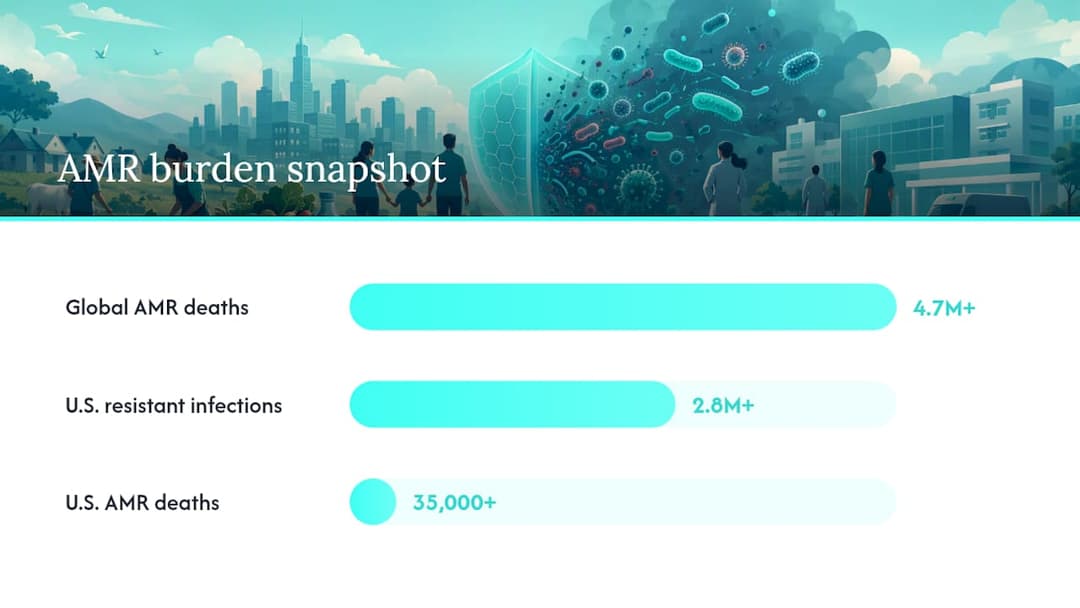
The trend line is the most concerning part. Resistance has risen in a substantial portion of monitored pathogen–antibiotic combinations in recent years. Without significant intervention in stewardship, surveillance, and drug development, those numbers are projected to worsen over the next decade as existing drugs lose effectiveness faster than new ones arrive.
AMR is one of those problems that can feel too large to act on individually. The numbers are global, the mechanisms are molecular, and the solutions seem to require governments and pharmaceutical companies to move faster than they historically have. That framing, while understandable, misses something important.
The most effective near-term levers are not waiting on a new drug or a new policy. They are already available: hand hygiene, vaccination, diagnostic-guided prescribing, and reliable access to infection-prevention supplies. Hospitals that maintain consistent PPE stocks — gowns, gloves, barrier devices — and treat supply chain reliability as a clinical priority are already reducing transmission of resistant organisms every day. Queenssurgical exists precisely to support that work, supplying infection-prevention materials across the Americas so that the gap between knowing what to do and having the supplies to do it stays as small as possible.

The science on what works is not ambiguous. The gap is implementation. Every clinician who orders a culture before prescribing, every procurement manager who maintains adequate PPE inventory, and every patient who completes their antibiotic course is contributing to a collective defense that genuinely slows resistance. That is not a small thing.
This article provides general health information and is not a substitute for professional medical advice. Confirm current clinical guidelines and treatment recommendations with a qualified healthcare provider or your national public-health authority.
What CDC, OSHA, AORN and WHO say about double gloving, when to do it, how to don two pairs, and what procurement teams should stock for compliance.
Mayo and Metzenbaum scissors look alike but do different jobs. See how blades, shanks and tips differ, when to use each, and how to care for them.
Sterile water or saline? Learn the difference in tonicity, safe uses, wound irrigation evidence, and how to choose irrigation and dressing supplies.