Double Gloving Guidelines: What U.S. Teams Should Follow
What CDC, OSHA, AORN and WHO say about double gloving, when to do it, how to don two pairs, and what procurement teams should stock for compliance.
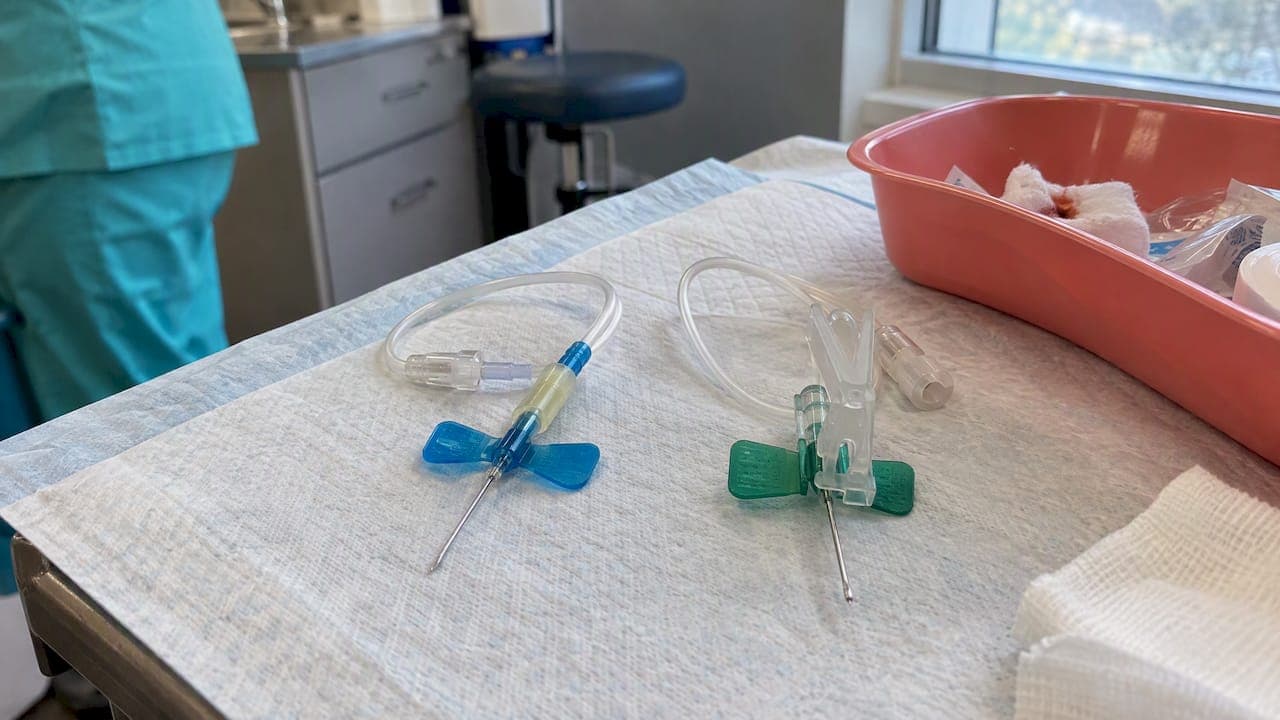
Safety-engineered needles reduce many percutaneous injuries compared with conventional needles when the device matches the procedure and frontline staff reliably activate the safety feature. OSHA requires employers to evaluate and document safer alternatives, with input from the clinicians who use them daily. The sections below walk through the evidence, the compliance obligations, and a practical procurement path.
TL;DR:
Source Needles for Your Facility
Browse Queens Surgical’s medical supplies and equipment through an online platform serving healthcare professionals and facilities across the Americas.
A conventional needle is a bare, exposed point from the moment it leaves the packaging until disposal. A safety-engineered device (SED) adds a mechanism that covers or retracts the point right after use, cutting the window where a clinician or housekeeping staff member can be stuck.
The main mechanism categories:
These map to specific tasks: retractable and resheathable designs dominate phlebotomy, IV catheter insertion, and vacutainer blood draws, while blunt-tip cannulas are common in insulin and medication-drawing steps. Suture needles and many biopsy needles still lack mature safety equivalents, which keeps conventional sharps in play for those procedures.
The strongest evidence comes from before-and-after facility trials and multi-hospital comparisons. One trial tracking a safety resheathable winged steel needle recorded injury rates falling from 13.41 to 6.41 per 100,000 procedures after the device replaced a conventional winged needle.
The reported relative risk reduction for SEDs ranges roughly 0.28 to 0.57 across procedures and device types, according to pooled trial data, meaning the injury rate with a safety device can fall to well under half of what a conventional needle produces in the same setting.
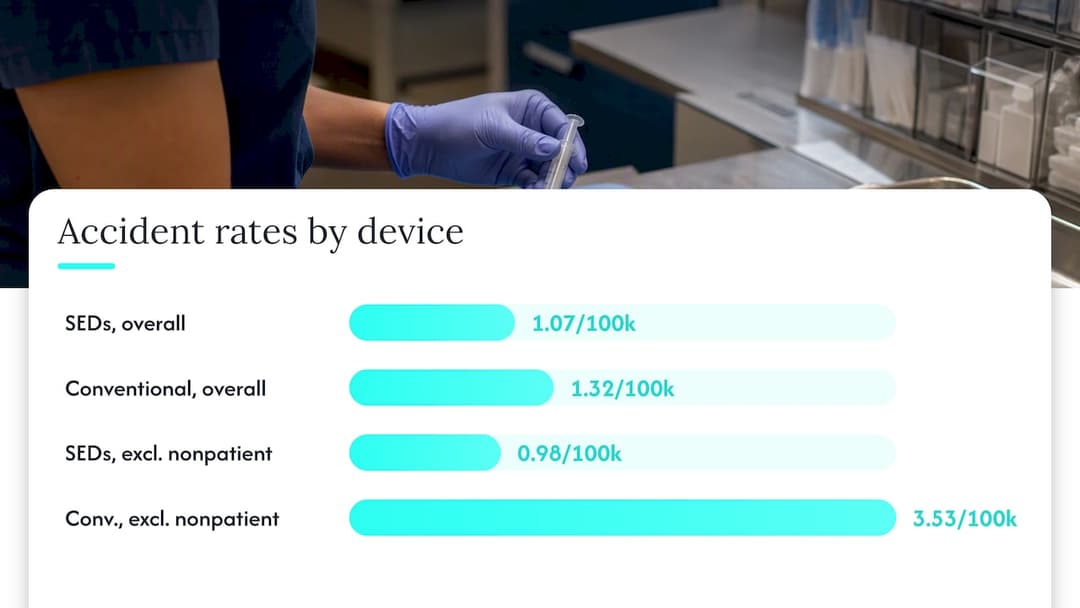
Multi-hospital data tell a similar story but add nuance: comparative accident-rate analyses found roughly 1.07 accidents per 100,000 SEDs against 1.32 per 100,000 conventional needles overall, and the gap widened sharply (0.98 versus 3.53) once standard needles used for non-patient tasks like drug dilution were excluded from the comparison.
A few caveats matter for interpretation:
The practical takeaway: adoption pays off for most high-volume procedures, but the benefit depends entirely on matching the device to the task and getting consistent activation from staff.
The Needlestick Safety and Prevention Act, implemented through OSHA’s Bloodborne Pathogens Standard, requires employers to evaluate and adopt safer medical devices where they are feasible, and to document that evaluation in the facility’s Exposure Control Plan.
Key obligations purchasers need to build into their process:
Feasibility and patient safety are legitimate reasons to stick with a conventional device in a given procedure, but OSHA interpretation letters make clear that contract pricing alone does not satisfy the evaluation requirement. Procurement teams should treat every SED decision as something that needs a paper trail, not a line item.
A safety mechanism only protects anyone if it actually engages. Automatic designs, which activate without requiring the clinician to remember a separate step, tend to outperform manual designs that depend on a deliberate action after an already busy procedure.
Common failure points show up in predictable places:
Downstream staff, including housekeeping and waste handlers, carry real risk when a device reaches a sharps container without its safety feature engaged. That makes activation-before-disposal a frontline training priority, not an afterthought.
Pro Tip: Favor devices that give an audible click or a visible tactile change on activation, since staff can confirm engagement without stopping to look closely.
Devices requiring minimal change to existing technique and offering clear confirmation of activation consistently show better real-world activation rates than designs that ask clinicians to relearn a motion.
Safety-engineered devices typically cost more per unit than conventional needles. The cost-effectiveness comparison looks different once total injury costs enter the picture: published ratios for cost per injury avoided have ranged from roughly $1,269 to $13,943 depending on device and setting, a spread wide enough that no single published figure should stand in for local numbers.
A short procurement sequence for teams evaluating a switch:
Other considerations to fold into the decision:
Avoid letting price alone settle the decision. A device that costs less per unit but shows poor activation in your pilot will cost more once injury follow-up, testing, and lost time are counted.
A successful switch follows a deliberate sequence rather than a single bulk order.
Track a small set of KPIs throughout: activation rate, needlestick injuries per 100,000 procedures, downstream injuries among non-users, staff satisfaction with the device, and cost per avoided injury.
Pro Tip: Pair every device rollout with a disposal-practice review, since CDC guidance points to multi-component programs, combining engineering controls, training, and disposal practices, as more effective than any single intervention alone.
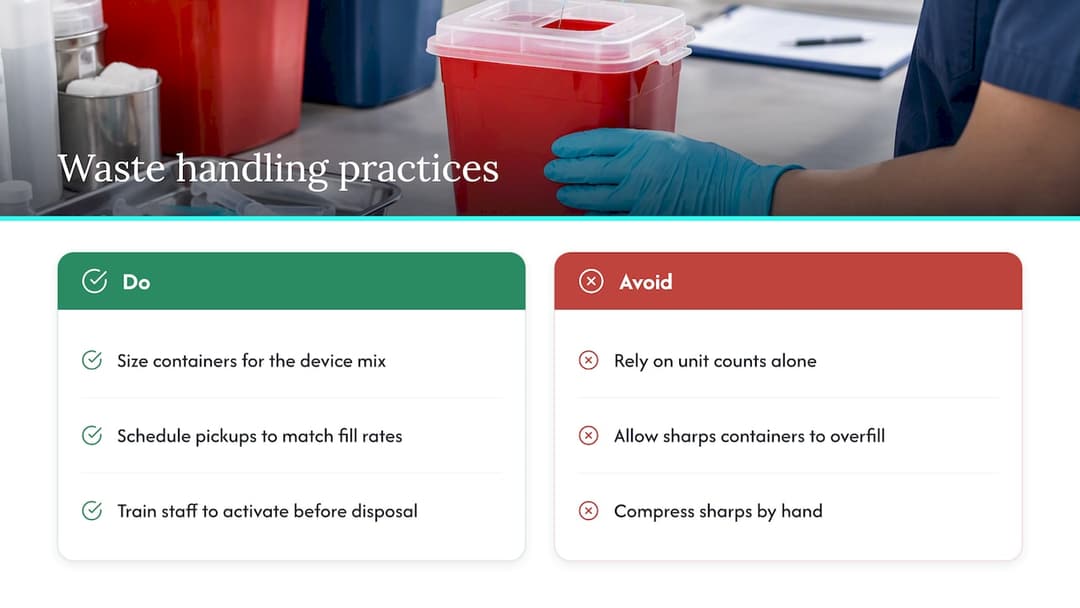
Switching device types changes the waste stream a facility has to manage. Retractable and resheathable safety needles generally contain more plastic and mechanical components than a bare conventional needle, which means sharps containers fill up faster by volume even when the number of procedures stays flat. That has a direct procurement consequence: container sizing and collection frequency need to account for bulkier devices, not just unit counts.
Disposal-phase injuries remain a concern regardless of device type. A needle that reaches the sharps container without its safety feature engaged still poses a stick risk to whoever handles that container next, so waste handling staff benefit from the same activation-before-disposal training as the clinicians who use the device. Facilities that right-size their containers to the actual device mix reduce overfill, a common contributor to disposal-stage injuries.
On the regulated medical waste side, both conventional and safety needles are typically processed the same way, through autoclaving or incineration under facility biohazard protocols, so the choice of device does not change downstream treatment requirements. The practical environmental question for most purchasers comes down to logistics: choosing appropriately sized containers, scheduling pickups to match fill rates, and avoiding the overfill that forces staff to compress sharps by hand. A sharps container sizing guide is a useful reference when adjusting disposal logistics after a device switch.
The evidence is consistent enough that the real procurement question is rarely whether safety devices work. It is whether a given facility has built the habits, training, and audits that let a device perform the way the trials suggest it can. A device with excellent published injury-reduction numbers still fails in practice if staff skip activation under time pressure, which is why I weight pilot data and activation audits more heavily than literature averages when advising on a purchase decision. Measure your own baseline, engage frontline staff early, and let your pilot numbers, not the catalog sheet, make the final call.
— QB
Sourcing safety-engineered devices alongside the rest of a facility’s supply list is easier when one supplier carries both. We stock medical disposables, PPE, and medical instruments across the full range procurement teams need for a pilot or a full rollout, with wholesale and retail ordering so a single clinic or a multi-site purchasing organization can order at the quantity that fits.

For testing a new device line, pilot-quantity orders can be supplied alongside sharps containers and disposables to support the rollout, allowing the evaluation to cover the full workflow rather than the needle alone. Browse our full product catalog to check availability and place a pilot order today.
A conventional needle stays exposed from use through disposal, while a safety needle adds a mechanism, retractable, resheathable, or blunt-tip, that covers the point immediately after use. That mechanism is what drives the injury reduction seen in facility trials, provided staff activate it consistently.
Comfort depends mainly on gauge and length rather than whether the device is a safety or conventional design; thinner, shorter needles generally cause less discomfort for subcutaneous injections. A needle gauge reference helps compare options when choosing between available sizes, and devices with minimal technique change tend to feel more familiar to patients self-injecting at home.
OSHA requires employers to evaluate safer needle devices and implement them where feasible, under the Needlestick Safety and Prevention Act, with documentation in the facility’s Exposure Control Plan. Feasibility and patient safety can justify keeping a conventional device for a specific procedure, but the evaluation and documentation step itself is mandatory.
Safety needles serve the same clinical purposes as conventional needles, including blood draws, IV catheter placement, and injections, while adding a built-in mechanism to reduce the chance of an accidental stick after use. They are most established in high-volume procedures like phlebotomy and vacutainer draws, where mature safety designs are widely available.
A practical evaluation combines hands-on technique training with a review of activation habits specific to the devices your staff use. Resources like a clinician-led injection training guide can supplement in-house training when outpatient injection volume is high.
What CDC, OSHA, AORN and WHO say about double gloving, when to do it, how to don two pairs, and what procurement teams should stock for compliance.
Mayo and Metzenbaum scissors look alike but do different jobs. See how blades, shanks and tips differ, when to use each, and how to care for them.
Sterile water or saline? Learn the difference in tonicity, safe uses, wound irrigation evidence, and how to choose irrigation and dressing supplies.