Double Gloving Guidelines: What U.S. Teams Should Follow
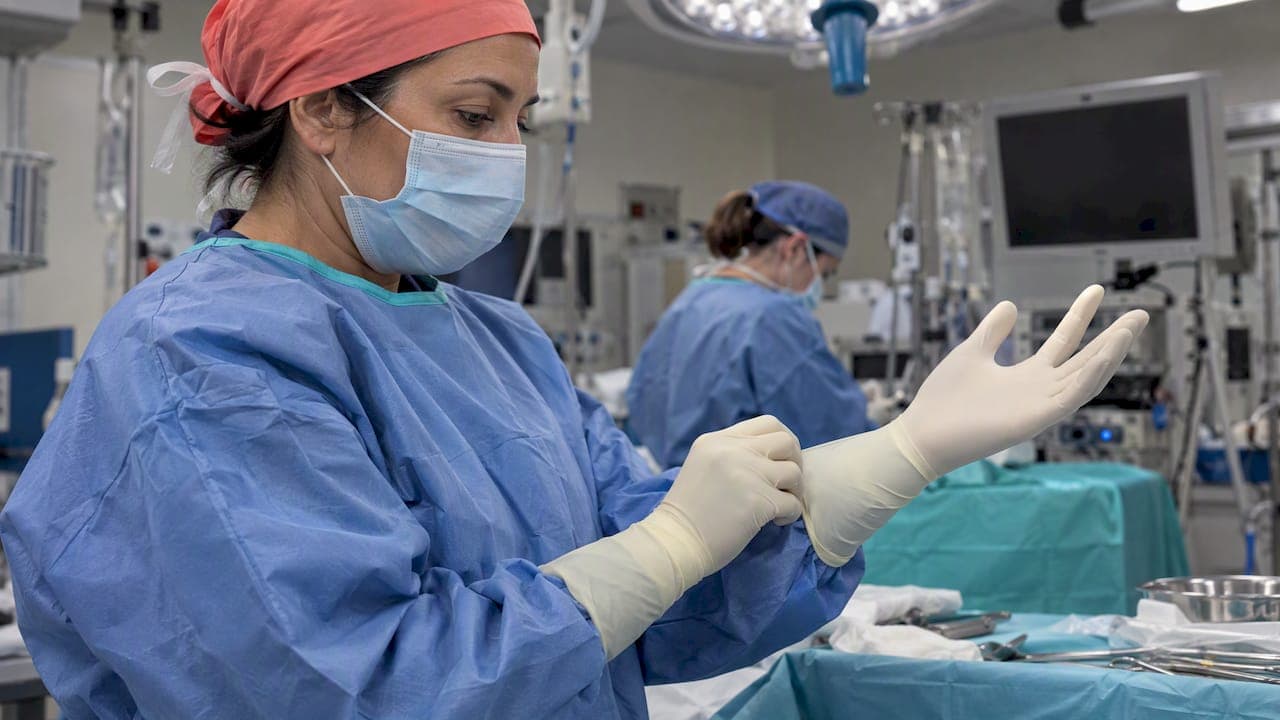
What CDC, OSHA, AORN and WHO say about double gloving, when to do it, how to don two pairs, and what procurement teams should stock for compliance.
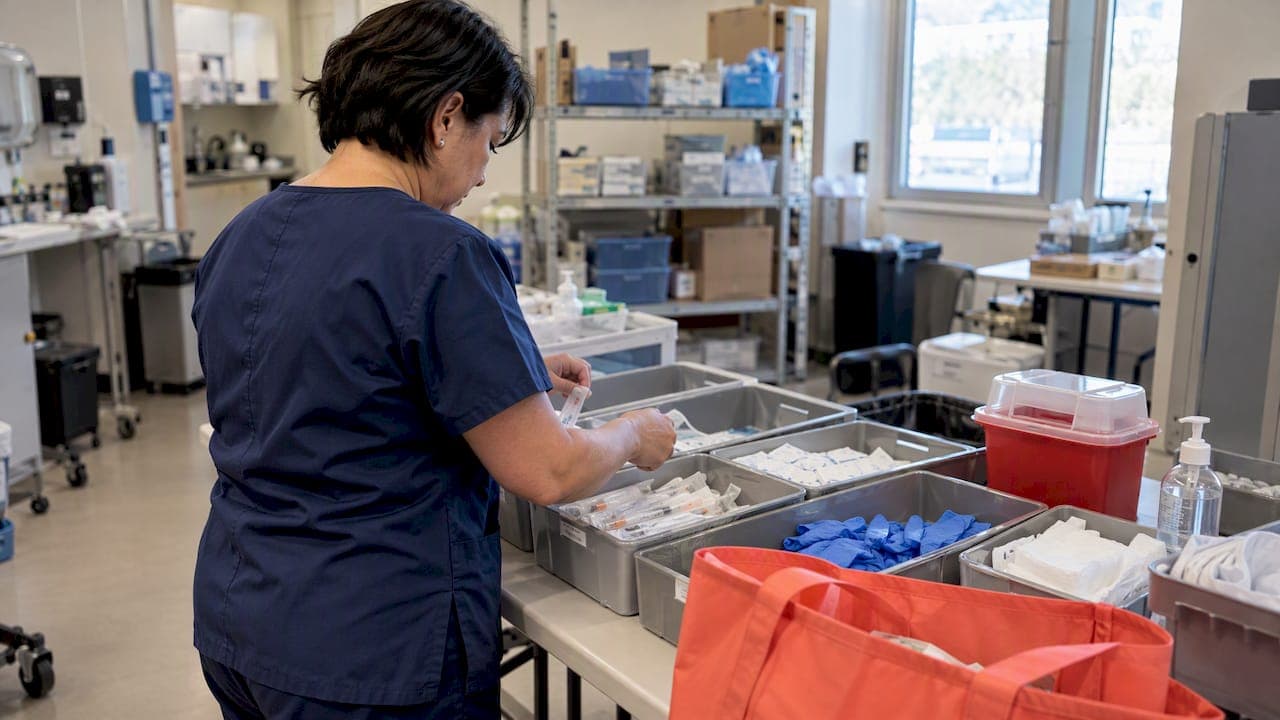
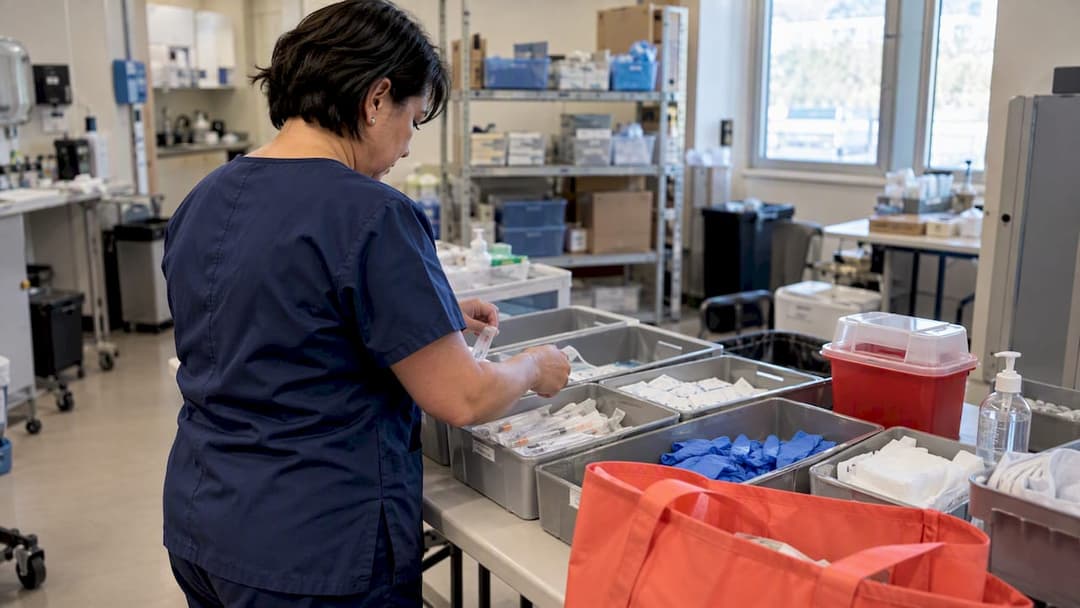
Running an accurate vaccination clinic depends on six nonnegotiable supply categories: vaccines and cold storage, administration supplies, clinic and office materials, PPE and sharps disposal, a medical emergency kit, and documentation. Continuous temperature monitoring and at least one staff member trained to manage anaphylaxis are required at every site. Beyond the general list, coordinators need to convert quantities into per-station par levels based on throughput and vaccine type before ordering anything.
TL;DR:
Source Essential Clinic Supplies
Browse medical products and equipment for vaccination stations, including gloves, masks, instruments, and other healthcare supplies.
A general list is a starting point, not a packing slip. Before you order, break the clinic down into its working parts: the vaccine supply itself, administration tools, the clinic environment, personal protective equipment, and sharps handling.
Vaccine storage and transport items form the backbone of the operation. You need qualified storage units, continuous digital data loggers often called temperature monitoring devices (TMDs), and qualified transport containers or packouts rated for the vaccines you’re carrying.
Administration supplies are where most clinics either run smoothly or stall out. According to CDC guidance on vaccine administration, a core order typically includes:
Needle and syringe selection isn’t one-size-fits-all. The right gauge and length depend on the vaccine, the injection route, and the patient’s age and body size, which is why a pediatric clinic and an adult flu clinic often need different needle assortments even when administering similar volumes.
Clinic and office supplies keep the operation running day to day: clipboards, pens, laptops or tablets, printers, signage for registration and observation areas, chairs and tables, and traffic-control materials like stanchions or floor markers for larger events.
PPE and infection control items round out the list: gloves, surgical masks, hand sanitizer, and surface disinfectant wipes or spray. Sharps containers deserve special attention. They must be closable, puncture-resistant, leak-proof on the sides and bottom, and clearly labeled, positioned as close to the point of use as is feasible so staff never have to carry an uncapped needle across the room.
Pro Tip: Order some extra syringes beyond your projected dose count to cover redraws, dropped units, and last-minute walk-ins.
Vaccine potency depends on an unbroken cold chain from delivery to administration. The CDC’s Vaccine Storage and Handling Toolkit calls for purpose-built storage units, not household refrigerators, paired with continuous digital data loggers that record temperature around the clock.
For off-site or mobile clinics, the rules shift slightly but the discipline doesn’t:
Continuous digital data loggers and properly maintained storage units are the cold-chain elements most often missed in clinic planning, which makes a written excursion-response SOP and an emergency contact list essential before clinic day, not something to draft afterward. Our guide to cold chain medical supplies walks through packout selection in more detail.
Every vaccination site needs an emergency kit and a trained person on hand before the first dose goes in an arm. CDC emergency preparedness guidance specifies the minimum contents and staffing standard.
At least one staff member must be trained to recognize anaphylaxis and administer intramuscular epinephrine, with repeat dosing every 5 to 15 minutes as needed while awaiting emergency services. Store emergency medications in a clearly marked, centrally located kit rather than scattered across stations, and rebuild the kit immediately after any use, documenting what was given and when.
Paperwork is part of the clinical record, not an afterthought; effective documentation and reporting workflows ensure accuracy and compliance during vaccination clinics. Before each dose, provide the current Vaccine Information Statement for that vaccine and document which edition was given and the date.
A platform like CDC’s VAMS can support inventory tracking, scheduling, and barcode-based administration records for participating jurisdictions.
A master list tells you what to buy. A bill of materials tells you how much to buy for each station, and that’s the step clinics skip most often.
Start with throughput: estimate vaccinations per hour per vaccinator, multiply by operating hours, then add a safety margin for no-shows, walk-ins, and wasted doses.
Build the BOM by station:
Pack vaccine caddies by lot number so staff can confirm matching lots at the point of administration, and build a day-of resupply plan so a station running low doesn’t have to shut down mid-session.
Pro Tip: Stage and verify each station’s BOM the morning of the clinic, matching physical counts against your printed par list before patients arrive.
Our urgent care supply list guide outlines a similar two-tier approach to converting general checklists into working par levels, and a needle gauge chart can speed up the selection step when you’re assembling vaccinator kits for mixed age groups.
Sharps containers get most of the attention, but a vaccination clinic generates other waste streams that need their own protocols. Used alcohol pads, bandage wrappers, and glove packaging typically go into regular trash, while any materials visibly contaminated with blood or bodily fluid, such as gauze used to manage a bleeding injection site, belong in a labeled biohazard bag separate from general waste.
Set up clearly marked waste stations at each vaccinator position: a regular wastebasket, a sharps container, and a biohazard bag or bin if your clinic anticipates contaminated waste beyond sharps. Staff should know which bin takes what before the clinic opens, not figure it out mid-shift.
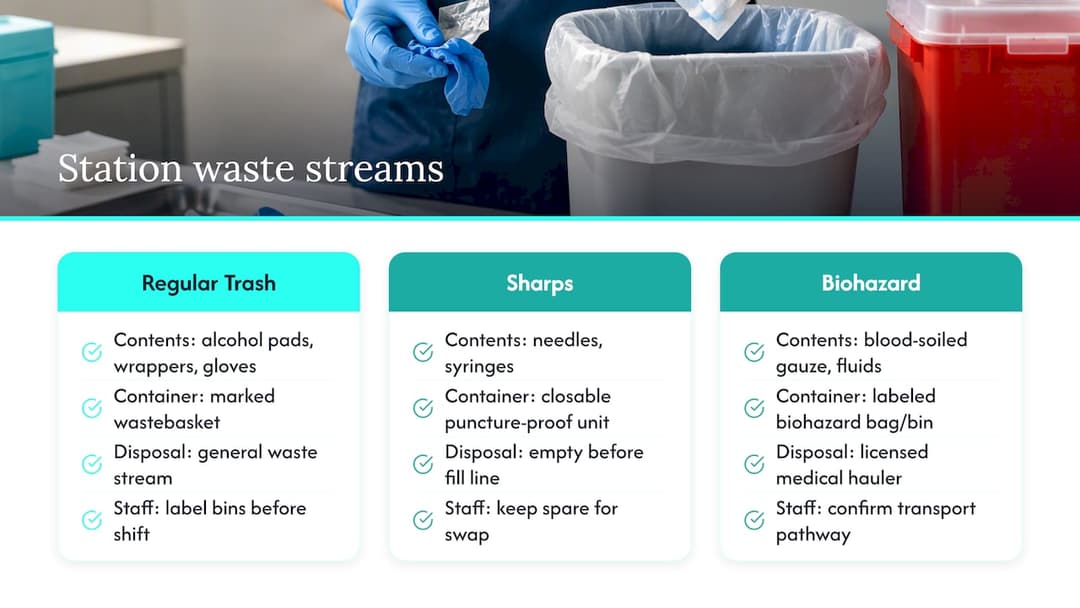
Biohazard waste requires handling under your facility’s existing medical waste disposal agreement or a licensed waste hauler, following the same chain-of-custody practices used in your home clinic. For temporary or mobile sites, confirm the disposal pathway in advance, including who transports biohazard bins back to a licensed facility and how spill kits are stocked in case of an exposure incident.
Empty sharps containers before they exceed the fill line marked on the container, and never attempt to manually open, empty, or force-close an overfilled unit. Keep a spare container at each station so a full one can be swapped out without disrupting patient flow, and log container swaps on a simple sheet so nothing gets left behind at a temporary site.
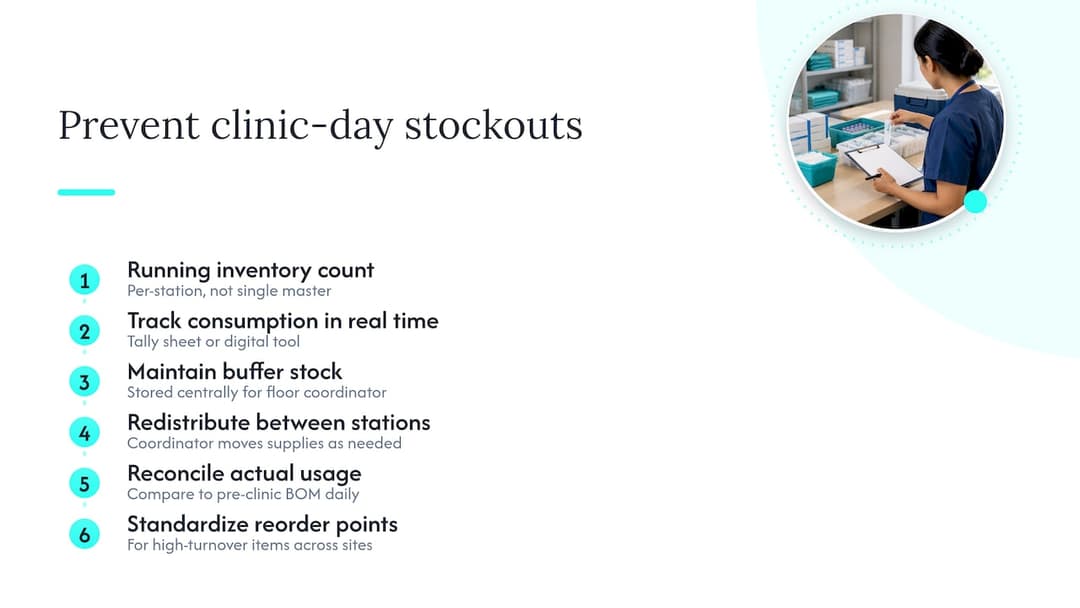
Running out of syringes or bandages mid-clinic is a planning failure, not bad luck. The fix starts with a running inventory count tied to your station-level par levels rather than a single master list checked once before the event.
Track consumption by station in real time where possible, using a simple tally sheet or a digital tool, so a station burning through supplies faster than projected gets resupplied before it empties out. Build a buffer stock separate from your station-level par levels, stored centrally and accessible to a floor coordinator who can redistribute supplies between stations as demand shifts.
Reconcile actual usage against your pre-clinic BOM at the end of each day or event. This closes the loop between what you planned and what you actually consumed, which sharpens your estimates for the next clinic rather than leaving you guessing again from scratch. Our guide to clinic supply inventory management covers par-level tracking methods in more depth for ongoing, not just single-day, vaccination programs.
For recurring or multisite clinics, standardize reorder points for high-turnover items like syringes, needles, and sharps containers so procurement isn’t starting from zero before every event. A shared inventory sheet across sites also flags when one location is consistently running short, which usually points to an estimation problem rather than a supply problem.
A vaccination station needs cleaning supplies that are separate from, and dedicated to, infection control rather than general tidiness. Surface disinfectant wipes or spray rated for the pathogens relevant to a clinical setting, along with hand sanitizer at every station, are baseline requirements alongside the gloves already on your PPE list.
Wipe down vaccination surfaces, such as the table or cart where supplies are prepared, between patients or at a set interval if volume is high enough that per-patient cleaning isn’t practical. Hand hygiene matters as much as surface cleaning: stock enough hand sanitizer that staff can use it between patients without walking to a shared dispenser across the room.
For mobile or temporary clinics, cleaning supplies often get left off the packing list because they feel secondary to vaccines and sharps. Treat them as part of the core kit instead: a spray bottle of disinfectant, a stack of disposable wipes, and extra hand sanitizer take up little space and prevent a station from going without when the first bottle runs dry partway through the day.
Establish a simple end-of-clinic breakdown routine: wipe down all surfaces, dispose of used PPE, and confirm sharps and biohazard containers are sealed before transport or storage. This protects staff handling the teardown as much as it protects the next group to use the space.
Physical layout affects both safety and speed, and the supplies that support good flow are easy to overlook next to vaccines and syringes. Registration and observation signage, floor markers or stanchions for queuing, and clearly labeled tables for each station help patients move through without staff having to redirect them constantly.
A workable layout typically separates three zones: registration, vaccination, and a post-vaccination observation area where patients wait the standard monitoring period before leaving. Chairs or benches in the observation zone, along with a visible staff member who can respond quickly, support both comfort and the emergency readiness covered earlier.
For mobile or mass clinics, additional furniture and equipment matter more than they would in a fixed office: tables and chairs for each station, internet access or a hotspot if you’re using digital registration or inventory tools, laptops or tablets, a printer for on-site forms, and basic communication devices so staff at different stations can reach a floor coordinator quickly. Wastebaskets at regular intervals keep general trash from accumulating at vaccination stations, which supports both the cleaning routine and the waste segregation covered above.
Traffic-control supplies also reduce bottlenecks at high-volume events. A clear path from entry to registration to vaccination to observation, marked with signage rather than left to staff verbal direction, keeps the line moving and reduces the chance of patients backtracking through an active vaccination station.
Running a clinic checklist against a dozen separate vendors multiplies the chances of a missing SKU on clinic day. Sourcing syringes, PPE, and clinic consumables from a single supplier with broad category coverage cuts down on the number of separate orders, delivery windows, and product specs a coordinator has to track for one event.
Fewer vendors means fewer places for a clinic-day shortage to originate.
— QB
We stock the consumables that show up on nearly every station-level BOM: adhesive bandages, syringes, gloves, and other PPE, available through both wholesale and retail ordering depending on your clinic’s size. Whether you’re stocking a single-site flu clinic or a multiday mobile event, the same categories apply.
Plan around your projected doses per vaccinator per shift, then add roughly 20% to cover redraws and walk-ins, consistent with CDC administration guidance on stocking 1 mL and 3 mL syringes. Exact counts depend on your vaccine mix and expected patient volume for that session.
CDC emergency preparedness guidance calls for at least three doses of age-appropriate epinephrine at 1 mg/mL (1:1000) immediately available at every site. At least one trained staff member must be ready to recognize anaphylaxis and administer it, with repeat dosing every 5 to 15 minutes as needed while awaiting EMS.
Continuous digital data loggers should monitor temperatures around the clock in storage units, and off-site or mobile clinics should check readings hourly during transport and throughout the clinic day, per the CDC’s storage and handling toolkit. Place the TMD probe in a thermal buffer next to the vaccines rather than against an ice pack for a more accurate reading.
Vaccine manufacturers generally do not recommend predrawing vaccines, even for off-site clinics, according to the CDC Pink Book chapter on storage and handling. Manufacturer-filled syringes are the preferred alternative for large clinics when available, since predrawing increases the risk of administration errors and wasted doses.
A sharps container should be closable, puncture-resistant, leak-proof, and clearly labeled, positioned as close to the point of use as possible per OSHA guidance. Swap containers before they exceed the fill line, never manually open or empty one, and keep a spare on hand so a full container can be replaced without pausing the vaccination line.
What CDC, OSHA, AORN and WHO say about double gloving, when to do it, how to don two pairs, and what procurement teams should stock for compliance.
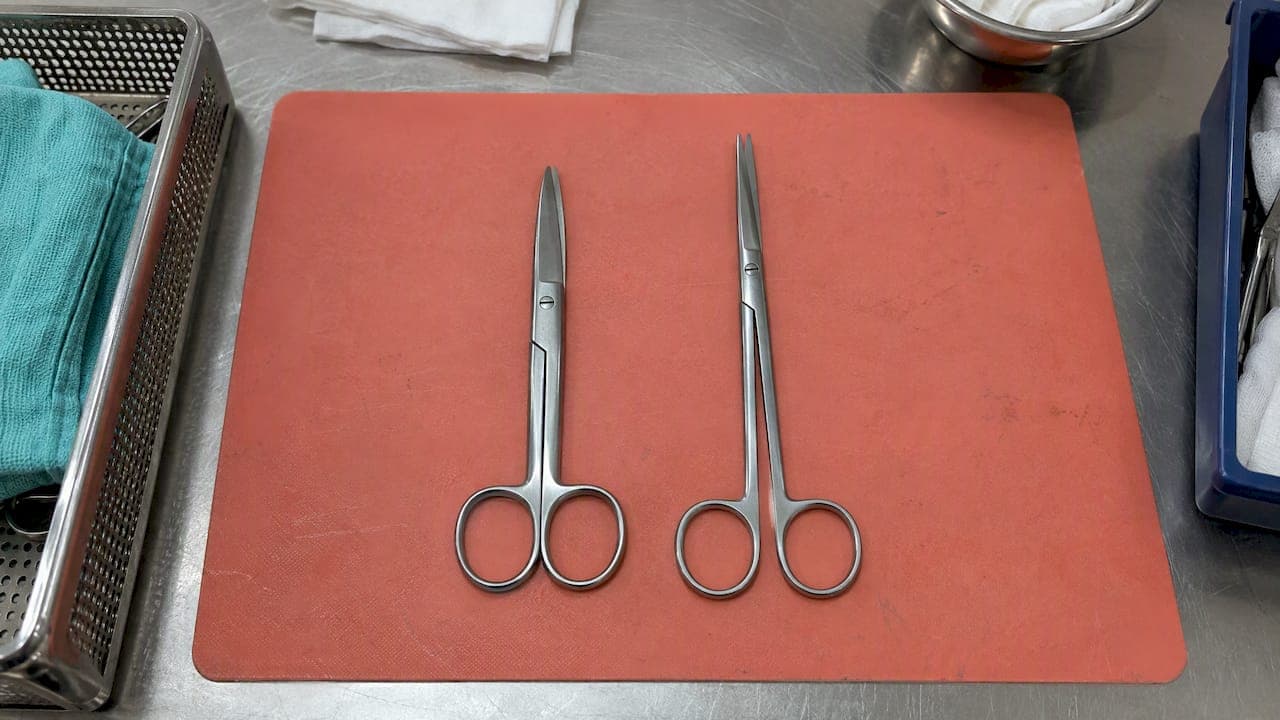
Mayo and Metzenbaum scissors look alike but do different jobs. See how blades, shanks and tips differ, when to use each, and how to care for them.
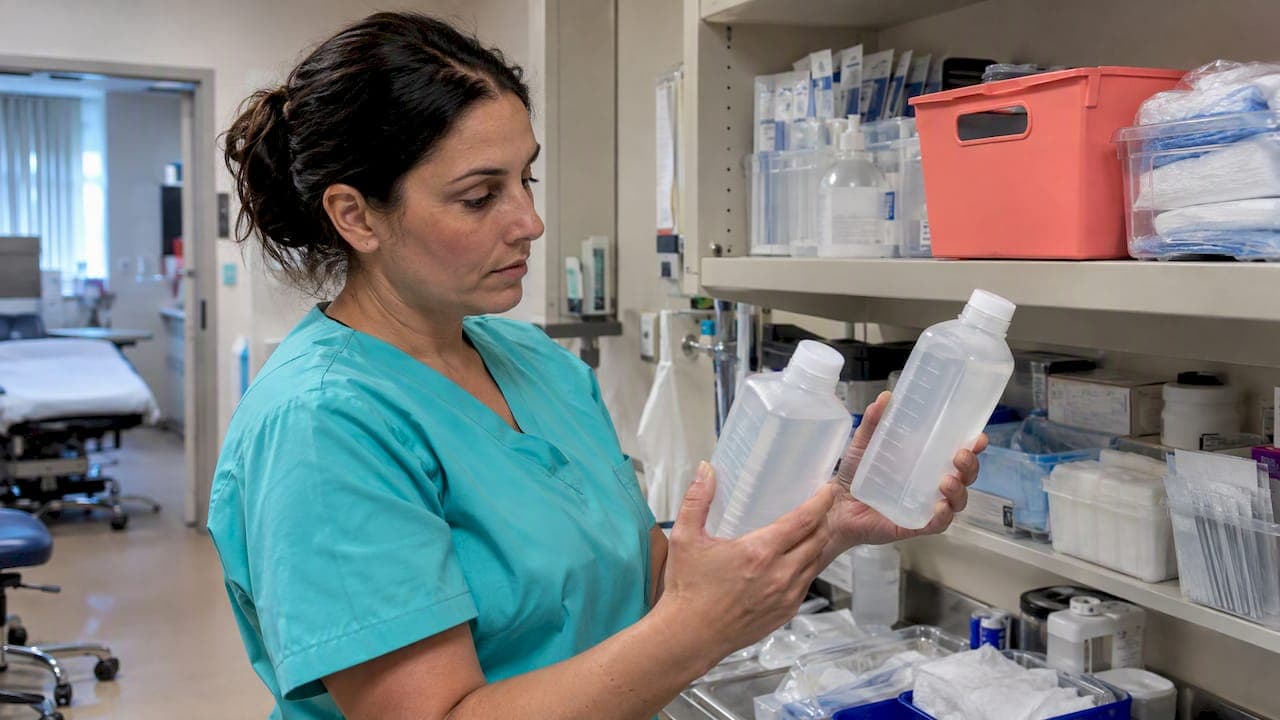
Sterile water or saline? Learn the difference in tonicity, safe uses, wound irrigation evidence, and how to choose irrigation and dressing supplies.