Double Gloving Guidelines: What U.S. Teams Should Follow
What CDC, OSHA, AORN and WHO say about double gloving, when to do it, how to don two pairs, and what procurement teams should stock for compliance.


Operating room turnover supplies are the disposable linens, drapes, disinfectant wipes, waste bags, and related consumables staff use to clean and reset a room between cases. The direct recommendation: standardize on single-use turnover kits matched to CDC and AORN cleaning tiers, and pair them with disinfectants proven against your highest-risk pathogens. Facilities that do this cut search time, shrink turnover delays, and pass infection-control audits with fewer gaps.
TL;DR:
Source Essential OR Supplies
Browse gloves, masks, instruments, medical equipment, and wellness products for clinics, hospitals, and healthcare procurement teams.
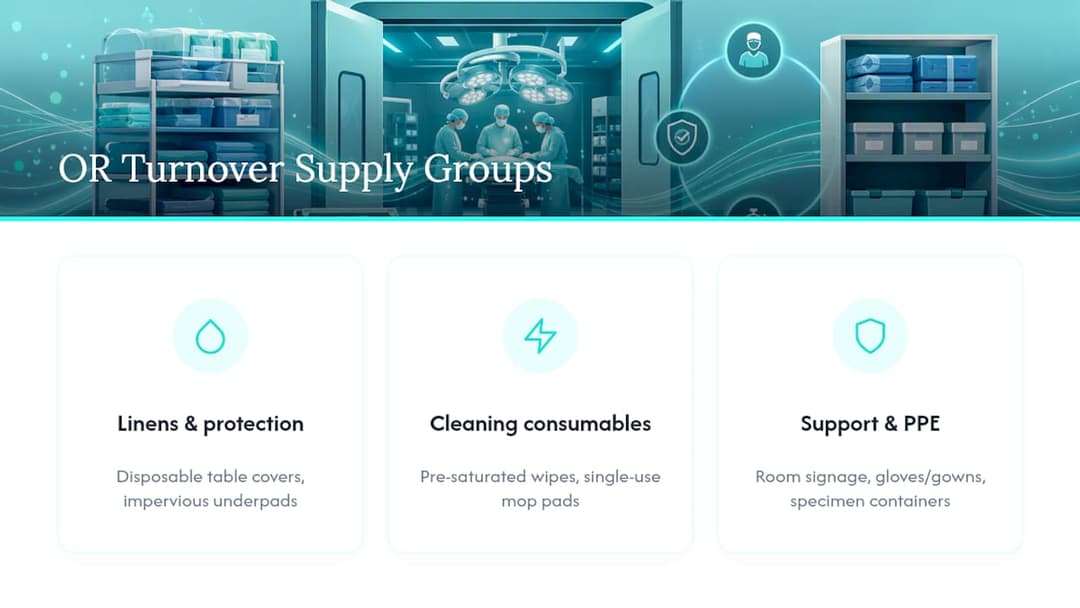
Most facilities lump turnover supplies into three functional groups, and procurement teams that track them this way build tighter, more accurate kits.
Linens and surface protection cover the largest volume: disposable table covers, lift and draw sheets, patient-positioning covers, impervious underpads, and armboard or headrest covers. Single-use versions eliminate the laundering lag that stalls reusable linen programs during high-volume days.
Cleaning consumables do the disinfection work. This category includes pre-saturated disinfectant wipes for between-case use, single-use mop pads, trash liners, dedicated linen bags, and sealed sharps containers rated for OR volume.
Support items and PPE round out the kit: signage marking room status, gloves and gowns for environmental services staff, adhesive tape, and specimen containers for anything collected mid-turnover.
When selecting among these, weigh single-use against reusable on more than price. Impervious backing matters for underpads and covers exposed to fluid, and every wipe or mop pad needs to match the contact time and chemistry your disinfectant protocol specifies. A detailed breakdown of surgical kit components is worth reviewing before finalizing a kit spec sheet.
Search-and-gather time, not cleaning itself, causes most turnover delays. Staff hunting for a missing drape or the right size underpad burns minutes that add up across a full surgical day, and pre-assembled single-use kits remove that hunt almost entirely.
The number: A systems-based redesign combining parallel workflows with standardized kits cut OR turnover time by 35% to 47% in academic hospital settings.
Kits enable that parallel work because cleaning, room reset, and equipment setup can happen simultaneously once nobody needs to leave the room for supplies. That shift changes the economics of turnover:
The cost-per-minute of OR downtime is well documented enough that even a modest turnover reduction pays for itself in avoided overtime and better block-schedule utilization.
Use this order when specifying a new kit or auditing an existing one:
Pro Tip: Print the kit checklist and a barcode or lot number directly on the packaging. It speeds returns processing and lets you reconcile kit use against case-level inventory during daily stock counts.
Reviewing how supply kits are structured for clinical use helps procurement teams avoid the common mistake of building a kit around convenience instead of case volume.
Three cleaning tiers govern every OR: cleaning before the first case of the day, cleaning between cases (turnover), and terminal cleaning after the last case. The CDC’s guidance on cleaning specialized patient areas defines each tier’s scope, and between-case turnover specifically requires removing used linens and drapes, disposing of waste and sharps, and disinfecting surfaces and noncritical equipment inside the surgical field.
Terminal cleaning goes further and gets more prescriptive under recent AORN guidance: documented personnel, product lot numbers, disinfectant contact time, and verification steps are now expected, not optional.
A few procurement-specific rules matter here:
PAR levels for kits and for standalone consumables should be reviewed on separate schedules. Kits track closely to case volume, so a facility running 20 cases a day needs a materially different PAR than one running 8. Individual high-turnover items like disinfectant wipes usually need a wider buffer because usage spikes unpredictably during outbreak periods or unplanned terminal cleans.
SKU bloat is the quiet cost center most procurement teams underestimate. Every surgeon who wants a slightly different drape configuration adds a line item, and those preference-driven variants are exactly what inventory optimization research targets when it recommends a controlled core kit plus a short, approved list of specialty add-ons.
That same study found inventory control interventions cut expired stock by more than 90% and reduced prep time per case by 45% in a hospital supply chain redesign.
Pro Tip: If your expired-stock dollar value climbs two months in a row, the fix is almost always PAR levels set too high for a specific SKU, not a demand spike. Audit the top five items by expiration write-off before assuming volume changed.
Most facilities treat turnover supplies as a commodity purchase, buying whatever’s cheapest per case without accounting for the labor cost of a kit that’s missing one item. That’s backwards.
Roll out changes as a pilot on two or three rooms, measure turnover time and expired-stock value for a month, then scale once the numbers hold. A supplier worth working with should offer sample kits, accept customization requests for specialty add-ons, and fulfill reorders fast enough that your PAR buffers can shrink over time. Some suppliers work with procurement teams on exactly that basis, from initial samples through standing wholesale orders.
— QB
Most turnover delays trace back to incomplete kits or last-minute substitutions, not slow staff. Queens Surgical fills that gap directly: a catalog built for procurement teams that need consistent, in-stock disposables across Medical Disposables, PPE, and wound care lines, with wholesale pricing built for hospitals and clinics ordering at volume alongside retail options for smaller practices.
If you’re building or auditing a turnover kit spec, start with the items that see the highest per-case volume: table covers, underpads, and sharps containers. Queens Surgical’s self-adherent bandage rolls and sterile urine containers are common additions to specialty add-on packs for urology and orthopedic cases. Have your current PAR levels and monthly case volume on hand when you request a quote, since that data lets some medical supply teams size a starting order that won’t leave you overstocked or short. Visit the Queens Surgical catalog to request sample kits or a wholesale quote for your facility.
Turnover time varies by facility and case complexity, but most hospitals track it from patient-out to next-patient-in. Facilities that redesign workflow around standardized kits and parallel tasking have documented reductions of 35% to 47% against their own prior baseline.
There’s no single universal benchmark since case type, room layout, and staffing all affect the number. The more useful target is tracking your own facility’s baseline turnover time and measuring improvement after standardizing kits and adopting parallel cleaning and setup workflows, an approach validated by systems-based redesign research.
A standard kit includes disposable table covers, lift and draw sheets, impervious underpads, pre-saturated disinfectant wipes, single-use mop pads, trash and linen bags, and a sealed sharps container. Queens Surgical stocks these categories under its Medical Disposables and PPE lines for procurement teams building standardized kits.
Room turnover refers to the cleaning and resetting process that happens between the end of one surgical case and the start of the next. It’s distinct from terminal cleaning, which happens after the last case of the day and follows a broader, more documented protocol under current AORN guidance.
Pricing depends on kit contents, order volume, and whether you’re purchasing retail or wholesale. Current pricing for Queens Surgical’s disposable kits and individual consumables is listed directly on the Queens Surgical site.
What CDC, OSHA, AORN and WHO say about double gloving, when to do it, how to don two pairs, and what procurement teams should stock for compliance.
Mayo and Metzenbaum scissors look alike but do different jobs. See how blades, shanks and tips differ, when to use each, and how to care for them.
Sterile water or saline? Learn the difference in tonicity, safe uses, wound irrigation evidence, and how to choose irrigation and dressing supplies.