
Double Gloving Guidelines: What U.S. Teams Should Follow
What CDC, OSHA, AORN and WHO say about double gloving, when to do it, how to don two pairs, and what procurement teams should stock for compliance.


A par level is the target quantity to keep at each stocking location so staff can restock to a predictable amount without guessing. You calculate it as average daily use multiplied by lead time, plus safety stock, and the smartest clinics set par by location, review it on a fixed schedule, and adjust it whenever usage or supplier timing shifts.
TL;DR:
Keep Clinic Supplies Ready
Queens Surgical supplies gloves, masks, instruments, equipment, and wellness products for clinics, hospitals, and healthcare professionals.
Every par level rests on three numbers: average daily use (ADU), lead time, and safety stock. ADU is how many units a location burns through per day. Lead time is how long it takes from placing an order to having usable stock on the shelf, including receiving and check-in. Safety stock is the cushion you hold for demand spikes or delivery delays.
The formula, as defined in clinical supply management references, is par level equals average daily use times lead time, plus safety stock. If a clinic uses 40 gauze packs a day, lead time is 3 days, and safety stock is 1 day of use, par equals (40 × 3) + 40, or 160 packs.
Par is a periodic-review model: you count on a schedule and order up to target. Reorder-point systems trigger an order the moment stock hits a threshold, which suits items with volatile demand or automated sensors. For most routine clinic consumables, periodic review is simpler to run and easier to audit.
Setting a workable par level takes four steps and a short tuning habit afterward.
Worked example, gauze packs: ADU is 40 packs, lead time is 3 days, safety stock is 1 day. Par equals (40 × 3) + 40 = 160 packs.
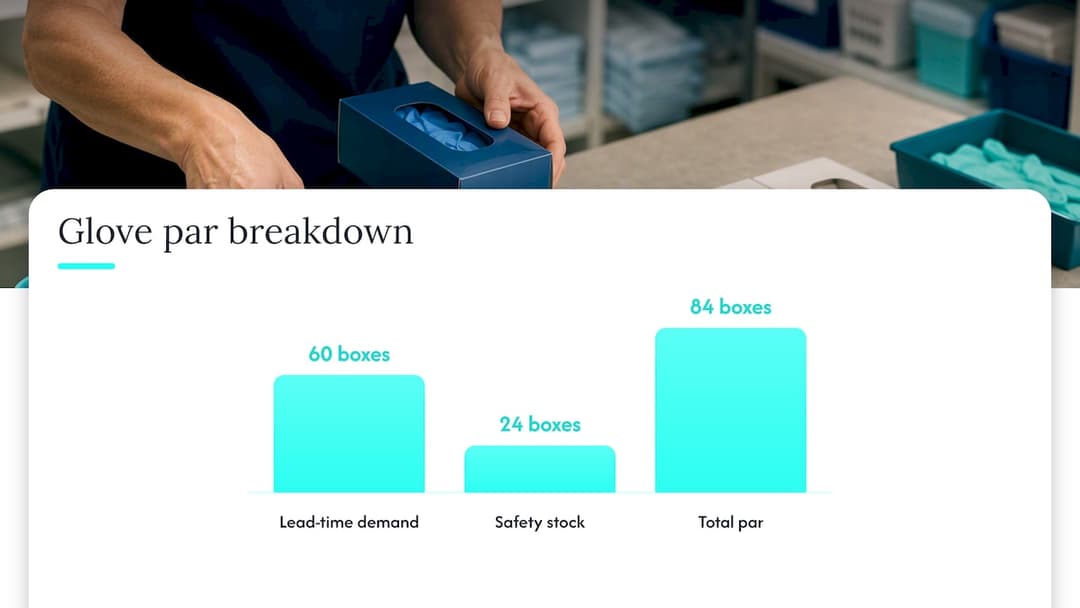
Worked example, nitrile gloves (boxes): ADU is 12 boxes, lead time is 5 days including a weekend, safety stock is 2 days. Par equals (12 × 5) + (12 × 2) = 84 boxes.
Pro Tip: Always convert vendor case-pack sizes into the same issue unit you count in, or your par math will be off by a multiple of the pack size.
Clinical supply management resources describe par-level systems as the standard model for high-volume, low-cost consumables like gauze, syringes, and gloves, because they rely on periodic counting rather than continuous tracking, which keeps staff workload manageable.
Linen behaves differently from disposables because the “lead time” includes the full wash, dry, and return cycle, not just delivery. If a linen service picks up soiled items on Monday and returns clean ones on Wednesday, your effective lead time is at least 2 days, even though nothing ships from a warehouse.
Pro Tip: For small clinics, a quick heuristic works: keep 3 clean sets per exam room, one in use, one in the cart, and one in reserve, and adjust upward if your laundry cycle runs longer than 48 hours.
A clinic running 6 exam rooms on a 2 day exchange cycle generally needs multiple sets of gowns or drapes in rotation, adjusted based on daily patient volume.

Routine consumables tolerate some flexibility, but procedure carts do not. A missing scalpel or guidewire during a central-line placement is not a minor gap, it delays care. The AHRQ central-line cart checklist lists example quantities for items like guidewires, scalpels, syringes, sterile gloves, gowns, drapes, antiseptics, sutures, and masks, and clinics can adapt that template as a starting par for their own carts.
Cart audits typically run daily or after every use for high-turnover carts, and weekly for lower-use procedure rooms. Related guidance on infection control supply checklists covers storage and labeling for these same high-risk locations.
Not every item deserves the same attention. ABC analysis sorts items by dollar value or usage volume: A items are high value or high volume, B items are moderate, C items are low. XYZ analysis sorts by demand variability: X items are stable, Y items fluctuate some, Z items are unpredictable. Combining the two into a 9-box matrix tells you where to focus.
A 2025 study combining ABC and VED with multi-criteria analysis found that this blended segmentation reduced the number of drugs classified in the top control tier while still producing measurable inventory cost savings, by concentrating oversight on genuinely high-value and clinically critical items. That kind of segmentation cuts review workload without leaving critical supplies exposed. For more on how this interacts with stock turnover, see this inventory turnover guide.
Two-bin (kanban) systems, automated dispensing cabinets (ADCs), and RFID tagging each solve a different problem. Two-bin systems make reorder timing visual and simple. ADCs add controlled access and usage tracking for regulated items. RFID improves real-time visibility and expiry tracking but adds hardware and training overhead.
Pro Tip: Pilot any new system on one location for 4 to 6 weeks and track cycle-count accuracy, stockout frequency, and staff time before rolling it out further.
Automation should improve visibility first. Adding auto-reorder on top of a messy count process just automates the mess. A cautious, metrics-first approach to healthcare automation reflects this same pilot-before-scale thinking. Set a rollback trigger in advance: if staff time goes up and accuracy does not improve within the pilot window, stop and reassess.
Par levels drift the moment nobody revisits them. A light governance routine keeps them honest.
Track stockout rate (stockouts divided by total order cycles), days-of-cover variance (actual days of stock on hand versus target), and turnover (units used divided by average units on hand). Assign one person per unit to own par changes, and require a brief written reason any time a par is adjusted, so the next reviewer understands why. The clinic supply inventory guide covers cadence planning in more depth.
A repeatable count script and a simple template remove most of the guesswork from par management.
For a printable version of a similar approach, the urgent care supply list offers a two-tier format worth adapting.
Par math assumes clean numbers, but case-pack sizes and minimum order quantities often force rounding that the formula does not account for. A product packed 50 to a case will push your order quantity up even when the calculated need is 38. Standardizing on consistent SKUs and case sizes across a clinic’s suppliers, and negotiating predictable delivery windows, does more to shrink real-world lead time than any formula adjustment. Consistent unit-of-issue labeling on products like self-adherent bandages or sterile urine containers prevents the counting errors that throw off an otherwise sound par calculation.
— QB
For hands-on reference, see the AHRQ central-line cart checklist, the VA AR/WS user manual, the ABC-VED inventory study, and the par level definition reference.
Consistent SKUs and reliable fulfillment make the difference between a par level that works on paper and one that holds up on the shelf. A supplier of gloves, wound care, PPE, respiratory, urology, and disposable consumables, some companies offer consistent product names and packaging each time, which helps keep unit-of-issue conversions stable instead of resetting when case sizes change. Whether you are stocking exam rooms with adhesive bandages or restocking urology carts with stainless steel urinals and lubricating jelly, predictable packaging is what keeps your par calculations accurate month over month. Browse the full catalog to check current stock and place an order for your next replenishment cycle.
PAR stands for “periodic automatic replenishment,” and it refers to the target stock level a location restocks to on a set schedule. The VA AR/WS manual describes this as an “Area of Use” model where each location carries its own par field and reorder logic.
Review cadence depends on the item type: daily or after-use checks for procedure carts, weekly cycle counts for high-turnover consumables like gloves and gauze, and monthly reviews for overall days-of-cover and turnover trends. Usage shifts, seasonal changes, or a new procedure volume should trigger an off-cycle review too.
A par level is a target quantity you restock to on a fixed schedule, known as periodic review. A reorder point is a threshold that triggers an order the instant stock drops to that number, which suits items with unpredictable demand or automated tracking rather than routine counting.
ABC-VED analysis for some clinics sorts items by cost and clinical importance so you can apply tighter par controls to high-value or critical items and looser controls to low-cost, stable-demand items. A 2025 study found this blended approach concentrated oversight on fewer top-tier items while still producing inventory cost savings.
What CDC, OSHA, AORN and WHO say about double gloving, when to do it, how to don two pairs, and what procurement teams should stock for compliance.
Mayo and Metzenbaum scissors look alike but do different jobs. See how blades, shanks and tips differ, when to use each, and how to care for them.
Sterile water or saline? Learn the difference in tonicity, safe uses, wound irrigation evidence, and how to choose irrigation and dressing supplies.